Showing posts with label Biblical Studies. Show all posts

Saturday, July 14, 2012

Wright on Dispensationalism and the Nation of Israel in the Theology of the Apostle Paul

Jerusalem besieged, 70 A. D.
I thought this was an interesting point made by N. T. Wright in his book Paul: Fresh Perspectives, he is discussing the nation of Israel and how Israel functions in the theology of the Apostle Paul. The point I am lifting from Wright here is a point that illustrates his dismay over North American Dispensational readings of Paul's theology, in particular his conception of the second coming of Christ. Here is what Wright writes:

[...] For some, alas, the very phrase 'second coming', and even perhaps the word 'eschatology' itself, conjures up visions of the 'rapture' as understood within some branches of (mostly North American) fundamentalist or evangelical Christianity, and as set out, at a popular level, in the 'Left Behind' series of novels by Tim F. Lahaye and Jerry B. Jenkins, and the theology, if you can call it that, which those books embody. That scheme of thought, ironically considering its fanatical though bizarre support for the present state of Israel, is actually deeply un-Jewish, collapsing into a dualism in which the present wicked world is left to stew in its own juice while the saints are snatched up to heaven to watch Armageddon from a ringside seat. (p. 145, Nook edition)

And then he goes on in the next paragraph to develop the Apostle Paul's actual thinking, in contrast to dispensationalism, on such things; he continues to write:

This is massively different from anything we find in Paul [referring to the dispensationalist reading he just mentioned], for all that the central text for the 'rapture' theology is of course I Thessalonians 4.16-17. What we find in Paul at this point is four things, in each of which we see the still-future Jewish eschatology redrawn around the Messiah.... (p. 145, Nook edition)

He goes on to develop his 'four things', which I don't want to get into at this point. Instead, I simply want to draw attention to the way that N. T. Wright (unsurprisingly) thinks of dispensational theology. I have come to agree with Wright about my former dispensationalism (I am an American Evangelical after all). But what does Wright mean when he writes 'That scheme of thought, ironically considering its fanatical though bizarre support for the present state of Israel, is actually deeply un-Jewish, collapsing into a dualism in which the present wicked world is left to stew in its own juice while the saints are snatched up to heaven to watch Armageddon from a ringside seat'? It is something that I have harped on for quite some time, whenever I write about dispensationalism; that is, this neo-Platonic, hard and fast distinction between Israel and the Church (the Church=for Wright 'the saints snatched up'). It is this distinction that ironically, but not, makes the Church God's saints, and the nation of Israel his Covenant People; such that the latter are judged (even though Jesus already was ... he was the Jew, wasn't he) by God in the 'Great Tribulation' (Daniel's so called 70th Week, or Jacob's Trouble, cf. Jer. 30:7), and the former are the beneficiaries of Christ's death for them on the cross. So we end up with this strange dualism between God's "two people," with the result that one still has to go through a blood letting of unimaginable depth, and the other has been released from such blood letting (the Church) through their Savior, Jesus Christ. My depiction might seem crude, but this is the inevitable conclusion to consistent and honest classical dispensational theology.

Wright, in the end, is right that dispensational theology offers a bizarre picture of what it means to 'support' the nation of Israel. Their theological framework has abstracted the nation of Israel out from Christ (in this dispensation, anyway ... i.e. the so called "Church Age"), and essentially placed them into a situation that has them facing something akin to a medieval Roman Catholic conception of purgatory; but instead dispensationalists have named it, 'The Great Tribulation', riffing on Jesus' words in the Olivet Discourse.

What say you Dispensationalist?

PS. In the end, though, I think Wright unhelpfully ends up offering an ecclesiocentric view of God's people, instead of grounding God's people (the Pauline 'One New Man' cf. Eph. 2.11ff) in God's life in Christ as his new creation in his covenant life of grace. So I think Wright is still in need of some dogmatic reflection, and I am happy to see that he seems to be open to some correction by some of his more recent interaction with Kevin Vanhoozer (esp. in areas having to do with union with Christ theology).

Tuesday, July 10, 2012

The Jesus of History & Faith, Conjoined

I wanted to address something that dovetails with a recent mini-essay that Darren Sumner wrote on Karl Barth's understanding of history and revelation. What I want to do is provide a counter-part post that underscores and articulates Thomas F. Torrance's view on the same subject. If you read Darren's post alongside this post; what you'll notice is that both Torrance and Barth share a very similar understanding on the relationship between how revelation and history work together, and how the former ultimately must be said to condition the latter; and not vice versa. Here is TF Torrance, at length (I will highlight the significance of this relative to the normal ways that Evangelicals and some of the Reformed use history as the foundation for their view of revelation---which is really backwards from a genuinely Christian order of things):

The mystery of Christ is presented to us within history --- that historical involvement is not an accidental characteristic of the mystery but essential to it. That is the problem.
Let us first put it this way, recalling the bi-polarity of our theological knowledge. If God has become man in the historical Jesus, that is an historical event that comes under our historical examination so far as the humanity of Jesus is concerned, but the fact that God became man is an event that cannot be appreciated by ordinary historical science, for here we are concerned with more than simply an historical event, namely, with the act of the eternal God. So far as this event is a fact of nature it can be observed, and so far as it is historical in the sense that other natural events are historical, it can be appreciated as such; but the essential becoming behind it cannot be directly perceived except by an act of perception appropriate to the eternal event. That act of perception appropriate to an eternal act, or divine act, would surely be the pure vision of God, which we do not have in history. Here on earth and in time we do not see directly, face to face, but see only in part, as through a glass enigmatically, in a mystery. We see the eternal or divine act within history, within our fallen world where historical observation is essential. Faith would be better described then as the kind of perception appropriate to perceiving a divine act in history, an eternal act in time. So that faith is appropriate both to the true perception of historical facts, and also to the true perception of God's action in history. Nor is it the way we are given within history to perceive God's acts in history, and that means that faith is the obedience of our minds to the mystery of Christ, who is God and man in the historical Jesus. What is clearly of paramount importance here is the holding together of the historical and the theological in our relation to Christ.

If the two are not held together, we have broken up the given unity in Christ into the historical on the one hand, and the theological on the other, refracting it into elements which we can no longer put together again. We then find that we cannot start from the historical and move to the theological, or from the theological and move to the historical without distortion, and nor can we rediscover the original unity. We can only start from the given, where the historical and the theological are in indissoluble union in Christ. [Thomas F. Torrance, Incarnation, 6-7]

So there is no analogy for the incarnation. And for Torrance, the incarnation must be the definitive touchstone for how we start to conceive of a knowledge of God (the Old Testament then is seen as the pre-incarnation of God in Christ); and since there is not human analogy for this reality to be found in the history of history (i.e. God and humanity united in a single person), the only 'foundation' that can be used to justify our belief about God must be given its shape and reality through the given reality of the incarnate Christ---which means, faith.

This means that we cannot start with an abstracted history (like a naked evidentialism) and seek to attach this to the history of Jesus, but the history we have, in itself, of Christ's revelation is the given reality itself; there is nothing else that can be determinate of that, other than the truly and self-determinately free God himself.

*A repost for those who may have not read this, I once posted this not too long ago at my EC (Wordpress) blog.

Monday, July 9, 2012

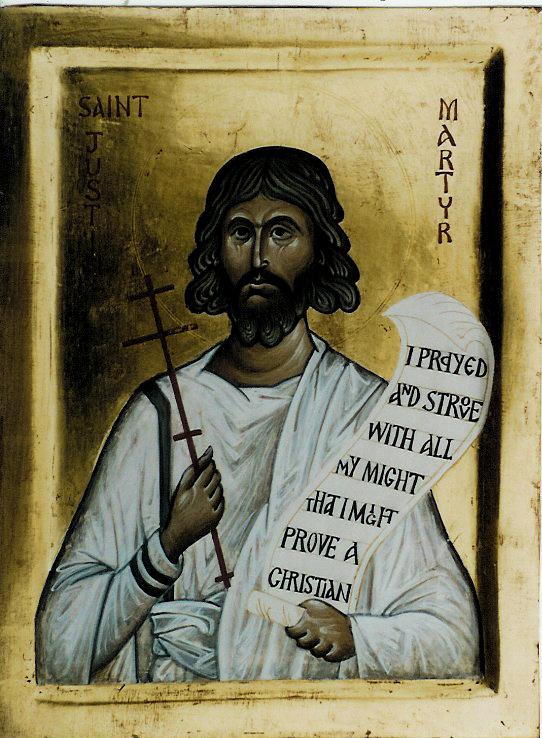
Thomas Torrance on Justin Martyr and "Proving Jesus" as Hermeneutic

Justin Martyr
Thomas Torrance, in his Theological Science (his theological method, and a title of one of his books), follows what he calls an epistemological inversion; in short, epistemological inversion is the approach that holds out that an object or subject (or both as in the case of Christian Theology) acts upon us (the knowers and inquirers), such that it itself opens up to us its own reality and structures of thought—this process remains an open structured event. It is from within this context that we can better understand Thomas Torrance’s appropriation of someone like Justin Martyr, and his defense of Christian reality and the Christic event itself (one and the same). Let’s follow along as Torrance engages Martyr, this quote will end with Torrance quoting Justin (which is the piece I really want to get to with this post—viz. Martyr’s “argument”):
The distinctive feature of this Word is its relation through the Spirit to historical facts and events. It is when we allow the Scriptures to direct us to these facts and events that our minds fall under the power of their truth and we are compelled to believe for they carry in themselves their own demonstration. This is not, of course, any kind of logical proof, but the kind of demonstration that arises immediately out of the facts and events themselves through their self-evidence. This is particularly well expressed in a fragment of a lost work on the resurrection that has survived through John of Damascus and attributed to Justin.
[T]he Word of truth is free, and carries its own authority, disdaining to fall under any skilful argument, or to endure the logical scrutiny for its hearers. But it would be believed of its own sake, and for the confidence due to him who sends it. Now the Word of truth is sent from God, wherefore the freedom claimed by the truth is not arrogant. For being sent with authority, it were not fit that it should be required to produce proof of what is said, since neither is there any proof beyond itself, which is God. For every proof is more powerful and trustworthy than that which it proves, since what is disbelieved, until proof is produced, gets credit when such proof is produced, and is recognised as being what it was stated to be. But nothing is more powerful or more trustworthy than the truth; so that he who requires proof of this, is like one who wishes it demonstrated why the things that appear to the senses do appear. For the test of those things which are received through the reason, is sense; but of sense itself there is not test beyond itself. As then we bring those things which reason hunts after, to sense, and by it judge what kind of things they are, whether the things spoken be true or false, and then sit in judgment no longer, giving full credit to its decision; so also we refer all that is said regarding men and the world to the truth, and by it judge whether it be worthless or no. But the utterances of truth we judge by no separate test, giving full credit to itself. And God, the Father of the universe, who is the perfect intelligence, is the Truth. And the Word, being his Son, came to us, having put on flesh revealing  both himself and the Father, giving to us in himself resurrection from the dead and eternal life afterwards. And this is Jesus Christ our Saviour and Lord. He, therefore, is himself both the faith and the proof of himself and of all things. [Thomas F. Torrance, Divine Meaning, 95-6; the quote from Justin, De resurrectione, 1.1f, from the Sacra Parallela of John of Damascus. E.T. from Ante Nicene Christian Library, vol. 2, pp. 341ff. This is not generally accepted as Justin's
own work, but like the Cohortatio ad Graecos was at least written under his influence.]

For all those weary souls who have labored under the Evangelical mantle of ‘Fighting Fundamentalism’ and the Apologetic Faith (as Warfield called it); won’t you join me in commending yourself to a more Christian Way? A ‘Way’ that does not entangle itself in the realm of rationalist-historicism, that seeks to ‘prove’ Jesus to themselves and the world. I am sure that it is the other way around … we are in need of ‘proving’. And I think the “Martyr” quote helps us to think in this order, and not the order of the “world.”

Sunday, July 8, 2012

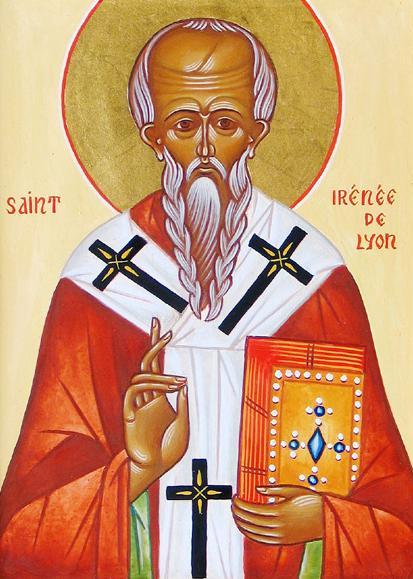
Too Much Jesus in the Bible?

I would like to expose you all to Thomas Torrance's take on Irenaeus' understanding on what could be called a Christocentric Hermeneutic. As you read Torrance's account of Irenaeus, understand that you are reading Torrance too. Here is Torrance on Irenaeus:

It is, then, to the Incarnation that Irenaeus turns for the clue to the interpretation of the history of creation and redemption and therefore for the clue to the interpretation of the Scriptures. The essential order and connection of things is embodied in Jesus Christ and it is by reference to him that the economic ministrations of God in humanity and the historical covenants are to be understood aright, and therefore the interconnection between the scriptures of the prophets and the scriptures of the Apostles, 'the Gospel and the Apostles. Even the Scriptures of the old covenant have to be read in the light of Christ's advent in the flesh, for his coming connected the end with the beginning and made the beginning predictive of the end, thus showing that the faith of the patriarchs and prophets and ours is one and the same. They sowed the seed, the word about Christ (sermonem de Christo), but it is in us that the fruit is reaped and received, and only in the Church is the truth of the things prefigured realised. 'Certain facts had to be announced beforehand by the fathers in a paternal manner, (paternaliter), and others prefigured by the prophets in a legal manner (legaliter), but others delineated according to the pattern of Christ (deformari secundum formationem Christi) by those who perceived the adoption, for in one God are all things shown forth.' [Thomas F. Torrance, Divine Meaning, 122-23]

How does this strike you? Do you think this is too intense for a hermeneutic or mode for interpreting Scripture? Is your method of biblical interpretation this intensively Christ focused? I am really curious how you all think of this; I obviously highly appreciate this kind of 'Patristic' method of interpreting and reinterpreting (the OT) Scripture in light of  its fulfillment in Christ. This rubs against the method of interpretation I learned (by and large) in Bible College and Seminary; which is the Literal Grammatical Historical method (the kind that leads to and from Dispensationalism).

Tuesday, July 3, 2012

Dispensationalists should "Re-interpret"

Addendum: See this dovetailing post I just read by Matthew Malcolm: Fundamentalist Hermeneutics Serves a Secularistic, Atheistic Agenda . Matthew's title is quite provocative, especially if you're still working from a dispensational hermeneutic; how would you counter Matthew's (and my) claim contra dispensational hermeneutics in particular? Matthew doesn't use the language of dispensational, but this is what he's referring to in the post (and then he broadens this out, as I have, to the issue that this revolves around; hermeneutical structure).

Rubin, Jerusalem circa. 1926
Must I? I guess I must. I must inform any of my newer readers that I grew up classic dispensational, moved to progressive dispensationalism (about 14 years ago), and finally (after much angst and study and deliberation ... seriously!) have arrived at all truth; viz. I am amillennial (so called). This is my little caveat prior to getting into the rest of this post. With that ground cleared before us, I simply wanted to highlight something that kept hitting me in the face as I was reading through Deuteronomy tonight. That is, that my dispensational brethren severely misread scripture (this is a strong statement ... who can hear it?) when they supposedly follow their literalist hermeneutic of interpretation instead of re-interpreting Scripture (like the New Testament authors did, as well as the early Church) in light of the Old Testament fulfillment, in Christ. Jesus was under no delusion that, indeed, Scripture was all about him; notice what he said to the religious leadership of his day (I think he would reiterate the same thing to Dispensationalists today):

39 You study the Scriptures diligently because you think that in them you have eternal life. These are the very Scriptures that testify about me, ... John 5:39

Jesus understood the Old Testament Scriptures, and the promises therein, as finding their reality and fulfillment and purpose in him. He believed that the Scriptures, and the Old Testament promises to his covenant people were all about him; and that they were personally fulfilled in him. For example, as I was reading through Deuteronomy this evening, the concept of "land" and blessing and "Yahweh's people" kept popping up. Like the Jewish zealots of Jesus' day, dispensationalists collapse this promise of blessing in the land for Yahweh's people into a geo-political and "literal" promise that is yet (and is currently) to be fulfilled by the Jewish people in present day Israel (a sign of this fulfillment, for dispensationalists, is the re-establishment of the nation of Israel in 1948). But if we re-interpret these promises as if their fulfillment has come to reality in Jesus Christ, then the promise of blessing in the land for Yahweh's covenant people will be understood to have fulfillment in and through the obedient humanity of Christ as the new man; the new and obedient Israel (Eph. 2:11ff); and in the New Heavens and New Earth, the Heavenly Jerusalem, as described in Revelation 21--22. So there is a literal fulfillment after all, but it has already been fulfilled (the now and not yet aspect of the kingdom ... or the in-between time we inhabit currently) penultimately in Christ's first advent, and yet ultimately in Christ's second advent and the consummation of all things.

One of the problems for dispensationalists is that they understand "literal" through a neo-Platonic lens; so that there is a hard distinction between the spiritual heavenly realm and the physical earthly realm. What the dispensationalist fails to appreciate, properly, is that if we interpret all of reality and the purpose of creation through the analogy of the incarnation and the hypostatic union between the divine and human; that the hard distinction between heaven and earth is not a viable option. If you will, the dividing wall has been broken, and all things have become One in Christ. Thanks for letting me get this off my chest ...

*Repost

Monday, July 2, 2012

On Biblical Studies and Systematic Theology: Their Marriage

I just finished reading a really helpful essay that was jointly written by, C. Kavin Rowe and Richard B. Hays; their chapter is in the 'Biblical Studies' category for The Oxford Handbook of Systematic Theology. They offer a sketch of development relative to the historical and contemporary relationship (or not) between so called 'Biblical Studies & Systematic Theology'. They seek to broach how it is that these two relative disciplines indeed have come to be separate, even competitive disciplines; such that the biblical/exegetical student could be as far apart from the systematic theologian as could the analytic theologian be apart from his counterpart, the so called dialectic theologian. In other words, they seek to both descriptively and constructively engage this so called divide; and in the end, they offer a constructive proposal that seeks to place biblical studies and systematic theology in dialectical and dialogical relation (such that they are no longer in a competitive relationship) – which correlates, by the way, with our thesis 9; that Evangelical Calvinism is a form of dialectical/dialogical theology and understanding. Let me share, the summarizing and concluding thoughts of Rowe and Hays; thoughts that I concur with and find quite encouraging, personally:

[...] where the subject matter of biblical exegesis and of dogmatic theology is thought to be the same, the two disciplines are of necessity inseparable. In this respect, to refuse interdisciplinary work between biblical interpretation and constructive theology is to deny the coherence of the subject matter itself. Today, however, the complexity of the interpretive task may warrant a continued, though always provisional and cooperative, division of labour between biblical scholars and systematicians. The exegete concentrates upon the refraction of the subject matter through particular witnesses, thereby penetrating more deeply into the particular shape of the subject matter and helping to avoid banal theological  generalities (Childs 2004: xi). And the theologian concentrates more upon the whole of the subject matter as it is expressed through the understanding of scripture in the dogmatic tradition, thereby helping to avoid the tendency toward fragmentation in exegesis (the old problem of losing the forest for the individual trees).

Yet, in continuity with the ancient church, there is no final division between biblical interpretation and theological reflection, for they are united in the common task of attending to the subject matter of scripture. Their actual relationship is thus dialectical, in the sense that within their respective foci there exists a constant movement between the particulars of the biblical text and the whole of systematic reflection in an effort to do justice both to the exegetical thickness of doctrine and the theological coherence of biblical exegesis. [C. Kavin Rowe and Richard B. Hayes, Biblical Studies: Chapter 24, in The Oxford Handbook of Systematic Theology, edited by Webster, Tanner, Torrance, p. 452]

In the essay, both Rowe and Hays speak quite approvingly of both Barth and Bultmann of being thinkers who brought together (in their own ways) the task of theologizing and biblical studyizing; that in the modern period (from which they both were birthed) had been divided  – as much as the 'historical Jesus' had been from the 'Jesus of faith'. To see biblical studies and systematic theology implicating each other – as we ought – is really to engage in a 'theology of retrieval. Meaning, as Rowe and Hays suggest through their historical development, that Barth & co. engaged in the process of retrieving the doing of biblical exegesis and theology (together) from the Patristic and Reformed periods; but in a way that also did the "retrieving" from a particular situation of development itself. So that this "retrieval" of thinking biblical studies and systematic theology together has taken shape with the full realization of all of the interpretive advances made, even in the modern period itself. The result, really, is that theological exegesis should be the only way Christian thinkers and readers engage the text of scripture and their respective thinking of the God revealed in Christ that scripture finds its scope through.

Saturday, June 23, 2012

Bobby's Developing Bible Study: "Jesus is the Key"


I have been seeking a hermeneutic, or a way beyond the impasse created by my move to what Gibson and Muller have called a principial & intensive method of biblical interpretation  (in reference to Barth on their part, no less). I have become disenchanted, over the past few years, with the hermeneutical framework (but not all of the ways) that I was trained in through both Bible College and Seminary; that is, the Literal, Grammatical, Historical method. Certainly, though, I cannot, nor do I want to fully abandon the Grammatical, Historical, and Canonical realities that make up the shaping of what we call the Bible. So in other words, I have been in some personal conflict when it comes to my theory of hermeneutic; wanting to affirm a methodologically and principled way of reading scripture, in Christ. And on the other hand, not also wanting to reject the historical and canonical aspects of scripture that repose in it its Christic shape; so I want to continue to use the grammar, the syntax, the lexical, and the canonical markers of scripture that serve instrumentally to point beyond themselves to the deep reality they signify, in Christ.

The 'Young', Martin Luther
In this seeking of mine, I have been reading Jens Zimmerman’s Recovering Theological Hermeneutics: An Incarnational-Trinitarian Theory of Interpretation. And unlike T. F. Torrance’s book Divine Meaning: Studies in Patristic Hermeneutics (which I thoroughly benefited from, of course, especially in serving the purpose in providing a general theory of hermeneutics that, indeed seeks to present a truly principled christocentric hermeneutic); Zimmerman’s book, and brief development of Luther (thus far in my reading of his chapter on Luther’s hermeneutic) has help to affirm the way that I want to proceed by being principially Christic in my biblical exegesis, and at the same time understanding that within this theoretical hermeneutical framework; that there is a viable way to employ all of the philological tools that one ought to employ when engaging the text of scripture, which is special literature.

The following two quotes from Zimmerman on Luther’s approach to biblical interpretation are the ones thus far that I have benefited from the most in my pursuit to provide some denouement to my, as of late, hermeneutical angst.

[I]t follows that the subject matter of the Bible, the good news of God’s love for humanity shown in the incarnation, cannot be understood through historical research alone. Nor in contrast to the historical school of the nineteenth century is historical distance a problem. The historical distance is nullified (not bridged) by the Word, which first created history and then was spoken into history. Luther concludes that it is the role of the Holy Spirit to make the incarnate Word present to the reader. Thus for Luther; a hermeneutics adequate to interpret the subject matter of the Bible is based on the unity of “Christ, Word, and Spirit” (EE, 365). Luther’s theory differed from a theory of verbal inspiration, for he insisted on a word behind the word that requires from the reader constant revisions in interpreting the written letter. . . . [59]
 In light of this, it is no surprise that someone like my friend, Matt, a Lutheran, is also a Barthian; for the above sketch of Luther’s hermeneutic sounds very much so like Barth’s (and T.F. Torrance’s, no less) approach to understanding the written word as it continually, and ever anew proximate the Living Word in whom the written and proclaimed word find their reality and orientation. As Karl Barth (I believe in his CD I/1) describes this, there is both the ‘outer-logic’ and ‘inner-logic’ of Scripture (playing off the Reformer’s perspicuity ‘outer/inner’ clarity dialectic); such that the written letter (outer logic) remains stable, our understanding of that is provisional and ever changing as we understand more and more the One, the Word, to whom this written word points (this is the ‘inner-logic’ according to Barth … and the reason that ‘theological exegesis’ should be understood as the norm for biblical interpretation).

The, Karl Barth
Here is the second quote that again helps assuage and also confirm me in my own movement forward as a theological/Christological exegete of Holy Scripture; Zimmerman summarizes:

To sum up, for Luther, “the Word of God in the cosmic sense was the eternal Christ, and as the Word of God in the New Testament was essentially the historical Christ. Given his doctrine of the Word, it was logical for Luther to see Christ and the cross as the central theme of God’s redemptive word”…. Luther’s systematic Christological hermeneutic principle does not mean, however, that he simply read his opinion into the text; the assiduous use of all philological aids available at his time in his sermon and lecture preparation demonstrates Luther’s desire to develop theology from the text. That is not to say, of course, that sometimes his vivid imagination saw Christ in the text where modern scholarship does not. However, respected strands of contemporary scholarship have come to agree in principle with Luther’s reading of Paul and the plausibility of the Pauline assertion that Jesus the Christ is the fulfillment of Torah and the messianic promises in Isaiah pertain to his redemption and vindication of humanity … [Jens Zimmerman, Recovering Theological Hermeneutics, 59-60]

 As Zimmerman developed in an earlier iteration of his chapter on Luther; for Luther there is no understanding the historical word of scripture without the Word of Faith breathing life into the history as it is conjoined in Christ as he is the point and purpose of creation and creation’s history unfolded toward and in Christ. If this is the case, the words of scripture cannot have meaning or signification if they are abstracted from their reason for being as they are taken up in Christ. And yet, more constructively, this is exactly how higher-critical and historist approaches to biblical interpretation (some of which I have been discussing in previous posts, whether on the ‘Liberal’ side or the ‘Fundamentalist/Evangelical’ side) have colluded in their adumbration of the text of scripture (adumbrated because these ‘critics’ have place scripture into a pretext of their own construction, one that doesn’t have eyes to see and ears to hear, because if it did, these critics would understand that they can’t understand the text without understanding that it’s all about Jesus).

And so, since this post is now just over the reported attention span of blog readers (which is a 1,000 words, max.); I will close this post. Maybe you can appreciate a little better, then, where I am at in my own development; and maybe you can see why I have jettisoned my beloved LGH and even Dispensational hermeneutical theory.

PS. I am, at the end of the day, really quite pragmatic when it comes to all of this stuff; meaning that I have one principle that guides the way I proceed: "Jesus is the Key". So, if it is Thomas Torrance, Karl Barth, John Calvin, my child-hood Sunday school teacher, or whoever else; if anyone or anyway serves my principle that 'Jesus is the key,' then I am willing to at least listen and test whether what one particular or another teacher communicates actually contributes to this principle or, instead, whether they quench this principle. Luther, and Zimmerman's constructive reading of Luther is helpful towards my principle. That said, the only way we can really know if someone is helpful towards affirming my principle is to truly understand what said teachers really taught and thought; for this is the only way we can potentially benefit from their stated christocentrism. 

Wednesday, June 20, 2012

A "Return" to American Evangelical Hermeneutics

For anyone who has read me for any length of time at all, it should by now be eminently clear that I have somewhat removed myself from the usual Evangelical-Fundamentalist method of biblical interpretation (not because I think I am better than, or because I no longer self-identify as an American Evangelical; because I do); or from what is known as the historical-critical or Literal, Grammatical, Historical (LGH) reading of the scriptures. It is, in fact, this method of biblical interpretation that has given rise to an idiosyncratic (and I mean this in the sense that this method is peculiar, by and large, to a certain and even large swath of American Evangelicals) expression of this kind of interpretive work; which as I have been surveying in a couple of posts (here & here) prior, is known as dispensationalism. 

I have often, again for anyone who has been reading me for any length of time, referenced how this situation, for American Evangelicals, has come to be. That is, how it is that many American Evangelicals have embraced this mode of biblical interpretation for themselves; it is really a quite ironic (and unfortunate) move, since it is this kind of rationalist, positivistic, and historist approach to biblical interpretation that these same American Evangelicals (originally known as Fundamentalists---I realize they are not the same exact thing, socio-culturally, but Evangelicalism still operates, linguistically and doctrinally from the same historical moorings that their parents, the Fundamentalists taught them) were decrying. They were fighting against the penetration of historical-criticism into the halls of what used to be 'Conservative' American Christianity (like that represented at Princeton, with B.B. Warfield & co.); and yet they chose to fight fire with fire instead of using water to put the fire out [I'd like to try fighting this historical-critical fire and its penetration into American Evangelicalism with the fresh and everlasting water of Jesus Christ ... the kind that once a person gets a drink of she/he never want anything else again]. Jens Zimmerman provides a good sketch, and helpful substantiation of my oft assertions in this very regard; Zimmerman writes,

Modernist interpretation emphasized historical-critical reading of the scriptures that modified or denied the Bible's own claim to be divine revelation and largely abandoned the biblical text as a unity. As a result, other texts gained more importance, and hermeneutics came to be conceived more broadly, comprising secular literature as well. Historical criticism is, of course, enormously important for any textual work. The historical-critical school, with its application of scientific method and positivistic approach to the biblical text, however, forces texts into the Procrustean [sic] bed of an Enlightement framework and rationalist standards, lopping off offending and bothersome textual elements and unenlightened statements with almost Puritan zeal.

Modern fundamentalists [and Evangelicals] who react against this so-called liberal theology unfortunately proceed from the same assumption as the "enemy," namely, that a text can have only one normative meaning but many possible applications, which can never become normative. Premodern interpreters by contrast possessed superior interpretive concepts, such as progressive revelation and typology, and were more keenly aware of the multiple layers of textual meanings. Their view of God's word as a vehicle of typological exegesis, the idea of sensus plenior [fuller meaning], and the analogy of faith renders fundamentalist notions of stable, unitary meanings highly problematic. Yet fundamentalist interpreters cheerfully continue to use modernist principles in their defense of theology, a highly unhelpful strategy of entrenchment, the zeal of whose practitioners does little to conceal the increasing irrelevance of their effort. [brackets our mine] [Jens Zimmerman, Recovering Theological Hermeneutics: An Incarnational-Trinitarian Theory of Interpretation, (Grand Rapids, Michigan: Baker Academic, 2004), 22-3.]

If this is juxtaposed with my last post on dispensationalism, it becomes clear how dispensational hermeneutics came to be; they are simply a re-telling of an centuries old American interpretive schema (with German origins) that has been employed over and over again within American biblical exegesis and exposition. Such that, the capacity for folk who have sat under the sway of this sometimes bellicose system of interpretation have become incapacitated to critically make a distinction between their system of biblical interpretation and the actual biblical narrative and its primary meaning.

Again, this post only really gestures towards the more 'Christ-conditioned' approach that I want to advocate for. Adam Nigh, an contributing author to our book has offered good development on how I would like to move forward in understanding a doctrine of scripture, an ontology of scripture (its place relative to God's own Self-testimony and speech for us); and how these two realities implicate a system of interpretation (hermeneutics) that finds its orientation intensively in its reality, Jesus Christ. Adam's chapter is entitled The Depth Dimension of Scripture: A Prolegomenon to Evangelical Calvinism [Chapter 3]. Adam sometimes ;-) blogs over at Out of Bounds.

Anyway, as usual, there is more to be said; and I will try to say more as this living thing known as my blog continues to give expression to more of my flowering thoughts on such things and more (of course).   

Tuesday, June 19, 2012

Why such the emphasis on Israel ...? Dispensationalism Revisted

I am continuing to respond to a good brother from our church congregation; I am responding to his queries about Dispensationalism, and eventually attempting to engage some of the broader contours related to this whole topic of discussion (e.g. eschatological and hermeneutical frameworks, and their relationship---which will ultimately lead us back to a doctrine of God, but that will be later ... this post is more specific to a certain set of questions). My brother from church asked me the following (on Facebook):

Reading your post over again, I am really curious about the two views on the nation of Israel and its position in God's plan for salvation (i.e. as the subject of the sentence or as one with Gentiles in Christ Jesus).

Perhaps both views hold to this idea or neither do, but I have always been under the understanding that God chose Israel, set them apart, and gave them the Law to be a light to the world in order draw the world to Himself. Obviously because of their disobedience this did not work as it should have so Christ came into to history to redeem humanity (something I assume He would have had to do anyway since even if we attempt to fully obey the Law, we will always be sinful in our current state and animal blood only points to Christ not actually covering our sins... right?). Wouldn't this mean that while God's promises for Israel will still be upheld, that salvation was always for all humanity (Jew and Gentile) and not just focused on Israel (which is what CD sounds like to me)? Why such the emphasis on Israel?

My response:

Orthodox Jews
The two views my friend is referencing (for those who are late to following this discussion) are the variances between a so called classic Dispensationalist view of Israel and the Church; and a so called Amillennial view of Israel and the Church (by the way, Postmillennialists, Historic Premillennialists, and Progressive Dispensationalists would all affirm the Amillennialist's view of Israel and the Church, in general ... of course where they go from there, at least the Progressive Dispensationalists, will vary from the Postmil, Historic Premil, and Amil understanding). And so to answering this question, we turn---I will be simply focusing on the classic Dispensational understanding in this post, since this is mostly what my friend's question is after (thus far).

Why is there such a focus on the Nation of Israel in Dispensational thought? The answer is really quite straightforward, it comes down to their asserted method of biblical interpretation; that is, they follow what they call a Literal method of interpretation. Here is how one of the most famed Dispensationalists, Charles Ryrie, states the classic and/or revised Dispensational approach to biblical interpretation:

Literal Hermeneutics. Dispensationalists claim that their principle of hermeneutics is that of literal interpretation. This means interpretation gives to every word the same meaning it would have in normal usage, whether employed in writing, speaking, or thinking. It is sometimes called the principle of grammatical-historical interpretation since the meaning of each word is determined by grammatical and historical considerations. The principle might also be called normal interpretation since the literal meaning of words is the normal approach to their understanding in all languages. It might also be designated plain interpretation so that no one receives the mistaken notion that the literal principle rules out figures of speech. Symbols, figures of speech, and types are all interpreted plainly in this method, and they are in no way contrary to literal interpretation. After all, the very existence of any meaning for a figure of speech depends on the reality of the literal meaning of the terms involved. Figures often make the meaning plainer, but it is the literal, normal, or plain meaning that they convey to the reader. [Charles C. Ryrie, Dispensationalism, Revised and Expanded, (Chicago: Moody Press, 1995), 80-1]

So when confronted with a passage of Scripture like this:

12 The Lord had said to Abram, “Go from your country, your people and your father’s household to the land I will show you.
“I will make you into a great nation,
    and I will bless you;
I will make your name great,
    and you will be a blessing.
I will bless those who bless you,
    and whoever curses you I will curse;
and all peoples on earth
    will be blessed through you. ” ~Genesis 12:1-3 [The 'Abrahamic Covenant']
Or,

37 The hand of the Lord was on me, and he brought me out by the Spirit of the Lord and set me in the middle of a valley; it was full of bones. He led me back and forth among them, and I saw a great many bones on the floor of the valley, bones that were very dry. He asked me, “Son of man, can these bones live?”I said, “Sovereign Lord, you alone know. ”Then he said to me, “Prophesy to these bones and say to them, ‘Dry bones, hear the word of the Lord! This is what the Sovereign Lord says to these bones: I will make breath enter you, and you will come to life. I will attach tendons to you and make flesh come upon you and cover you with skin; I will put breath in you, and you will come to life. Then you will know that I am the Lord. ’” ~Ezekiel 37:1-6 [The Dry Bones (or 'Nation' of Israel) Vision]
Or especially a passage like this:

 35 This is what the Lord says,
he who appoints the sun
    to shine by day,
who decrees the moon and stars
    to shine by night,
who stirs up the sea
    so that its waves roar —
    the Lord Almighty is his name:
36 “Only if these decrees vanish from my sight,”
    declares the Lord,
“will Israel ever cease
    being a nation before me.”
37 This is what the Lord says:
“Only if the heavens above can be measured
    and the foundations of the earth below be searched out
will I reject all the descendants of Israel
    because of all they have done,”
declares the Lord. ~Jeremiah 31:35-37 [This is right after the famous New Covenant passage, which Dispensationalists believe is only properly understood as applicable to the nation of Israel.]
 If we are employing a literal method interpretation, as Ryrie describes it; then how else can (must) we take passages like these from the Old Testament? It must be understood as referencing the Nation of Israel as God's prescribed plan for human history; that is, it must be that God has an all encompassing plan for human history that is solely oriented around the Nation of Israel. When you couple this kind of literalist method of interpretation with a Progressive Revelation reading of Scripture (meaning that we start in the Old Testament, and read that into the New Testament); then the natural outcome will be to see the Nation of Israel at the center of prophetic and biblical history. 

What is lost in this approach, is an emphasis on Jesus as the the point of Israel's vocation; they were to mediate Yahweh's salvation to the Nations, and it was always understood that the 'Seed' that they carried would be the One to accomplish that purpose for all of humanity (including the Nation of Israel). At least that is what the Apostle Paul thought when he was writing Galatians 3. And yet, I jump ahead of myself; I will touch upon the contrary approach to the Dispensational approach later (and soon).


If I was committed to the philosophy of history, the philosophical assumptions (Scottish Sense Realism), that governs the Dispensational mode of life; then it does make internal sense (relative to their system of interpretation, etc.) that they end up where they do. So the question isn't if Dispensational hermeneutical theory (what informs the way they conceive of doing biblical interpretation) is coherent and self-referentially consistent (within their system); the question is whether or not their system actually best proximates the actual intention of Scripture's message, and salvation history's purpose? I will seek to answer these questions some time soon. 

So, do the promises made to the Nation of Israel still stand? I would say yes (again I am jumping ahead of myself, but only to gesture towards answering your questions to me, I will develop my views more later). But qualified in a way that sees Jesus as the ground and fulfillment of what it means to be Israel. The Nation of Israel has the same purpose, in Christ (cf. Eph. 2:11ff) as every other nation. The promises made to Israel are indeed irrevocable (cf. Rom. 11:29), but Israel was always intended to be understood through her ground and purpose and fulfillment, 'in Christ'. This is the key, that is, Christ is the key to sourcing an understanding of a properly constructed 'literal' method of biblical interpretation. The New Testament authors thought so, and thus; so should we. I have left us with quite a few assertions, but this is where I will finally get to as we continue to work through Dispensationalism V. a 'Christ-Conditioned' hermeneutic; for this is where this whole debate really dwells. That is, how it is that we conceive of our philosophies of biblical interpretation? Until next time, brother ...


Tuesday, June 12, 2012

A Primer and Comparison on Classic Dispenationalism and Amillennialism

This post is my inaugural one that will be dealing with a comparison between Dispensational Premillennialism and Amillennialism. This post represents one of many posts that I will be doing in a loose-leaf series kind of way (in another words, sporadic) on a concern that largely is an un-concern for many of the types of folk I generally engage with in Christian academia. In other words, this issue has really become more of an idiosyncratic one that a certain subset of American Evangelicals (usually) emphasize in their biblical interpretive strategies. So consider me an idiosyncratic American Evangelical when it comes to this, especially when I do posts on the finer nuances of the respective systems of interpretation (for that is what these are). My hope though, in the process of doing posts on this topic, is that I can somewhat de-idiosyncratize this issue by framing it in such a way that my personal and rather amorphous 'Christ-conditioned' biblical hermeneutic will bubble over; such that what is at the heart of this 'idiosyncratic issue' (e.g. biblical interpretation/hermeneutics) will become significant relative to framing the finer points of discerning a difference between the philosophy of interpretation that either leads to adopting a system that is Dispensational, or not.

A Classic Dispensational Chart (click on for larger view)
With that ground cleared lets get into it. As a caveat, I have been in some recent correspondence with a brother from my church; and he is interested (and curious) about the differences between classic Dispensationalism (which is what our church denomination teaches from, in general, i.e. Calvary Chapels) and Amillennialism---and then of course the finer nuances that characterize such systems of interpretation, such as: views on the so called 'Tribulation' period (for Dispensational Premillennialists those range from Pre-Tribulational, Mid, and Post and then there is Pre-Wrath for good measure); concerns about the Kingdom 'Now & Not-Yet'; etc. So understand that as I write posts (this one included), I will have my friend in mind (who hasn't had really any exposure to any of these, except for the subconscious teaching that he has received on it, which is informed by a Dispensational lens). And I am sure that as I have him in mind, that his questions and curiosities are representative of a whole host of you readers 'out there'.

Now let's get into it. For this first post, let me just highlight (off the top) some general differences between Premil classic Dispensationalism (CD), and Amillennialism (A):

  • CD "supposedly" follows a literal method of biblical interpretation. Meaning that they take the plain sense meaning of words in their 'plain sense' until taking them in their plain sense becomes non-sensical. 
  1. A is usually purported to follow a allegorical or symbolic ('type/anti-type') method of biblical interpretation. Which for some of its history is true, but not all of its history. I will argue (suggestively on the blog) that A actually is follows a more consistently literal method of biblical interpretation than does CD.
  • CD believes, in general, that there is a hard distinction between Israel and the Church (in fact this is probably the sine qua non of what identifies someone as Dispensational, even Progressive Dispensationalists); such that ethnic Israel are God's so called 'earthly people' to whom all the promises were made (like the 'Land Covenant' etc.), and that prophetic history is oriented and directly and solely about the Nation of Israel. And CD sees the Church as God's Heavenly People who are only being included in his salvation as a parenthesis in his 'real' prophetic plan of salvation which is for the Nation of Israel (e.g. so if you were to think of God's plan for prophetic and salvation history in terms of a 'sentence', the Nation of Israel is the subject of the whole sentence, but because of their rejection of their Messiah [initially at his first coming], God interrupts his plan, his sentence, and inserts a parenthesis into his sentence (an after-thought, to be crude)---that parenthesis is the so called 'Church Age' and Dispensation of Grace. Once the full number of Gentiles (and some Jews) come into the fold, during this season, they will be snatched (raptured) out of the world, and God can return his focus back on his primary plan of salvation which only for the Nation of Israel). 
  1. A holds that the two peoples, Jew and Gentile, have been made one new man in Christ (Ephesians 2:11ff); and thus God does not have two peoples, but one, and that those peoples find their ground for their humanity in the vicarious humanity of Christ (note, my redressing of Amillennialism will be nuanced by my own appropriation of it---in general, by way of framework, I am consistently thinking from within the Amillennial purview, I will just shape and nuance things per my own theological thinking (Evangelical Calvinism). So prophetic and salvation history, for the A, is actually totally and completely about Jesus Christ. The implication of this being that prophetic and salvation history is all about ALL of Humanity, since Jesus is God for us!
  • CD believes that we God relates to humanity through 7 Dispensations (or economies). And that these relationships are cyclical, such that once a particular group finally biffs an economy up so bad (the arrangement God had set up with them, to relate to them---which is preceded by his judgment); then this screw up initiates another cycle. So, for example, we went from a time of Law to a time of Grace (between part of the OT and NT); since Israel messed it up so bad, this in turn initiated God's next Dispensation of Grace, wherein God now relates to humanity in the Church. But once the time of 'Apostasy' comes to fruition (referenced in the Epistles to Timothy), then this will initiate the turn to the Dispensation, again, preceded by judgment which is what the 'Great Tribulation' represents.
  1. A believes that God relates to humanity by overarching Covenants. This is a point where I will distinguish myself from the regular Amillennial approach, which is usually framed through Federal or Covenant Theology; the former being a special kind of Covenant theology. Classic Covenant Theology sees God relating to humanity through a Covenant of Works (which he initiated with Adam and Eve in the Garden), and Covenant of Grace. The former is one that is conditional and based upon obedience to God's Law; since Adam and Eve failed, this plunged humanity into an irreparable situation and a penalty was now required to be paid for the 'Law-breaking'. This is remedied by the Covenant of Grace, wherein Jesus comes for an elect group of people (that God arbitrarily had already elected in eternity past) for whom he pays their penalty (death---passively), and fulfills the conditions of the Law for them (actively). This is usually the hermeneutical schema used for framing A through (in the classic way). But for reasons that go beyond this post (and which I have already elaborated upon, substantially), I will not get further into critiquing this position. In Contrast:   I follow a Covenantal scheme as well. Yet, my scheme only has the Covenant of Grace, which its inner reality is God's life (its outer is exemplified in creation); such that God's life and choice for humanity (including the initial act of creation) is all based in his life of other-centeredness, which is definitive of his inner Trinitarian life of love (which I have already discussed at length at the blog here as well). This is the 'Covenantal' scheme that I think from, just to be clear. And this whole point to highlight, that A, in general, is much different in orientation to biblical interpretation than is CD. The primary thing of note here is that, I will argue, that CD's biblical interpretation is given shape by a Nation (Israel); while A is, in general, given biblical interpretive shape by a Person (Jesus Christ). I will get more into this later, as I relate this to my so called 'Christ-conditioned' hermeneutic, which I have posted a bit on already here at the blog. 
  • CD believes that the promised Davidic Kingdom (cf. II Sam. 7) will only 'LITERALLY' be fulfilled in the future earthly 1000 year reign of Christ. Which is one of the reasons CD must have a yet future fulfillment of the Davidic Kingdom; because they believe it is only applicable for the the Nation of Israel. So this also will tie into their need for a Pre-Tribulational view of the Tribulation options. Further, CD interprets Revelation 20 and the thousand years there as a literal-sequential time frame.
  1. A holds that the Davidic Kingdom has been inaugurated at the first coming of Jesus; through the shedding of his blood and the establishment of the New Covenant. They interpret the thousand years of Revelation 20 through an apocalyptic genre lens leading to the conclusion (given the numerous usages of the multiple of 10 in Revelation and gematria as a 1st century interpretive method) that this should be understood symbolically or  figuratively of the current period we inhabit between the first and second comings of Jesus. So A believes that there is a two-age model of the Kingdom, i.e. the "Now/Not-Yet" aspects. 
  • CD holds to a Pretribulational theory of the rapture. Meaning that they believe prior to the the last week of Daniel's so called '70 Weeks'---which is the 7 year period often referenced when thinking about the future tribulation period---the Church will be snatched out or raptured out of this world, this ending the Church Age, and initiating the time of "Jacob's Trouble" (Jer. 3), and/or "The Great Tribulation". CD needs this mechanism (Pre-Trib) in order to remove the Heavenly People from the earth, so that God can get back to dealing with his Earthly People, ethnic Israel. The Tribulation period, is primarily God's judgment on the Nation of Israel for their initial rejection of the Messiah; and yet, it will have universal ramifications causing God to judge the world, since they will rise up to try and destroy Israel and ultimately God (or "Armageddon"). They also argue that Christians are not appointed to God's wrath (cf. I Thess. 5:9), and since the Tribulation is representative of the "Lord's Day" and God's wrath, there is no reason for us (the Church) to be here. I will get into more of this later.
  1. A, in general, holds that 'The Great Tribulation' was historically in reference to the destruction of Jerusalem in 70AD by Titus Vespasian of Rome. Yet, some also believe, that this is typological of an intensification of Tribulation that will encompass the whole globe up until the 'end'. This is how some As interpret the book of Revelation, through a progressive parallelism, such that each of the groupings of judgments (seals, trumpets etc.) are referencing the same thing; but at the same time they also represent an intensification of God's judgment and a Great Tribulation just prior to his coming. So, in general, As believe that we have been in Tribulation and will be, in intensifying ways, right up until the end (or beginning). I will be talking more about an interpretation of the book of Revelation, through Richard Bauckham later, which nuances this in a way that I really appreciate.
I think, as an opener, this will have to suffice. You can check out a comparison chart between Dispensationalism and Amillennialism (that I stole from Google images) below. I am not sure how 'ordered' my following posts on this will be---I might jump around on things---but I will be doing future posting on all of this. Primarily because I am buffeted with this stuff quite frequently in the circles which I inhabit, and so it prompts responses in me that I need to give voice somewhere. And since I don't have anywhere to teach real life people, I end up voicing my thoughts here ;-).

Comparsion Between Premil and Amil

Sunday, June 10, 2012

An Up-Tick Discussing Dispensationalism and my Amillennialism

I am planning on writing a bit more on amillennialism V. dispensationalism, stay tuned. For those who don't know, I was a dispensationalist (classic and progressive) for many years; I have been an out of the closet amillennialist (fully persuaded), now, for probably close to a year now. It has taken me years of study to come to this conclusion, and I only came to this conclusion somewhat tentatively. But once I came to this conclusion, I now wonder how I ever held to the Dispensational hermeneutical framework.

Anyway, I look forward to writing some on this; I have a lot to say about it, as I have probably spent more time reading and studying this issue as much as anything else I have spent studying (including Trinitarian theology, and all of the historical systematic and biblical theology that I have studied). I will still be, of course, posting on other things; but I just wanted you all to know that you should expect an up-tick in this area of my posting---I see a bunch of confusion on this stuff out there, especially in the American Evangelical realm which I inhabit.

PS. Hermeneutical theory will definitely a major part of my discussions on this. I will be getting into Torrance's 'Depth Dimension' hermeneutic, and a 'Christ-conditioned' approach to biblical interpretation. A lot of my discussions, I imagine, on this will once again be instances of me simply thinking out loud---which is how I have used my blogging (at points) over the years, i.e. as a notepad where I do my theological brainstorming, and creative writing.

Thursday, May 24, 2012

What Happened to 'All the men' in Titus? The NRSV

I just read Titus (a book of the Bible I have memorized before ;-), and I was reading from my New Revised Standard Version, which I try to read from every now and then; that is, until it gets me upset, and I return either to my NKJV (I know about the text critical concerns here ;-), NASBu, ESV, or NIV (I read from all of these, although the NKJV is the one I've read the most and memorized from in the past). Anyway, Titus 2.11 represents just an occasion for me to get upset and, indeed, return to one of my old faithfuls. The NRSV rendering of Titus 2.11 reads this way:

"For the grace of God has appeared, bringing salvation to all,..."

Here is how the NKJV reads the same passage:

"For the grace of God that brings salvation has appeared to all men,..."

And then the NASB:

"For the grace of God has appeared, bringing salvation to all men,..."

And then finally (which is where I went to check this passage first), the Greek New Testament (this is the SBL version, I checked my UBS text, but they are the same here):

 "Ἐπεφάνη γὰρ ἡ χάρις τοῦ θεοῦ σωτήριος πᾶσιν ἀνθρώποις...."

The word that the NRSV lops off in order to be gender inclusive is ἀνθρώποις, which is properly translated by the NKJV and NASB as 'all men'. This really isn't a surprise to me given the various translation philosophies afoot, and what informs the NRSV approach. But what totally peeves me is when the philosophy of translation nullifies the actual translation of actual 'words' in the actual text of scripture. You can't just cut off and not include a word in your translation of scripture just because it doesn't fit with a particular cultural more; I would have been much happier if the NRSV would have just translated ἀνθρώποις as 'humanity'. But instead, they totally cut this word out of their translation; this does not impress me to continue reading the NRSV, except in cases where I might be doing cross reference check while studying or something. That's too bad!

Babylon V. Zion as a Biblical Interpretive Theme

I am just finishing up my reading of Psalms in my Bible reading, and I just read Psalm 146, especially vv. 5-10, which reads as follows:

Blessed is he whose help is the God of Jacob,
    whose hope is in the Lord his God,
who made heaven and earth,
    the sea, and all that is in them,
who keeps faith forever;
     who executes justice for the oppressed,
     who gives food to the hungry.
The Lord sets the prisoners free;
     the Lord opens the eyes of the blind.
The Lord lifts up those who are bowed down;
     the Lord loves the righteous.
The Lord watches over the sojourners;
     he upholds the widow and the fatherless,
    but the way of the wicked he brings to ruin.
10  The Lord will reign forever,
    your God, O Zion, to all generations.
Praise the Lord!

I couldn't help but think of the contrast that occurs between Revelation 17--18 & 21--22, and the two kingdoms involved there; Babylon V. Zion. Babylon in the Revelation passages operates with the same kind of oppressive power against the poor and powerless in the world as our Psalm vv.7-9 describes. And, just as the last line of v. 9 indicates 'but the way of the wicked he brings to ruin', this is exactly what happens in Revelation 19--20; which transitions us, finally from the oppressive hand and power of Babylon (and even Rome in the Revelation context), into what we have in our v. 10 of Psalms---i.e. God reigning forever from Zion (which correlates with Revelation 21--22). 

A quick application of this might shake us up, especially as Americans. Does America function more from Zion characteristics or Babylon/Roman characteristics and power? So, my question here obviously is a theopolitical question; one that I think is quite convicting, at least for me.

A Christ-Conditioned Interpretation of Scripture, As Literature

Of course in light of my last post; scripture is literature, and so I should be clear that I am not in anyway suggesting a rejection of that more than obvious reality. Instead, that there is an ontology of Scripture that flows from within a properly construed concept of God's triune life and Self-revelation of himself in Jesus Christ. It is this framework that ought to tense the way we approach scripture as the literature that it is, and appreciate that the singular meaning of scripture is centered in Jesus Christ and the God revealed in and through Jesus Christ (Triune). As Thomas Torrance has said, this is scriptures 'depth dimension', and one that framing and understanding scripture in the way that Ernst Käsemann cannot appreciate. Scripture is about Jesus, and I think it is about Jesus in an intensively, principial way; meaning that Jesus and God's Triune life is what holds all of scripture together. If this is the case, and I think it is, then this ought to impinge on the way we interpret scripture (as it did for Karl Barth for example in his Commentary on Romans). Here is how David Gibson describes Barth's approach to biblical interpretation, and in particular, his interpretation of Romans 9--11 as a case study:

Karl Barth
 A good example can be found in the way Barth approaches Romans 9–11. When his thesis of biblical text as witness to revelation is read in conjunction with his understanding of Jesus Christ as the object of that witness, and with his understanding of Jesus Christ as therefore the electing God and the elected man, then a particular set of theological lenses for reading Romans 9–11 come into view. Barth’s approach is well stated by Douglas Sharp:
[Barth's] exegesis [of Rom. 9--11] presupposes the identity of revelation/incarnation and election, and can be seen to consist in the interpretation of an objective reality (Israel and the Church) which he finds imaged in the text. The truly significant element of the exegesis is the fact that it is not so much the intepretation of biblical revelation as it is an interpretation of a medium which is itself an interpretation of revelation. This is to say that the exegesis of Romans 9–11 is an interpretation of an interpretation. Jesus Christ is the revelation, and Barth views the existence of the community as an interpretation of that revelation. Thus Barth interprets the community in its two forms in terms of the primary reality of Jesus Christ’s election.
This argument corresponds with what we discovered in reading Barth’s exegesis of Romans 9–11. The two forms of the community, Israel and the church, were read by Barth as witnesses to the two-fold determination of Jesus Christ for both judgment and mercy; here Christology intensively occupies the horizon of interpretation. We may recall how different this is to Calvin’s approach. Calvin’s covenant hermeneutic for Romans 9–11 (arguably the most salient feature of his exegesis) is influenced by Christology. But his hermeneutic is not christologically intensive, because he does not see Christology as the meaning of certain verses where Christ himself is not mentioned or as providing the typological structures for Israel and the church within the details of the text.

It is now clear that Barth’s reading of the Bible displays a heremeneutical paradigm that is created not just by Barth’s doctrine of election as it has emerged out of his reading of the Johannine Prologue, but just as closely by a tightly related set of well developed and consistently applied hermeneutical convictions that have operated at least as far back as CD I/2. As Barth comes to provide extended exegesis of biblical texts as part of his doctrine of election, his understanding of interpretive freedom and responsibility ensures that his exegesis of election will be carried out in a manner that may be described as intensively christocentric. This is because his account of the required subordination of the biblical interpreter to the witness of revelation is itself intensively christocentric. [David Gibson, Reading The Decree: Exegesis, Election, and Christology in Calvin and Barth, (London: T&T Clark, A Continuum imprint, 2009), 190-91]

I am actually not totally sure I am altogether comfortable with interpreting scripture the way Barth does, in toto, but I am quite close. I see all of the OT, for example, prefiguring the preincarnate Christ; and then the OT given it's proper orientation in its fulfillment in and through Jesus Christ's actual incarnation (and all the attendant realities associated with that). Nevertheless, in gist, I am heading more in the direction of Barth, than what Gibson describe's of Calvin's approach as soteriological-extensive (which we can get more into later); if possible, I might be somewhere in between Barth and Calvin. Which really, that's right about where T.F. Torrance was at.

PS. Just so you all know, if not apparent, I often work through my thinking right here at the blog, in the open. So, a post like this represents that mode of my blogging existence; I'm in process here.


Trying to Rethink a Usual Evangelical Conception of Scripture and Interpretation

I was trained to study the Bible at what is now called Multnomah University (both the Bible College and Seminary). By and large, the methodology that I was taught (and that I also taught for a time) was/is known as the Literal Grammatical Historical approach to biblical interpretation. This approach is one that has been adopted, and really, inherited from the hard fought battles of yester-year from within the Christian 'Fundamentalist' fight with the so called 'Liberal higher critics'. So it is ironic, to say the least, that the Fundamentalists (and later, the Evangelicals) ended up adopting a historicizing and rationalist mode of interpreting the Bible; wherein Scripture becomes literature like any other kind of literature (albeit, because of the Fundamentalist-Pietist veneration, it is imbued with a special kind of status), and the tools that the Liberal higher critics employed to interpret the Scriptures, just the same. But this is indeed what has happened. Scripture and its interpretation has become reduced to abstracting ethical and propositional axioms which then are made available to furnish the theologian's and ethicist's framework or construct of articulation (but even this style, proof-texting, of theologizing has really gone out of style, except for some hold overs within the Evangelical movement---but I would say that most Evangelical theologians have moved away from using scripture in this way). This problem actually probably plagues the Evangelical pastor more than anyone else; since he has been trained to interpret this way, with no real recourse to trends away from this today (like towards theological exegesis, etc.). I am just reading Stephen Fowl's contribution to The Oxford Handbook of Systematic Theology, which is on Scripture. Fowl sketches the history that has led to the usage of the Literal Grammatical Historical method of biblical interpretation; he writes:

[O]ver the past forty years ... it has become much more common for this Christological analogy to be applied to scripture in the way advocated by Ernst Kasemann. For Kasemann (1967), this application of a Christological metaphysic to scripture results in or justifies a further set of arguments and practices. First, scripture's human, historical status necessitates the wide variety of practices commonly known as historical criticism. Failure to see this is to lapse into a sort of docetism. Because the Bible is a human book, it should be subject to the same interpretive practices and standards as any other ancient text. In this light, the interpretative practices and theories of biblical scholars should be accessible to all regardless of one's disposition to the claims of Judaism or Christianity. Should an interpreter be a Jew or a Christian, those convictions need to be abstracted as much as possible from one's interpretative work as a biblical scholar. Biblical interpretation becomes an end in itself whose goal is either the unearthing or the construction of textual meaning(s). 
Upon deciding to treat the Bible as a human, historical text to be read like any other, the remaining issue for theologians, and Christians more generally, is how to treat the Bible as the word of God. Once interpreting the Bible as a human book becomes its own end, the question is how to move from the results of that work either to theological claims, or to the moral and ascetical formation of Christians, or to any other edifying practice which Christians have traditionally based upon scripture. 
Attempts to distil [sic] the timeless truths of scripture from the historical particularities of the biblical texts and those texts' production represent simply one form of the attempt to figure out how to treat the Bible as the word of God after already treating it as the work of human hands. The so called 'biblical theology movement' represents another form of the same attempt . . . . [Stephen E. Fowl, Scripture, in The Oxford Handbook of Systematic Theology, 347]

So Fowl, while discussing the impact of using the Christological analogy for scripture, identifies how we have gotten to where we have gotten in much of Evangelical biblical interpretation. Indeed, as he notes in his last paragraph---which is the other way I was taught to interpret the scriptures---was from the 'biblical theology movement'---which is just another attempt for the Evangelical to move beyond the rationalist method of interpretation that they fought against; but this attempt fails too, since, again, along with Kasemann, it views scripture just like any other form of ancient 'Literature', albeit imbued with special prowess, as God's Word---but this move isn't made until as Fowl notes "... simply one form of the attempt to figure out how to treat the Bible as the word of God after already treating it as the work of human hands".

Upon further reflection, I might be a little too optimistic (from earlier) about Evangelical exegetes moving beyond the specter that Fowl describes as a result of Kasemann's impact. I interact with quite a few Seminary trained Evangelicals who seem to engage the scriptures in the same way that Kasemann does; as historical literature that anyone has access to.

But how is this Christian in methodology? There is a dualism of history V. faith that is presupposed in this approach. Which is illustrated in Historical Jesus studies; when these scholars refer to 'The Jesus of Faith V. The Jesus of History'. For the Christian there should be no such competition in their Christology, and I think most Christians would say amen. But I wonder if we are this careful in the way that we conceive of Scripture and the hermeneutical theory which we so often employ as we interpret Scripture. If we follow Kasemann (like I think so many Evangelicals do), then scripture is reduced to ancient historical literature (akin to 'the Jesus of history'), to be interpreted like any other ancient literature; and then afterword, we try to figure out how our findings, through this kind of interpretive work, can be imbued with special significance for the faithful (Christians) (this is akin to 'the Jesus of faith'). But this is not to think of Scripture from within a Christian doctrine of God, and from within God's speech act to us which is centered in and from his Self-revealed Word, who is Jesus Christ.

In the next section of Fowl's chapter he moves to John Webster's proposal for scripture and biblical interpretation which Webster articulates in his awesome little book Holy Scripture: A Dogmatic Sketch. I am really happy to see Fowl make this move. I have already previously discussed this through some posts, not too long ago, right here at the blog. I would like to challenge my brethren and sistren to maybe rethink their conception of scripture, and the impact that this has upon their exegesis, their expositing, and their pulpit -preaching ministries. This is only an invitation to re-think, not, obviously, a full offering for how to proceed forward (although those other posts broach that).