Showing posts with label Ethics. Show all posts

Tuesday, July 3, 2012

Some Perspective on Calvin

I just came across this quote from an acquaintance on Facebook---the quote intends to give a more round characterization of Calvin (or maybe demonize him):

John Calvin
Most Protestant Christians know John Calvin (1509 – 1564) as the French theologian of the Protestant Reformation who fathered Calvinism, the theological backbone of the Dutch Reformed and Presbyterian churches. However few know the unflattering, intollerant & self righteous side of Calvin, whom had 16th century Geneva (1540s & 1550s) under such control that he was known as the "the Protestant Pope" and the "Dictator of Geneva". Following is a brief synopsis of Calvin's life in Geneva, with URL linked references. A picture emerges of a well educated, polemic defender of the Reformed faith, who's vast theological contributions are marred by instances of religious intolerance, jealousy & mis-use of power/authority over those who disagreed w/ him, theologically or otherwise.

It is true that Calvin was a human being, or Luther's simul justus et peccator; ‎but what's the point of highlighting such things, if not (usually) to marginalize and poison the material that Calvin offered the church, theologically? This is not to say that I agree with Calvin just because he is Calvin; indeed, I disagree with some fundamental things relative to Calvin's theology (like his construal of election ... I advocate for our Evangelical Calvinist understanding instead). But, if I quit paying attention to theologians and Christians because of some sort of heinous sin or character flaw in their person; then, there would be no one to pay attention to in the Christian faith---not to mention, David (in the Old Testament). I am not excusing Calvin's flaws, I am only trying to provide some perspective; Calvin was a man. Usually the mood that often prompts the kind of sentiment communicated in the above quote comes with something related to Calvin's handling of the Servetus incident. I have an old post on that here.

Does Christian character matter? Yes! Was Calvin someone who sought Christ, and yet remained a sinner? Yes! It would be very scary, indeed, if we all were studied, scrutinized, and scoped the way Calvin is. I would imagine that we would all be disqualified from the faith. I don't think it is wrong to try and know who Calvin was, for historical reasons; but it is the way that this kind of historical reconstruction is used that causes me to be wary in such instances.

Sunday, June 3, 2012

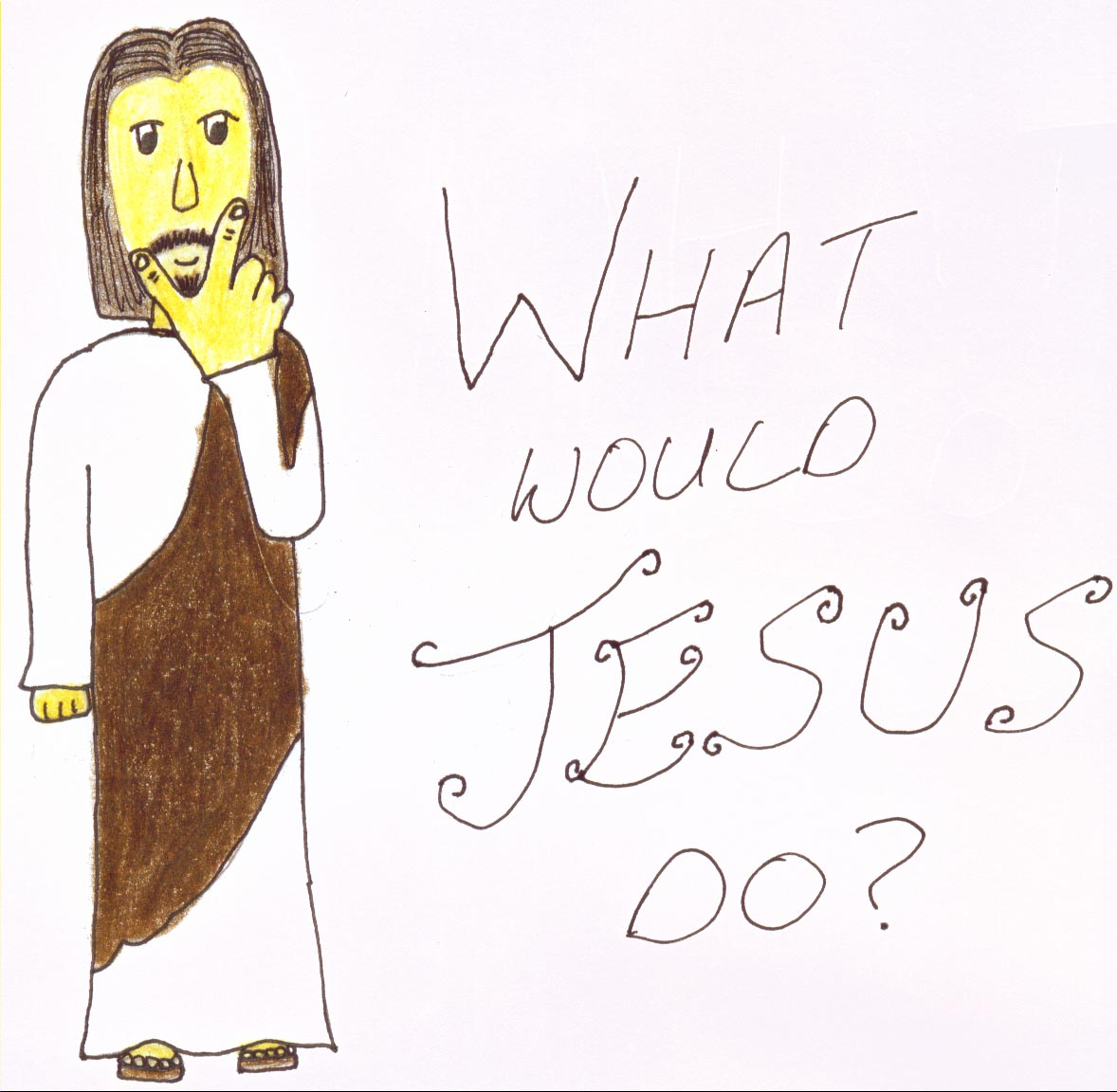
A Critique of the 'What Would Jesus Do?' Society

I really like how John Webster describes Barth's understanding against the Liberal Protestantism of his day. Ironically, I think, that the way Barth understood the Liberal Protestants of his day, could (should) be the way (by and large) that we understand American Evangelicals of our day [please note: I am speaking in generalities, there are obviously many exceptions to this amongst American Evangelicals, just as there was exceptions to the Liberal Protestants in Barth's day]. In fact, I think this dovetails nicely with the post I just posted on Occupy Wall Street. It gets to the question of how it is that "good" honest hard working (even Christian) people can be duped into thinking that the aformentioned attributes serve as the garb that justifies their place in society (i.e. as good honest hard working folk). There is always room for conviction and self-"criticality;" I know we don't like this, and I know that much of this ultimately bothers our sensibilities; but we are Christians, people of love and truth (insofar as we participate in God's life in Christ). As I've already alluded to, the following is Webster commenting on Barth and his critique of the Liberal Protestants (which I am lifting and applying to American Evangelicals). This is intended to decenter our trust in ourselves, and instead cause us to throw ourselves at the mercy of God in Christ. This is intended to turn our lights on so that we can more critically see how what counts as Christian and Ethical (in America and the West), probably is not as ethical and Christian as we think. This is intended to highlight how it is that "we" so easily become the standard for what is good and right in the world instead of our Savior, Jesus Christ.

[A] large part of Barth's distaste is his sense that the ethics of liberal Protestantism could not be extricated from a certain kind of cultural confidence: '[H]ere was ... a human culture building itself up in orderly fashion in politics, economics, and science, theoretical and applied, progressing steadily along its whole front, interpreted and ennobled by art, and through its morality and religion reaching well beyond itself toward yet better days.' The ethical question, on such an account, is no longer disruptive; it has 'an almost perfectly obvious answer', so that, in effect, the moral life becomes too easy, a matter of the simple task of following Jesus.

Within this ethos, Barth also discerns a moral anthropology with which he is distinctly ill-at-ease. He unearths in the received Protestant moral culture a notion of moral subjectivity (ultimately Kantian in origin), according to which '[t]he moral personality is the author both of the conduct with which the ethical question is concerned and of the question itself. Barth's point is not simply that such an anthropology lacks serious consideration of human corruption, but something more complex. He is beginning to unearth the way in which this picture of human subjectivity as it were projects the moral self into a neutral space, from which it can survey the ethical question 'from the viewpoint of spectators'. This notion Barth reads as a kind of absolutizing of the self and its reflective consciousness, which come to assume 'the dignity of ultimateness'. And it is precisely this --- the image of moral reason as a secure centre of value, omnicompetent in its judgements --- that the ethical question interrogates. [John Webster, Barth's Moral Theology: Human Action in Barth's Thought, 35-6]

The 'Human culture building itself up' was the German one (for Barth) that ultimately expressed itself in German bourgeois society, and ultimately Nazi Germany. For Barth, for the Liberal Protestant, because of the collapse of the Christian self into the self as the moral self; there no longer remained space for Christ to break in and speak a fresh word of holiness over and against the established norms of what the Liberal Protestant had come to already think of what counted as such. In other words, Barth was against a What Would Jesus Do? society. I am appropriating this critique from Barth (a la Webster) for the American Evangelical in particular. We have come to think that what counts as moral is captured by the symbol 'Conservative'. It is this absolutized 'Conservative Self' that presumes that what it means to be moral, and Christian is to ask, simply, 'What Would Jesus Do?' This perfectly illustrates Barth's critique of the German Liberal Protestant. For them, as for us, to be Christian, was to be nationalist, exceptional, and normal. It is this posture that negates any space for the Word of God to break in on all of these norms or the status quo; since the status quo is synonymous with being Christian. And it is this self-evidential situation which allows for atrocities to take place in the name of Christ; through the "absolute self."

Is what I am getting at overstated?

A repost

Sunday, May 6, 2012

A Clarification: Christ Centered Exposition

Let me make this clarification in regard to my last post.

When I speak of interpreting Scripture christocentrically, in a Christ conditioned manner; by and large this has to do with a macro-hermeneutical level instead of a micro-exegetical level. Meaning that, for example, what I am calling for is a hermeneutic, in contrast to something like Dispensationalism or classic Covenantalism, that does not see the nation of Israel (Dispy) or the Church (simpliciter) as the key to understanding Scripture; but as theologian Kathryn Tanner has aptly entitled one of her books: Christ The Key. And this should have a drastic impact upon the way we think hermeneutically. I am not suggesting that we abandon our literary tools, grammatical and historical tools, etc.; but that the frame within which these tools are employed need to be cognizant of and take shape from the fact that Scripture is intentionally and self consciously given by the second person of the Trinity, Christ Jesus himself!

It is only from within this kind of interpretive framework that an orthodox understanding of various issues can be discerned (and I mean ethics, holiness, etc.). Only as relationship and encounter with God in Christ are seen as the ultimate ground and reality of all of Scripture's disclosure. I am not saying there is nothing to be applied to our personal lives, for example, from Scripture; to the contrary! I am suggesting that the only way we will have sound things to apply from Scripture is when we see our lives grounded from and within the Spirit anointed humanity of Jesus Christ. It is as we encounter and cultivate relationship with Christ through meeting him through the Spirit's witness in the Scripture that our lives will be transformed from glory to glory into the image of the Son; and it is this kind of recreated humanity wherein application of God's Word is living and active.

Hope that helps clarify a little further.

Sunday, April 29, 2012

Wimpy Christianity: "We Have Christian Individuals, But Do We Have a Christian Church?"

Thomas Torrance asks very perceptively (as usual) whether or not we actually have a Christian church? He makes the point that we indeed have Christian individuals, but what does this mean when we inhabit an un-Christian church culture? The following Torrance quote comes from his lectureship at the University of Edinburgh, New College in Scotland where he lectured for many years. Understand that as he gave his lectures this takes us back some 40 to 50 years; but his concern then is of course, and more so, just as much of a concern today---especially in the American Evangelical church of which I am a part. Here is what Torrance asked his students:

[W]hat does this have to say to us today about what we call 'evangelical Christianity'? We have been concerned with evangelising men, women, and children as individual human beings, calling for repentance and personal decision for Christ as Lord and saviour, and rightly so. But have we been concerned with the evangelising of the mind of the society in which these people live? If not, how can a Christian church put down roots in an unevangelical society and remain genuinely Christian? I believe this is where evangelical Christianity today has failed terribly. By and large, as far as I can see, even the mind of the church, let alone the mind of society, is still secular in that it shares the mind of the secular society within which it exists. We have Christian people, but do we really have a Christian church? We have people who profess to believe in Christ as Lord and saviour, but do we have a church that is so imbued with the mind of Christ that its members individually and as a community think instinctively in a Christian way? Thomas F. Torrance, "Atonement," 444-45.

Torrance's concern is something that I have been burdened with for quite awhile now. I think the mission field (as one of my other teachers, Ron Frost has said) has actually come to us right in the church. There is such a dearth of sound Christian teaching with an emphasis on lively doctrine (which should produce worship) that I think it can truly be said that the American (Western) Evangelical church, by and large, is lost. That seems to be a hard teaching and critical diagnosis, but if we don't make prescient diagnoses then we are bound to live in the captivity of our society and cultures and not bound by captivity to Christ!

So the goal for pastors and Christian teachers is to teach and model Christ crucified in a way that produces a tsunami and sea change such that there is a communitarian repentance of thought. We not only need to be evangelists to the individual, but we need to evangelize thought patterns and the systemic structures of our society through prophetic and witness oriented evangelism that penetrates down into the depths. Here is something Torrance said to his students in this regard:

[T]here often came a point in my classes when I felt that the students wanted to throw the books at me, as the inner struggle between the gospel and the frame of mind they brought to it became intense. Let us make no mistake about it: divine revelation conflicts sharply with the structure of natural reason, with the secular patterns of thought  that have already become established in our minds through the twist of our ingrained mental alienation from God. We cannot become true theologians without the agonising experience of profound change in the mental structure of our innermost being. Thomas F. Torrance, "Atonement," 443.

The way forward requires courage, and a resolve to disentangle oneself from secular thinking; this resolve must be present first and foremost in the leadership and teaching office of the church. This is a painful process that requires sacrifice, work, and time; or as Jesus said, it requires 'that we take up our crosses daily and follow him'. This isn't an option, by the way, it is a mandate from the one we call Lord! It's time to step up to the mic for a sound check; are you present and accounted for, or are you just going to be another wimpy who continues to feast at the secular table of "having it your way?"

Sunday, April 22, 2012

Earth Day: 'Worshipping the Creation Rather than the Creator'

The problem with ‘Earth Week’ (or day), as it is ‘framed’ today, is basic; it is shaped and informed by an naturalist understanding of the universe (and thus earth). It is based upon assumptions that believe that all reality is reducible to material; here is a succinct summary of this perspective, provided by James Sire:
1. Matter exists eternally and is all there is. God does not exist.
As in theism and deism, the prime proposition concerns the nature of basic existence. In the former two the nature of God is the key factor. In naturalism it is the nature of the cosmos which is primary, for now, with an eternal creator-God out of the picture, the cosmos itself becomes eternal—-always there though not necessarily in its present form, in fact, certainly not in its present form. Carl Sagan, astrophysicist and popularizer of science, has said it as clearly as possible: “The Cosmos is all that is or ever was or ever will be.” (James W. Sire, “The Universe Next Door,” 54)

The consequence of living as if there is no God is to fill that void with [an]other god; that is, material “creation” itself becomes God, but not without us. In other words, man becomes the center of the universe, and the earth becomes his sustenance — ‘Mother Earth’. This way of thinking is not ‘new’, it is not progressive or ‘cutting-edge’; it is as old as the ‘Fall’ itself (see Gen. 3 and the ensuing story [the rest of the scriptures, esp. the OT]). In fact the LORD admonishes his people, contrary to the ‘natural way of thinking’, not to lift up ‘nature’ as if that is all there is; He says:
15“Therefore watch yourselves very carefully. Since you saw no form on the day that the LORD spoke to you at Horeb out of the midst of the fire, 16beware lest you act corruptly by making a carved image for yourselves, in the form of any figure, the likeness of male or female, 17the likeness of any animal that is on the earth, the likeness of any winged bird that flies in the air, 18the likeness of anything that creeps on the ground, the likeness of any fish that is in the water under the earth. 19And beware lest you raise your eyes to heaven, and when you see the sun and the moon and the stars, all the host of heaven, you be drawn away and bow down to them and serve them, things that the LORD your God has allotted to all the peoples under the whole heaven. 20But the LORD has taken you and brought you out of the iron furnace, out of Egypt, to be a people of his own inheritance, as you are this day. ~Deuteronomy 4:15-20
The negative of what Yahweh admonishes His people “not to do” (in the passage above) is the “natural orientation” of Fallen man. It is to worship the creation rather than the Creator (cf. Rom. 1); and this is what ‘Earth day (week, year)’ actually pivots upon.

Christians should not confuse stewardship of God’s creation with being ‘Green’. And really the only, and most basic reason for this, is what I have been trying to distinguish in my previous narrative; and that is, that ‘being Green’ is informed by an ‘worldview’ that is incompatible with the ‘Christian trinitarian’ perspective. The ‘Green’ approach “starts” out with the assumption that there is no God; the Christian, or what I like to call, ‘the Red’ approach, assumes just the opposite —- that there is a creator God, and He has revealed Himself to us in Christ.

In my view, it is irresponsible for Christians to take up the mantle of the ‘Green approach’, and assume that there is compatibility simply in the name of being ‘good stewards’. We need to be good ‘Stewards’ indeed, but in the name of Christ; and not simply by adopting the approach offered by the ‘unbelieving world’ (Christologically this is akin to the adoptionist heresy known as Ebionitism), and thus ‘Christianizing’ the pagan way of doing and thinking things.

**My next post will be on how to think about this stuff through the analogy of the incarnation (or Christologically); Colossians 1 is key for the Christian understanding at this juncture. If Christ is supreme over all creation, both as Creator and Redeemer, then as Christians it behooves us to think this issue out of that paradigm. Really this whole discussion orbits around that classic discussion between the relationship of nature and grace; the answer to that question must be centered in the life of Christ and how His hypostatic union (the relationship between his divine and human natures) should inform our approach to being stewards of this ‘creation’ or ‘recreation’ through Him. Instead of ‘Green’ I think Christians should call themselves ‘Red’, because without the shedding of God’s blood in Christ all we really have is ‘Black’ — which is what I think ‘Earth Day’ and its approach should really be called [not 'green']. Anyway, more to come.**