Some folk might wonder what the big to do is all about when it comes to the whole discussion this blog is dedicated to; that is, the discussion surrounding Calvinism and Armianism. In fact, I think many Evangelical Christians are so far removed from anything dogmatic or doctrinal, and instead given to 'real life', practical and pragmatic issues, that they simply scratch their heads when they come a cross a blog like mine. I have this experience, personally, quite often; in other words, nowadays when folk ask me about my book (when they find out I have one), and I start to explain it to them, most of the significance is lost on them because they don't have enough context, theologically, to grasp the significance of what we are trying to offer alternatively through the introduction of Evangelical Calvinism.
Nevertheless, to most Evangelical's chagrin, they are induced by the theological categories of Arminianism or Calvinism (in their classic forms) any time they listen to radio preachers, their preacher, and or fellowship with other Christians. The fact that they can't identify the theological categories they are being exposed to on a daily basis (if they indeed inhabit the Evangelical sub-culture) does not also mean that they aren't being exposed; it just means they are ignorant or naive to their exposure. So part of my goal, with a blog like this (and just in my own mode of daily life as a Christian) is to expose people and inform folk to what they are indeed being exposed to theologically. Some people might say, who cares; but the reality is, is that ideas have consequences (even ideas, and especially ideas that are held unconsciously), and so it behooves the Christian person to become aware of the ideas that shape their own theological identity, and then seek to make sure that what they explicitly or implicitly endorse, theologically, actually aligns with scripture and the God who is Self-Revealed in Jesus Christ.
Unfortunately, part of the 'Fall' (in the garden with Adam and Eve) entailed the fact that knowing God requires work (and I don't mean a works righteousness salvation, but that even in our salvation, we are called upon to grow in the grace and knowledge of Jesus Christ; and this presupposes work and toil cf. II Tim. 2:15). Of course, our 'flesh' or sin nature does not like to toil and work, and our culture conditions us to just take it easy. But this is not the ethic and life that God has called us to in Christ Jesus. Our hearts beat from a different city, a city whose foundations are heavenly (not platonically understood of course); and thus we need to be busy about God's mission and work. Part of this busy-ness requires that we cultivate relationship with God in Christ. This cultivation process is commonly known as theology.
At the end of the day, this is why understanding something as nuanced as Arminianism and Calvinism matters. We don't live in a theological vacuum, we live in a Christian world that comes with its own categories of thought and cultural dispositions; we are all impacted by theological ideas, the responsible Christian will try to understand what those are, and then act on cultivating healthy Christian ideas relative to God's Word.
Check out my other blog: The Face Of Christ

Showing posts with label American Evangelicalism. Show all posts
Showing posts with label American Evangelicalism. Show all posts
Tuesday, August 7, 2012

Saturday, July 14, 2012
Wright on Dispensationalism and the Nation of Israel in the Theology of the Apostle Paul
 |
| Jerusalem besieged, 70 A. D. |
[...] For some, alas, the very phrase 'second coming', and even perhaps the word 'eschatology' itself, conjures up visions of the 'rapture' as understood within some branches of (mostly North American) fundamentalist or evangelical Christianity, and as set out, at a popular level, in the 'Left Behind' series of novels by Tim F. Lahaye and Jerry B. Jenkins, and the theology, if you can call it that, which those books embody. That scheme of thought, ironically considering its fanatical though bizarre support for the present state of Israel, is actually deeply un-Jewish, collapsing into a dualism in which the present wicked world is left to stew in its own juice while the saints are snatched up to heaven to watch Armageddon from a ringside seat. (p. 145, Nook edition)
And then he goes on in the next paragraph to develop the Apostle Paul's actual thinking, in contrast to dispensationalism, on such things; he continues to write:
This is massively different from anything we find in Paul [referring to the dispensationalist reading he just mentioned], for all that the central text for the 'rapture' theology is of course I Thessalonians 4.16-17. What we find in Paul at this point is four things, in each of which we see the still-future Jewish eschatology redrawn around the Messiah.... (p. 145, Nook edition)
He goes on to develop his 'four things', which I don't want to get into at this point. Instead, I simply want to draw attention to the way that N. T. Wright (unsurprisingly) thinks of dispensational theology. I have come to agree with Wright about my former dispensationalism (I am an American Evangelical after all). But what does Wright mean when he writes 'That scheme of thought, ironically considering its fanatical though bizarre support for the present state of Israel, is actually deeply un-Jewish, collapsing into a dualism in which the present wicked world is left to stew in its own juice while the saints are snatched up to heaven to watch Armageddon from a ringside seat'? It is something that I have harped on for quite some time, whenever I write about dispensationalism; that is, this neo-Platonic, hard and fast distinction between Israel and the Church (the Church=for Wright 'the saints snatched up'). It is this distinction that ironically, but not, makes the Church God's saints, and the nation of Israel his Covenant People; such that the latter are judged (even though Jesus already was ... he was the Jew, wasn't he) by God in the 'Great Tribulation' (Daniel's so called 70th Week, or Jacob's Trouble, cf. Jer. 30:7), and the former are the beneficiaries of Christ's death for them on the cross. So we end up with this strange dualism between God's "two people," with the result that one still has to go through a blood letting of unimaginable depth, and the other has been released from such blood letting (the Church) through their Savior, Jesus Christ. My depiction might seem crude, but this is the inevitable conclusion to consistent and honest classical dispensational theology.
Wright, in the end, is right that dispensational theology offers a bizarre picture of what it means to 'support' the nation of Israel. Their theological framework has abstracted the nation of Israel out from Christ (in this dispensation, anyway ... i.e. the so called "Church Age"), and essentially placed them into a situation that has them facing something akin to a medieval Roman Catholic conception of purgatory; but instead dispensationalists have named it, 'The Great Tribulation', riffing on Jesus' words in the Olivet Discourse.
What say you Dispensationalist?
PS. In the end, though, I think Wright unhelpfully ends up offering an ecclesiocentric view of God's people, instead of grounding God's people (the Pauline 'One New Man' cf. Eph. 2.11ff) in God's life in Christ as his new creation in his covenant life of grace. So I think Wright is still in need of some dogmatic reflection, and I am happy to see that he seems to be open to some correction by some of his more recent interaction with Kevin Vanhoozer (esp. in areas having to do with union with Christ theology).
Monday, July 9, 2012
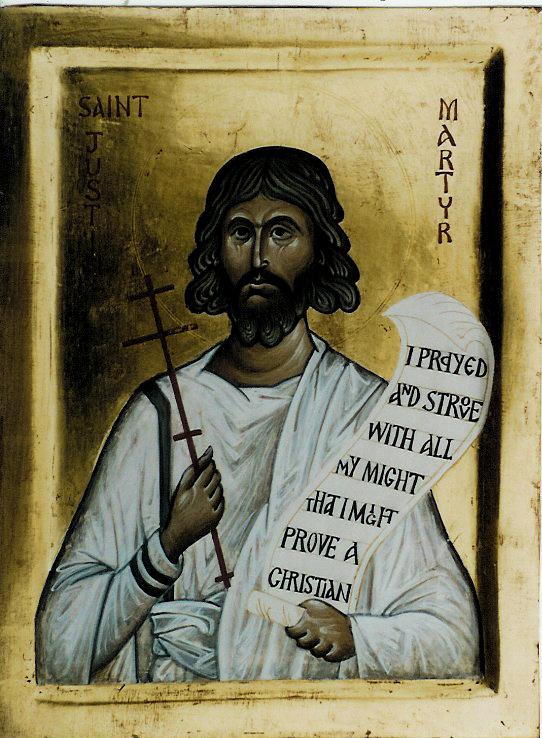
Thomas Torrance on Justin Martyr and "Proving Jesus" as Hermeneutic
 |
| Justin Martyr |
The distinctive feature of this Word is its relation through the Spirit to historical facts and events. It is when we allow the Scriptures to direct us to these facts and events that our minds fall under the power of their truth and we are compelled to believe for they carry in themselves their own demonstration. This is not, of course, any kind of logical proof, but the kind of demonstration that arises immediately out of the facts and events themselves through their self-evidence. This is particularly well expressed in a fragment of a lost work on the resurrection that has survived through John of Damascus and attributed to Justin.
[T]he Word of truth is free, and carries
its own authority, disdaining to fall under any skilful argument, or to
endure the logical scrutiny for its hearers. But it would be believed of
its own sake, and for the confidence due to him who sends it. Now the
Word of truth is sent from God, wherefore the freedom claimed by the
truth is not arrogant. For being sent with authority, it were not fit
that it should be required to produce proof of what is said, since
neither is there any proof beyond itself, which is God. For every proof
is more powerful and trustworthy than that which it proves, since what
is disbelieved, until proof is produced, gets credit when such proof is
produced, and is recognised as being what it was stated to be. But
nothing is more powerful or more trustworthy than the truth; so that he
who requires proof of this, is like one who wishes it demonstrated why
the things that appear to the senses do appear. For the test of those
things which are received through the reason, is sense; but of sense
itself there is not test beyond itself. As then we bring those things
which reason hunts after, to sense, and by it judge what kind of things
they are, whether the things spoken be true or false, and then sit in
judgment no longer, giving full credit to its decision; so also we refer
all that is said regarding men and the world to the truth, and by it
judge whether it be worthless or no. But the utterances of truth we
judge by no separate test, giving full credit to itself. And God, the
Father of the universe, who is the perfect intelligence, is the Truth.
And the Word, being his Son, came to us, having put on flesh revealing
both himself and the Father, giving to us in himself resurrection from
the dead and eternal life afterwards. And this is Jesus Christ our
Saviour and Lord. He, therefore, is himself both the faith and the proof
of himself and of all things. [Thomas F. Torrance, Divine Meaning, 95-6; the quote from Justin, De resurrectione, 1.1f, from the Sacra Parallela of John of Damascus. E.T. from Ante Nicene Christian Library, vol. 2, pp. 341ff. This is not generally accepted as Justin's
own work, but like the Cohortatio ad Graecos was at least written under his influence.]
Saturday, July 7, 2012
Knowledge of God for Thomas Torrance
Here is a video I did about 2 years ago (forgive my haircut, this is actually just after I finished my chemo treatments, so my hair is growing back :-). Anyway, I am interacting with Paul Molnar's book Thomas F. Torrance: The Trinitarian Theologian. I think the material covered in this video is apropos towards providing more insight into some of the issues that seem to be arising for Roger Olson as he interacts with our book. Furthermore, the material covered in this video is what I develop further in my personal chapter in our book.
So knowledge of God can only come through knowledge of God as it is Self-revealed and determined to be in Jesus Christ (cf. Jn. 1:18). Knowledge of God can only be regulated by his own Self-revelation, and thus other modes for providing grammar and content for knowledge of God cannot be entertained (such as using philosophical categories like appealing to Aristotle etc. appeal to).
So knowledge of God can only come through knowledge of God as it is Self-revealed and determined to be in Jesus Christ (cf. Jn. 1:18). Knowledge of God can only be regulated by his own Self-revelation, and thus other modes for providing grammar and content for knowledge of God cannot be entertained (such as using philosophical categories like appealing to Aristotle etc. appeal to).
Saturday, June 23, 2012
Bobby's Developing Bible Study: "Jesus is the Key"
I have been seeking a hermeneutic, or a way beyond
the impasse created by my move to what
Gibson and Muller have called a principial
& intensive method of biblical interpretation (in reference to Barth on their part, no
less). I have become disenchanted, over the past few years, with the
hermeneutical framework (but not all of the ways) that I was trained in through
both Bible College and Seminary; that is, the Literal, Grammatical, Historical method. Certainly, though, I
cannot, nor do I want to fully abandon the Grammatical, Historical, and
Canonical realities that make up the shaping of what we call the Bible. So in
other words, I have been in some personal conflict when it comes to my theory
of hermeneutic; wanting to affirm a methodologically and principled way of reading
scripture, in Christ. And on the
other hand, not also wanting to reject the historical and canonical aspects of
scripture that repose in it its Christic
shape; so I want to continue to use the grammar, the syntax, the lexical,
and the canonical markers of scripture that serve
instrumentally to point beyond themselves to the deep reality they signify,
in Christ.
 |
| The 'Young', Martin Luther |
In this seeking of mine, I have been reading Jens
Zimmerman’s Recovering Theological
Hermeneutics: An Incarnational-Trinitarian Theory of Interpretation. And
unlike T. F. Torrance’s book Divine
Meaning: Studies in Patristic Hermeneutics (which I thoroughly benefited
from, of course, especially in serving the purpose in providing a general
theory of hermeneutics that, indeed seeks to present a truly principled
christocentric hermeneutic); Zimmerman’s book, and brief development of Luther
(thus far in my reading of his chapter on Luther’s hermeneutic) has help to
affirm the way that I want to proceed by being principially Christic in my biblical exegesis, and at
the same time understanding that within this
theoretical hermeneutical framework; that there is a viable way to employ all
of the philological tools that one ought to employ when engaging the text of scripture, which is special literature.
The following two quotes from Zimmerman on Luther’s
approach to biblical interpretation are the ones thus far that I have benefited
from the most in my pursuit to provide some denouement
to my, as of late, hermeneutical angst.
[I]t follows that the subject matter of the Bible, the good news of God’s love for humanity shown in the incarnation, cannot be understood through historical research alone. Nor in contrast to the historical school of the nineteenth century is historical distance a problem. The historical distance is nullified (not bridged) by the Word, which first created history and then was spoken into history. Luther concludes that it is the role of the Holy Spirit to make the incarnate Word present to the reader. Thus for Luther; a hermeneutics adequate to interpret the subject matter of the Bible is based on the unity of “Christ, Word, and Spirit” (EE, 365). Luther’s theory differed from a theory of verbal inspiration, for he insisted on a word behind the word that requires from the reader constant revisions in interpreting the written letter. . . . [59]
In light of this, it is no surprise that someone
like my friend, Matt, a Lutheran, is also a Barthian; for the above sketch of
Luther’s hermeneutic sounds very much so like Barth’s (and T.F. Torrance’s, no
less) approach to understanding the written word as it continually, and ever
anew proximate the Living Word in
whom the written and proclaimed word find their reality and orientation. As
Karl Barth (I believe in his CD I/1)
describes this, there is both the ‘outer-logic’ and ‘inner-logic’ of Scripture
(playing off the Reformer’s perspicuity ‘outer/inner’ clarity dialectic); such
that the written letter (outer logic) remains stable, our understanding of that
is provisional and ever changing as
we understand more and more the One, the Word, to whom this written word points
(this is the ‘inner-logic’ according to Barth … and the reason that ‘theological
exegesis’ should be understood as the norm for biblical interpretation).
 |
| The, Karl Barth |
Here is the second quote that again helps assuage
and also confirm me in my own movement forward as a theological/Christological exegete
of Holy Scripture; Zimmerman summarizes:
To sum up, for Luther, “the Word of God in the cosmic sense was the eternal Christ, and as the Word of God in the New Testament was essentially the historical Christ. Given his doctrine of the Word, it was logical for Luther to see Christ and the cross as the central theme of God’s redemptive word”…. Luther’s systematic Christological hermeneutic principle does not mean, however, that he simply read his opinion into the text; the assiduous use of all philological aids available at his time in his sermon and lecture preparation demonstrates Luther’s desire to develop theology from the text. That is not to say, of course, that sometimes his vivid imagination saw Christ in the text where modern scholarship does not. However, respected strands of contemporary scholarship have come to agree in principle with Luther’s reading of Paul and the plausibility of the Pauline assertion that Jesus the Christ is the fulfillment of Torah and the messianic promises in Isaiah pertain to his redemption and vindication of humanity … [Jens Zimmerman, Recovering Theological Hermeneutics, 59-60]
As Zimmerman developed in an earlier iteration of his chapter on Luther; for Luther there is no understanding the historical word
of scripture without the Word of Faith breathing life into the history as it is
conjoined in Christ as he is the point and purpose of creation and creation’s
history unfolded toward and in Christ. If this is the case, the words of
scripture cannot have meaning or signification if they are abstracted from their
reason for being as they are taken up in Christ. And yet, more constructively,
this is exactly how higher-critical and historist approaches to biblical
interpretation (some of which I have been discussing in previous posts, whether
on the ‘Liberal’ side or the ‘Fundamentalist/Evangelical’ side) have colluded
in their adumbration of the text of scripture (adumbrated because these ‘critics’
have place scripture into a pretext of their own construction, one that doesn’t
have eyes to see and ears to hear, because if it did, these critics would
understand that they can’t understand the text without understanding that it’s
all about Jesus).
And so, since this post is now just over the
reported attention span of blog readers (which is a 1,000 words, max.); I will
close this post. Maybe you can appreciate a little better, then, where I am at
in my own development; and maybe you can see why I have jettisoned my beloved
LGH and even Dispensational hermeneutical theory.
PS. I am, at the end of the day, really quite pragmatic when it comes to all of this stuff; meaning that I have one principle that guides the way I proceed: "Jesus is the Key". So, if it is Thomas Torrance, Karl Barth, John Calvin, my child-hood Sunday school teacher, or whoever else; if anyone or anyway serves my principle that 'Jesus is the key,' then I am willing to at least listen and test whether what one particular or another teacher communicates actually contributes to this principle or, instead, whether they quench this principle. Luther, and Zimmerman's constructive reading of Luther is helpful towards my principle. That said, the only way we can really know if someone is helpful towards affirming my principle is to truly understand what said teachers really taught and thought; for this is the only way we can potentially benefit from their stated christocentrism.
Friday, June 22, 2012
"You Are Just Too Smart ... You Don't Think Biblically"
I just came across this quote from a Systematic Theology written by R. D.
Culver (who apparently was American Biblical Theologian, Walter Kaiser's doktorvater)..
Notice the sentiment being articulated by Culver in
what he here writes:
Thomas Aquinas, The Heir of 'Biblical Theology' A diversion into recent theories of language analysis and of hermeneutics at this point would show how skepticism [sic], denial that anything anyone speaks or writes is true in any important sense, has imported Pilate’s skeptical question wholesale to the academy. Recently these theories have invaded all university departments except the hard sciences. The public has been made aware of this disastrous development as ‘deconstructionism’.Deconstruction uses figures, tropes, neologisms, irony and philosophy to sever any connection between an author’s true self and what he has written. The motives of these literary dogmatists apparently are chiefly to create an elite of critics who have their own club. The strength of this syndrome is an informal connection of ambitious professors and their admirers, supported by tenure rules that deliver the star performers from necessity of constructive labour.[Culver, R. D. (2005). Systematic Theology: Biblical and Historical (100). Ross-shire, UK: Mentor.] (ht)

The irony of this quote is the apparent suspicion attendant
to it. Culver is really, as I read this quote without further context,
reinforcing an anti-intellectualism by caricaturing anyone who might be
theologically oriented in their speech and thought; anyone who might be
academic by training; or anyone who thinks that Scripture itself thinks
theologically instead of biblically (which of course is itself a false
dichotomy, but so goes the thinking---I surmise).
My tentative reading of this quote is only
reinforced given the context in which it was originally used; and for the
audience for whom it was lifted up with somewhat adulation (see the ht). I
don't highlight this particular quote because I want to harp on the place I
took this quote from (online); instead, I simply take notice of this because it
saddens me (in the theme of my recent post on "I Don't Think,Theologically") . Certainly, if I were an elitist I would simply consider
the thinking reflected in this quote as simpleton rubbish; something I could
simply relegate to the dust-bin of Fundamentalist naïvete. But I am not an elitist.
Sunday, June 17, 2012
"I Don't Think, Theologically ..."
I was at a church gathering yesterday that brought me into contact with a couple of brothers, and a brief and interesting exchange in regards to theology, and thinking theologically. I was discussing with one of the brothers, in ear-shot of the other, about theology; and in particular, German theology (since the brother I was talking to is a missionary in Germany). Who else but Karl Barth came up. And so the one brother I was talking to (who teaches at one of our current church's denomination's Bible Colleges) mentioned straightaway, that he had studied with a guy who had studied Barth for years; this particular brother I was talking with mentioned that he had studied Barth, amongst other "German theologians," and that (reading between the lines) he had come to the conclusion that Barth was simply a Neo-Orthodox theologian (which is akin to calling someone a semi-Pelagian, or it is really a negative caricature used to marginalize someone like Barth as a 'Liberal', just as using semi-Pelagian is used to marginalize someone, say, who is Arminian in orientation). Anyway, I develop the setting a bit, in this way, just to set up what, in conversation, happened next with the other brother in ear-shot of my current mini-discussion (by the way, I questioned whether placing Barth in the Neo-Orthodox camp was legitimate, which the brother I was speaking with seemed to disagree with me on). Somehow, in the midst of all of this, it came up that I had a book that just came out; and that I was a theologian (which was news to the brother I was talking with). Well, the other brother, in ear-shot, asserted something that I want to make the topic of the rest of this post. He said, "he doesn't do theology, and that this is his solution to having to think about such things" (like Karl Barth, etc.). I really didn't respond to this brother's comment in that context, it wasn't fitting at that moment.

Nevertheless, I bring this up, because this represents something else that I would like to address further at the blog here; in the days to come, that is. I want to evaluate, deconstruct and then constructively engage the ethos & pathos, church-culturally, that could prompt a statement like my brother made; i.e. that he basically avoids theology. I am an American Evangelical, and I live smack dab in the middle of American Evangelicalism sub-culturally. The sentiment voiced by my brother is ubiquitous and pervasive within this sub-culture; an anti-intellectual (but what I will be calling an 'anti-theo-logical') perspective. I want to deal with the socio-cultural and theological factors that have led American Evangelicals to this rather blighted state. I mean I have already started down that road with that post I once wrote entitled A Critique of the What Would Jesus Do? Society. But I would like to take a longer look at this problem, because it is one that plagues my own theological existence and Christian walk on a day to day basis, really.
I will hopefully be digging a bit further into American Pietism, American Christian Fundamentalism, and also looking at some forms of Medieval Mysticism. And trying to do some landscaping that will help give a better lay of the land in a way that would help explain why a brother of mine at church (representative of thousands and thousands of American Evangelicals) would voice his perception about theology in the way that he did. There is a radical anti-theo-logicalism at work in the higher rankings of leadership in the denomination we are a part of, and this, unfortunately has bled down into their schools of education (ironically), thus affecting many folk's own perception of "doing theology" in our current denominational affiliation (a perception given voice towards me by my brother from church).
So where does this perception of theology come from? The one that would motivate my brother's voice towards it? It comes from, I think, in general, a perception that experience with God involves an unmediated encounter; such that spirituality is contingent upon mystical encounter with a God who is solely apophatic in orientation. It comes from the simple belief that theology, in general, attempts to sequester God, and contain God in human ways; that in the process we lose God, and thus genuine experience of God, and instead replace worship of God with worship of men (like my picture of Calvin here at the blog might suggest to some). The irony of this, though, is that this perception fails to recognize (because even the recognition itself would require the kind of sequestering self-critical postulating that this perception believes is cutting real encounter with God off in the first place) that God has already accommodated himself in gracious movement towards us (which is commonly known as Grace), with the result that God has actually contained and sequestered humanity in himself, for himself, in Christ. So encounter with God is highly kataphatic, highly concrete, and highly particularized (and demystified, by the way) as we move through the mediating humanity of Jesus Christ to God. This is obviously the kind of theology that I advocate for, that we advocate for as Evangelical Calvinists; that is, a 'Christ-conditioned' Trinitarian theology. Encounter with God is what we should all be seeking, but encounter with God cannot be manufactured out of thin-air-experiences; instead they must be grounded in the encounter that God has already freely chosen for himself to have with us in the humanity of Christ.
In the end. There are only two alternatives. Either we try to do 'good theology', or we don't try, and we end up doing bad theology (worse, we end up worshiping ourselves, and the projections of ourselves overlaid onto an un-revealed revelation of God that we think is Jesus Christ pace Feuerbach). At this point, I am afraid that my brother is only doing bad theology, if he has chosen not do theology at all.
PS. A few quick responses to the quip that "one has chosen not to do or think theology" might be:
PPS. I want my tone on this to be understood; it is one of concern, and not one of holier-than-thou or smarter-than-thou thinking. I think the LORD has so much for us, and that we can only stop and participate in this (him) as we self-consciously and intentionally stop and think and speak about him in honoring, critical, reflective, and devotional ways. I also think that 'right-doctrine' leads to 'right-practice' (and vice-versa).

Nevertheless, I bring this up, because this represents something else that I would like to address further at the blog here; in the days to come, that is. I want to evaluate, deconstruct and then constructively engage the ethos & pathos, church-culturally, that could prompt a statement like my brother made; i.e. that he basically avoids theology. I am an American Evangelical, and I live smack dab in the middle of American Evangelicalism sub-culturally. The sentiment voiced by my brother is ubiquitous and pervasive within this sub-culture; an anti-intellectual (but what I will be calling an 'anti-theo-logical') perspective. I want to deal with the socio-cultural and theological factors that have led American Evangelicals to this rather blighted state. I mean I have already started down that road with that post I once wrote entitled A Critique of the What Would Jesus Do? Society. But I would like to take a longer look at this problem, because it is one that plagues my own theological existence and Christian walk on a day to day basis, really.
I will hopefully be digging a bit further into American Pietism, American Christian Fundamentalism, and also looking at some forms of Medieval Mysticism. And trying to do some landscaping that will help give a better lay of the land in a way that would help explain why a brother of mine at church (representative of thousands and thousands of American Evangelicals) would voice his perception about theology in the way that he did. There is a radical anti-theo-logicalism at work in the higher rankings of leadership in the denomination we are a part of, and this, unfortunately has bled down into their schools of education (ironically), thus affecting many folk's own perception of "doing theology" in our current denominational affiliation (a perception given voice towards me by my brother from church).
So where does this perception of theology come from? The one that would motivate my brother's voice towards it? It comes from, I think, in general, a perception that experience with God involves an unmediated encounter; such that spirituality is contingent upon mystical encounter with a God who is solely apophatic in orientation. It comes from the simple belief that theology, in general, attempts to sequester God, and contain God in human ways; that in the process we lose God, and thus genuine experience of God, and instead replace worship of God with worship of men (like my picture of Calvin here at the blog might suggest to some). The irony of this, though, is that this perception fails to recognize (because even the recognition itself would require the kind of sequestering self-critical postulating that this perception believes is cutting real encounter with God off in the first place) that God has already accommodated himself in gracious movement towards us (which is commonly known as Grace), with the result that God has actually contained and sequestered humanity in himself, for himself, in Christ. So encounter with God is highly kataphatic, highly concrete, and highly particularized (and demystified, by the way) as we move through the mediating humanity of Jesus Christ to God. This is obviously the kind of theology that I advocate for, that we advocate for as Evangelical Calvinists; that is, a 'Christ-conditioned' Trinitarian theology. Encounter with God is what we should all be seeking, but encounter with God cannot be manufactured out of thin-air-experiences; instead they must be grounded in the encounter that God has already freely chosen for himself to have with us in the humanity of Christ.
In the end. There are only two alternatives. Either we try to do 'good theology', or we don't try, and we end up doing bad theology (worse, we end up worshiping ourselves, and the projections of ourselves overlaid onto an un-revealed revelation of God that we think is Jesus Christ pace Feuerbach). At this point, I am afraid that my brother is only doing bad theology, if he has chosen not do theology at all.
PS. A few quick responses to the quip that "one has chosen not to do or think theology" might be:
- Do you read your Bible, believing that God speaks there? Then, you are affirming a theological tradition that asserts the belief that God speaks in and through the witness of Scripture.
- Do you affirm or believe in the doctrine of the Trinity? Then, you are affirming theological grammar (that is 'extra-biblical') that was developed post Apostolic Witness. So you 'do theology then'.
- Do you affirm the full humanity and full deity in the person of Jesus Christ? Then ...
PPS. I want my tone on this to be understood; it is one of concern, and not one of holier-than-thou or smarter-than-thou thinking. I think the LORD has so much for us, and that we can only stop and participate in this (him) as we self-consciously and intentionally stop and think and speak about him in honoring, critical, reflective, and devotional ways. I also think that 'right-doctrine' leads to 'right-practice' (and vice-versa).
Tuesday, June 12, 2012
A Primer and Comparison on Classic Dispenationalism and Amillennialism
This post is my inaugural one that will be dealing with a comparison between Dispensational Premillennialism and Amillennialism. This post represents one of many posts that I will be doing in a loose-leaf series kind of way (in another words, sporadic) on a concern that largely is an un-concern for many of the types of folk I generally engage with in Christian academia. In other words, this issue has really become more of an idiosyncratic one that a certain subset of American Evangelicals (usually) emphasize in their biblical interpretive strategies. So consider me an idiosyncratic American Evangelical when it comes to this, especially when I do posts on the finer nuances of the respective systems of interpretation (for that is what these are). My hope though, in the process of doing posts on this topic, is that I can somewhat de-idiosyncratize this issue by framing it in such a way that my personal and rather amorphous 'Christ-conditioned' biblical hermeneutic will bubble over; such that what is at the heart of this 'idiosyncratic issue' (e.g. biblical interpretation/hermeneutics) will become significant relative to framing the finer points of discerning a difference between the philosophy of interpretation that either leads to adopting a system that is Dispensational, or not.
With that ground cleared lets get into it. As a caveat, I have been in some recent correspondence with a brother from my church; and he is interested (and curious) about the differences between classic Dispensationalism (which is what our church denomination teaches from, in general, i.e. Calvary Chapels) and Amillennialism---and then of course the finer nuances that characterize such systems of interpretation, such as: views on the so called 'Tribulation' period (for Dispensational Premillennialists those range from Pre-Tribulational, Mid, and Post and then there is Pre-Wrath for good measure); concerns about the Kingdom 'Now & Not-Yet'; etc. So understand that as I write posts (this one included), I will have my friend in mind (who hasn't had really any exposure to any of these, except for the subconscious teaching that he has received on it, which is informed by a Dispensational lens). And I am sure that as I have him in mind, that his questions and curiosities are representative of a whole host of you readers 'out there'.
Now let's get into it. For this first post, let me just highlight (off the top) some general differences between Premil classic Dispensationalism (CD), and Amillennialism (A):
 |
| A Classic Dispensational Chart (click on for larger view) |
Now let's get into it. For this first post, let me just highlight (off the top) some general differences between Premil classic Dispensationalism (CD), and Amillennialism (A):
- CD "supposedly" follows a literal method of biblical interpretation. Meaning that they take the plain sense meaning of words in their 'plain sense' until taking them in their plain sense becomes non-sensical.
- A is usually purported to follow a allegorical or symbolic ('type/anti-type') method of biblical interpretation. Which for some of its history is true, but not all of its history. I will argue (suggestively on the blog) that A actually is follows a more consistently literal method of biblical interpretation than does CD.
- CD believes, in general, that there is a hard distinction between Israel and the Church (in fact this is probably the sine qua non of what identifies someone as Dispensational, even Progressive Dispensationalists); such that ethnic Israel are God's so called 'earthly people' to whom all the promises were made (like the 'Land Covenant' etc.), and that prophetic history is oriented and directly and solely about the Nation of Israel. And CD sees the Church as God's Heavenly People who are only being included in his salvation as a parenthesis in his 'real' prophetic plan of salvation which is for the Nation of Israel (e.g. so if you were to think of God's plan for prophetic and salvation history in terms of a 'sentence', the Nation of Israel is the subject of the whole sentence, but because of their rejection of their Messiah [initially at his first coming], God interrupts his plan, his sentence, and inserts a parenthesis into his sentence (an after-thought, to be crude)---that parenthesis is the so called 'Church Age' and Dispensation of Grace. Once the full number of Gentiles (and some Jews) come into the fold, during this season, they will be snatched (raptured) out of the world, and God can return his focus back on his primary plan of salvation which only for the Nation of Israel).
- A holds that the two peoples, Jew and Gentile, have been made one new man in Christ (Ephesians 2:11ff); and thus God does not have two peoples, but one, and that those peoples find their ground for their humanity in the vicarious humanity of Christ (note, my redressing of Amillennialism will be nuanced by my own appropriation of it---in general, by way of framework, I am consistently thinking from within the Amillennial purview, I will just shape and nuance things per my own theological thinking (Evangelical Calvinism). So prophetic and salvation history, for the A, is actually totally and completely about Jesus Christ. The implication of this being that prophetic and salvation history is all about ALL of Humanity, since Jesus is God for us!
- CD believes that we God relates to humanity through 7 Dispensations (or economies). And that these relationships are cyclical, such that once a particular group finally biffs an economy up so bad (the arrangement God had set up with them, to relate to them---which is preceded by his judgment); then this screw up initiates another cycle. So, for example, we went from a time of Law to a time of Grace (between part of the OT and NT); since Israel messed it up so bad, this in turn initiated God's next Dispensation of Grace, wherein God now relates to humanity in the Church. But once the time of 'Apostasy' comes to fruition (referenced in the Epistles to Timothy), then this will initiate the turn to the Dispensation, again, preceded by judgment which is what the 'Great Tribulation' represents.
- A believes that God relates to humanity by overarching Covenants. This is a point where I will distinguish myself from the regular Amillennial approach, which is usually framed through Federal or Covenant Theology; the former being a special kind of Covenant theology. Classic Covenant Theology sees God relating to humanity through a Covenant of Works (which he initiated with Adam and Eve in the Garden), and Covenant of Grace. The former is one that is conditional and based upon obedience to God's Law; since Adam and Eve failed, this plunged humanity into an irreparable situation and a penalty was now required to be paid for the 'Law-breaking'. This is remedied by the Covenant of Grace, wherein Jesus comes for an elect group of people (that God arbitrarily had already elected in eternity past) for whom he pays their penalty (death---passively), and fulfills the conditions of the Law for them (actively). This is usually the hermeneutical schema used for framing A through (in the classic way). But for reasons that go beyond this post (and which I have already elaborated upon, substantially), I will not get further into critiquing this position. In Contrast: I follow a Covenantal scheme as well. Yet, my scheme only has the Covenant of Grace, which its inner reality is God's life (its outer is exemplified in creation); such that God's life and choice for humanity (including the initial act of creation) is all based in his life of other-centeredness, which is definitive of his inner Trinitarian life of love (which I have already discussed at length at the blog here as well). This is the 'Covenantal' scheme that I think from, just to be clear. And this whole point to highlight, that A, in general, is much different in orientation to biblical interpretation than is CD. The primary thing of note here is that, I will argue, that CD's biblical interpretation is given shape by a Nation (Israel); while A is, in general, given biblical interpretive shape by a Person (Jesus Christ). I will get more into this later, as I relate this to my so called 'Christ-conditioned' hermeneutic, which I have posted a bit on already here at the blog.
- CD believes that the promised Davidic Kingdom (cf. II Sam. 7) will only 'LITERALLY' be fulfilled in the future earthly 1000 year reign of Christ. Which is one of the reasons CD must have a yet future fulfillment of the Davidic Kingdom; because they believe it is only applicable for the the Nation of Israel. So this also will tie into their need for a Pre-Tribulational view of the Tribulation options. Further, CD interprets Revelation 20 and the thousand years there as a literal-sequential time frame.
- A holds that the Davidic Kingdom has been inaugurated at the first coming of Jesus; through the shedding of his blood and the establishment of the New Covenant. They interpret the thousand years of Revelation 20 through an apocalyptic genre lens leading to the conclusion (given the numerous usages of the multiple of 10 in Revelation and gematria as a 1st century interpretive method) that this should be understood symbolically or figuratively of the current period we inhabit between the first and second comings of Jesus. So A believes that there is a two-age model of the Kingdom, i.e. the "Now/Not-Yet" aspects.
- CD holds to a Pretribulational theory of the rapture. Meaning that they believe prior to the the last week of Daniel's so called '70 Weeks'---which is the 7 year period often referenced when thinking about the future tribulation period---the Church will be snatched out or raptured out of this world, this ending the Church Age, and initiating the time of "Jacob's Trouble" (Jer. 3), and/or "The Great Tribulation". CD needs this mechanism (Pre-Trib) in order to remove the Heavenly People from the earth, so that God can get back to dealing with his Earthly People, ethnic Israel. The Tribulation period, is primarily God's judgment on the Nation of Israel for their initial rejection of the Messiah; and yet, it will have universal ramifications causing God to judge the world, since they will rise up to try and destroy Israel and ultimately God (or "Armageddon"). They also argue that Christians are not appointed to God's wrath (cf. I Thess. 5:9), and since the Tribulation is representative of the "Lord's Day" and God's wrath, there is no reason for us (the Church) to be here. I will get into more of this later.
- A, in general, holds that 'The Great Tribulation' was historically in reference to the destruction of Jerusalem in 70AD by Titus Vespasian of Rome. Yet, some also believe, that this is typological of an intensification of Tribulation that will encompass the whole globe up until the 'end'. This is how some As interpret the book of Revelation, through a progressive parallelism, such that each of the groupings of judgments (seals, trumpets etc.) are referencing the same thing; but at the same time they also represent an intensification of God's judgment and a Great Tribulation just prior to his coming. So, in general, As believe that we have been in Tribulation and will be, in intensifying ways, right up until the end (or beginning). I will be talking more about an interpretation of the book of Revelation, through Richard Bauckham later, which nuances this in a way that I really appreciate.
 |
| Comparsion Between Premil and Amil |
Sunday, June 3, 2012
A Critique of the 'What Would Jesus Do?' Society
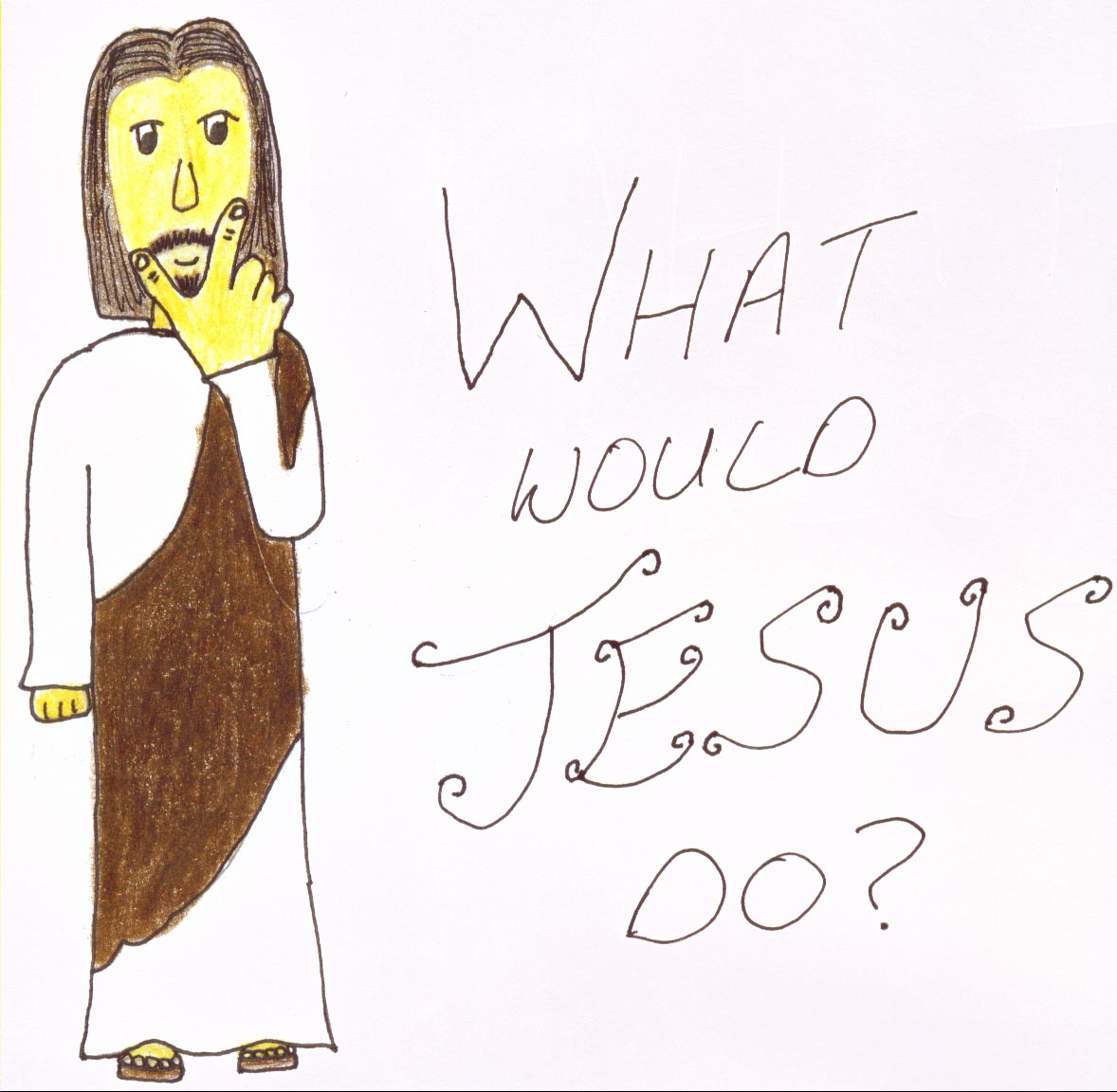 I really like how John Webster describes Barth's understanding against the Liberal Protestantism of his day. Ironically, I think, that the way Barth understood the Liberal Protestants of his day, could (should) be the way (by and large) that we understand American Evangelicals of our day [please note: I am speaking in generalities, there are obviously many exceptions to this amongst American Evangelicals, just as there was exceptions to the Liberal Protestants in Barth's day]. In fact, I think this dovetails nicely with the post I just posted on Occupy Wall Street. It gets to the question of how it is that "good" honest hard working (even Christian) people can be duped into thinking that the aformentioned attributes serve as the garb that justifies their place in society (i.e. as good honest hard working folk). There is always room for conviction and self-"criticality;" I know we don't like this, and I know that much of this ultimately bothers our sensibilities; but we are Christians, people of love and truth (insofar as we participate in God's life in Christ).
As I've already alluded to, the following is Webster commenting on Barth and his critique of the Liberal Protestants (which I am lifting and applying to American Evangelicals). This is intended to decenter our trust in ourselves, and instead cause us to throw ourselves at the mercy of God in Christ. This is intended to turn our lights on so that we can more critically see how what counts as Christian and Ethical (in America and the West), probably is not as ethical and Christian as we think. This is intended to highlight how it is that "we" so easily become the standard for what is good and right in the world instead of our Savior, Jesus Christ.
I really like how John Webster describes Barth's understanding against the Liberal Protestantism of his day. Ironically, I think, that the way Barth understood the Liberal Protestants of his day, could (should) be the way (by and large) that we understand American Evangelicals of our day [please note: I am speaking in generalities, there are obviously many exceptions to this amongst American Evangelicals, just as there was exceptions to the Liberal Protestants in Barth's day]. In fact, I think this dovetails nicely with the post I just posted on Occupy Wall Street. It gets to the question of how it is that "good" honest hard working (even Christian) people can be duped into thinking that the aformentioned attributes serve as the garb that justifies their place in society (i.e. as good honest hard working folk). There is always room for conviction and self-"criticality;" I know we don't like this, and I know that much of this ultimately bothers our sensibilities; but we are Christians, people of love and truth (insofar as we participate in God's life in Christ).
As I've already alluded to, the following is Webster commenting on Barth and his critique of the Liberal Protestants (which I am lifting and applying to American Evangelicals). This is intended to decenter our trust in ourselves, and instead cause us to throw ourselves at the mercy of God in Christ. This is intended to turn our lights on so that we can more critically see how what counts as Christian and Ethical (in America and the West), probably is not as ethical and Christian as we think. This is intended to highlight how it is that "we" so easily become the standard for what is good and right in the world instead of our Savior, Jesus Christ.
[A] large part of Barth's distaste is his sense that the ethics of liberal Protestantism could not be extricated from a certain kind of cultural confidence: '[H]ere was ... a human culture building itself up in orderly fashion in politics, economics, and science, theoretical and applied, progressing steadily along its whole front, interpreted and ennobled by art, and through its morality and religion reaching well beyond itself toward yet better days.' The ethical question, on such an account, is no longer disruptive; it has 'an almost perfectly obvious answer', so that, in effect, the moral life becomes too easy, a matter of the simple task of following Jesus.
Within this ethos, Barth also discerns a moral anthropology with which he is distinctly ill-at-ease. He unearths in the received Protestant moral culture a notion of moral subjectivity (ultimately Kantian in origin), according to which '[t]he moral personality is the author both of the conduct with which the ethical question is concerned and of the question itself. Barth's point is not simply that such an anthropology lacks serious consideration of human corruption, but something more complex. He is beginning to unearth the way in which this picture of human subjectivity as it were projects the moral self into a neutral space, from which it can survey the ethical question 'from the viewpoint of spectators'. This notion Barth reads as a kind of absolutizing of the self and its reflective consciousness, which come to assume 'the dignity of ultimateness'. And it is precisely this --- the image of moral reason as a secure centre of value, omnicompetent in its judgements --- that the ethical question interrogates. [John Webster, Barth's Moral Theology: Human Action in Barth's Thought, 35-6]
Is what I am getting at overstated?
A repost
Saturday, May 26, 2012
Following Calvin and the "Five Points"
Calvinism is a variegated thing, but in its American instantiation, it has come to be most 'popularly' identifiable by its unbreakable relationship with that ubiquitous acronym, TULIP, or the Five points. Not just that, but there has always been a question related to how far Calvinists, today, proximate the actual teaching of their name-sake, John Calvin. Indeed, to the surprise of many an American Calvinist, there are many more layers and strands that make up Calvinism in general; indeed, one of those strands is what we are calling 'Evangelical Calvinism,' a strand that presses and develops one of Calvin's most endearing themes; his teaching on union with Christ, and double grace theology. Nevertheless, the Five points of Calvinism continue to retain the most glaring meaning for what it means to be a Calvinist; at least in America. Yet, as so many Calvinists want folk to know, the Five points ought not be understood as what it means to be Calvinist, in toto. Instead, as many a Calvinist are prone to press; they would rather be defined by what they call 'The Doctrines of Grace' shaped by God's unrelenting Sovereignty. It is this reality that is well articulated by Dewey Wallace:
As Dewey notes, for one thing, there are more strands that make up the Reformed Faith, and/or Calvinism, than many people think (which is where you can insert 'Evangelical Calvinism' or 'Scottish Theology'). But, it is also a reality (esp. in America), that "five point" Calvinism is the most dominate and recognizable and apparently self evident of the Calvinist expressions around today. Something that Dewey highlights, that I think is very significant, is taken up in his last clauses, when he writes; 'which consisted of an overwhelming sense of divine sovereignty and of the pure gratuitousness of the saving grace of God, both of which were soteriological in focus.' This is where the contours of Evangelical Calvinism (the kind we advocate in our book and here at the blog) touch in common with all the varied strands of the Calvinist tradition. Yet, as Evangelical Calvinists, we see God's sovereignty and saving grace shaped by who he is as Triune Love. We have a unique way of articulating and emphasizing this; such that God is seen in a very intimate personal way, wherein the decrees and any such talk are all reduced and collapsed into the person of Jesus Christ. This subtle, but profound difference in shaping the way we understand God's sovereignty and grace makes our approach primarily christological in focus V. the soteriological (that Dewey notes) focus of the "five point" variety of Calvinism.
Anyway, just trying to draw continued attention to how Evangelical Calvinism works a bit differently than its "five point" cousin. We take many of our cues from Calvin, just as much, if not more so than our "five point" brethren---of course this is a contentious assertion ;-).
[T]he extent to which later Calvinists were faithful to Calvin has been a matter of considerable argument. Calvin wrote his theology in the context of the excitement of the striking insights of the early Reformation, and a later Reformed scholasticism developed that was methodologically at some remove from Calvin and sometimes less flexible in its formulations. Nonetheless, Reformed theology was a living tradition and not just the theology of Calvin, so that development, both as the unpacking of the implications of the early Reformed theologians, including Calvin, and as the need to adapt the Reformed outlook to new conditions and challenges, was inevitable. Thus Calvinism came to stand for a position that emphasized the doctrinal points enshrined confessionally in the most international of the Reformed statements of faith, the Canons and Decrees of the Synod of Dort of 1618. And while the decrees of Dort as a definer of Calvinism can be exaggerated, insofar as there were many strands of Reformed theology, this doctrinal statement articulated what came to be known as the "five points" of Calvinism: unconditional election (predestination), total depravity, limited atonement, irresistible grace, and perseverance of the saints, that is the indefectibility of the elect---what some later Calvinists called "once saved, always saved." But these points were a kind of carapace surrounding and protecting the softer body of Reformed religiosity and teaching, which consisted of an overwhelming sense of divine sovereignty and of the pure gratuitousness of the saving grace of God, both of which were soteriological in focus. [Dewey D. Wallace, Jr., Shapers of English Calvinism 1660-1714: Variety, Persistence, and Transformation, (New York: Oxford University Press, 2011), 12-13]
The 'Young Calvin' painted by Theologian, Oliver Crisp

As Dewey notes, for one thing, there are more strands that make up the Reformed Faith, and/or Calvinism, than many people think (which is where you can insert 'Evangelical Calvinism' or 'Scottish Theology'). But, it is also a reality (esp. in America), that "five point" Calvinism is the most dominate and recognizable and apparently self evident of the Calvinist expressions around today. Something that Dewey highlights, that I think is very significant, is taken up in his last clauses, when he writes; 'which consisted of an overwhelming sense of divine sovereignty and of the pure gratuitousness of the saving grace of God, both of which were soteriological in focus.' This is where the contours of Evangelical Calvinism (the kind we advocate in our book and here at the blog) touch in common with all the varied strands of the Calvinist tradition. Yet, as Evangelical Calvinists, we see God's sovereignty and saving grace shaped by who he is as Triune Love. We have a unique way of articulating and emphasizing this; such that God is seen in a very intimate personal way, wherein the decrees and any such talk are all reduced and collapsed into the person of Jesus Christ. This subtle, but profound difference in shaping the way we understand God's sovereignty and grace makes our approach primarily christological in focus V. the soteriological (that Dewey notes) focus of the "five point" variety of Calvinism.
Anyway, just trying to draw continued attention to how Evangelical Calvinism works a bit differently than its "five point" cousin. We take many of our cues from Calvin, just as much, if not more so than our "five point" brethren---of course this is a contentious assertion ;-).
Wednesday, May 23, 2012
The Guts of Classic Dispensationalism
If you are unaware of what classic Dispensationalism is shaped by, then I offer you this post. I will never fully escape Dispensationalism; I am an American Evangelical after all, and it has held more of my life than not (now I am amil), thus far. So I will continue to write on this system of interpretation, as I have a chance; and I will do so in constructive ways ;-).
According to Charles Ryrie here are the 3 most basic ingredients that must be present in order for someone to pop out as an Dispensationalist:
This provides the rubric from which dispensationalism flows (esp. in
its Classic and Revised forms). Each of these points require further
explanation, and development; but for now I will just state them up
front like this, just in case you are unaware of some of these basic
points upon which dispensational theology pivots. In the same flow, let
me also list the 7 dispensations usually articulated by both
Classic/Revised dispensationalists; again, we will hear from Ryrie:
Do these sound familiar? Maybe not all of these, but I would imagine
the last 3 that many of you are quite familiar with; at least if you are
an American Evangelical. You can see how the cycles of “stewardship”
work between each new dispensation. There are certain responsibilities
given to humanity in each dispensation; when this group of people fail,
they experience God’s judgment, which then also becomes the trigger for
the next dispensation to start. Interestingly, the end of the 6th
dispensation would come about by unbelief in Christ (by much of the
Church); which for the Apostle Paul (like in his epistles to Timothy)
coincides with the “Great Apostasy” that will typify the end of days
(which many believe we are experiencing right now).
Let me know what you think . . .
PS. Addendum: You know how I just recently said I was going to be writing at my other blog 'Blogic Of Grace', well I lied ;-). I am just going to post here, it gets too confusing sometimes for folk to follow me at two venues. The reason I was going to blog elsewhere is becomes sometimes being known as 'The Evangelical Calvinist' in the blogosphere carries with it unwanted connotations amongst various Christians, and I get tired (some times) of having to explain how EC is different than what people usually think of as Calvinist; and usually what happens is that people presumptuously pigeon hole me, and don't even give me a chance to explain what Evangelical Calvinism entails. Anyway, forget that, I am 'The Evangelical Calvinist' in the blogosphere for better or worse ... ultimately I think, for the better :-)!
[T]he essence of dispensationalism is (1)
the recognition of a consistent distinction between Israel and the
Church, (2) a consistent and regular use of a literal principle of
interpretation, and (3) a basic and primary conception of the purpose of
God as His own glory rather than the salvation of mankind. (Charles
Ryrie, “Dispensationalism,” 45)
 |
| Jerusalem, 70 A.D. |
1.) Name: INNOCENCY –> Scripture:
Genesis 1:3–3:6 –> Responsibilities: Keep Garden, Do not eat one
fruit, Fill subdue earth, Fellowship with God. –> Judgment(s):
Curses, and physical and spiritual death.
2.) Name: CONSCIENCE –> Scripture: Genesis 3:7–8:14 –> Responsibilities: Do good –> Judgment(s): Flood.
3). Name: CIVIL GOVERNMENT –>
Scripture: Genesis 8:15–11:9 –> Responsibilities: Fill earth,
Capital Punishment –> Judgment(s): Forced scattering by confusion of
languages.
4.) Name: PATRIARCHAL RULE –>
Scripture: Genesis 11:10–Exodus 18:27 –> Responsibilities: Stay in
Promised Land, Believe and obey God –> Judgment(s): Egyptian bondage
and wilderness wanderings.
5.) Name: MOSAIC LAW –> Scripture: Exodus 19:1–John 14:30 –> Responsibilites: Keep the law, Walk with God –> Judgment(s): Captivities.
6.) Name: GRACE –>
Scripture: Acts 2:1–Revelation 19:21 –> Responsibilities: Believe on
Christ, Walk with Christ –> Judgment(s): Death, Loss of rewards.
7.) Name: MILLENNIUM –>
Scripture: Revelation 20:1-15 –> Responsibilities: Believe and obey
Christ and His government –> Judgment(s): Death, Great White Throne
Judgment.
– Charles C. Ryrie, Dispensationalism, 54
Let me know what you think . . .
PS. Addendum: You know how I just recently said I was going to be writing at my other blog 'Blogic Of Grace', well I lied ;-). I am just going to post here, it gets too confusing sometimes for folk to follow me at two venues. The reason I was going to blog elsewhere is becomes sometimes being known as 'The Evangelical Calvinist' in the blogosphere carries with it unwanted connotations amongst various Christians, and I get tired (some times) of having to explain how EC is different than what people usually think of as Calvinist; and usually what happens is that people presumptuously pigeon hole me, and don't even give me a chance to explain what Evangelical Calvinism entails. Anyway, forget that, I am 'The Evangelical Calvinist' in the blogosphere for better or worse ... ultimately I think, for the better :-)!
Friday, May 18, 2012
Calvinism Sells: More on Evangelical Calvinism
Nothing has really changed. It's kind of weird to have a certain blogging identity, like I do (like we all do, at some level). I mean mine has become rather specific, it seems (the name of my blog contributes to this, no doubt). My blog, relative to the hits it receives, almost dies when I talk about anything other than Calvinism (and things related). Yet, when I do posts on Calvinism (or the doctrine of Scripture), my hits per article surge dramatically. I'm not totally sure how I feel about this, but as I opened 'nothing has really changed'. What I mean is, is that ever since I've started blogging (back in 2005); my posts on Calvinism (Arminianism), and soteriology, in general, have always been the most popular. Indeed, I don't think this is simply my problem; I think, in general, that this is the case (blogosphere wide) for almost all bloggers who attempt to bring up this never ceasing hot button issue (e.g. the debate and continuum of Calvinism-Arminianism).
 My greatest concern, though, is that so many folks (and I refer to the popular level) remain in a state of confusion; it's as if folk think the the binary between Calvinism and Arminianism (classically construed) cannot be reframed in a way that is actually 'Evangelical' and 'Scriptural' (and I mean thematically). I am afraid that people see 'the Evangelical Calvinist' and presume that this is simply a case of math wherein we have Evangelical + Calvinist = Evangelical Calvinism. But this is sorely presumptive, and these folk only are presuming through their lack of exposure to the history of interpretation, ideas, and theology in particular. It is really only arrogance, from my perspective, that keeps lay and academic thinkers, alike, in the muddle of the false binary that classic Calvinism and Arminianism represents (the recent dialogue between Roger Olson and Michael Horton only helps to reinforce this binary). What people on both of these sides of the same coin are failing to grasp is that it is possible to start with a different doctrine of God, within the Reformed heritage, than does the classical representation of Calvinism and Arminianism start with. It is possible to actually start with a Trinitarian understanding of God, within the Reformed tradition (whether that be Calvinian, Torrancean, Barthian, Sibbesian, et al.), that leads beyond and around the classical debate between Calvinists and Arminians. This is what I, at points, am continuing to try to do here at 'The Evangelical Calvinist'. And yet, I grow weary some times; at least in trying to persuade people that there is another way to think of such things relative to salvation theory (amidst its given doctrine of God).
I will try to do more posts, in the near future on this issue ... count this one as the first of many.

I will try to do more posts, in the near future on this issue ... count this one as the first of many.
Monday, May 14, 2012
Classic Dispensationalism's Faulty Understanding of 'Seed' in Galatians
Let me continue on with my thinking relative to Dispensationalism. And to clarify, for those unaware, I grew up as the son of a Conservative Baptist Dispensational Premillennial Pre-Tribulational pastor; I inherited and owned this view as my own, especially as I entered into Bible College and even Seminary; and then became a vociferous advocate for this framework of interpretation with whoever would listen, and especially here on the internet (in my earlier years of blogging, starting about 7 years ago now). After moving from classic Dispensationalism, I moved into what is called Progressive Dispensationalism (I will have to sketch the differences at a later time). Since, then, I have had a radical shift, moving into Historic Premillennialism; and finally after much ado landing where I am now as an Amillennialist. With that ground cleared, let me get us into what I want to look at in this post.
 Classic Dispensationalists [CD from here on out] (Progressives are different at this point) see a hard distinction between the nation of Israel, and the Church. They see the former as God's chosen people, and as those for whom prophetic and salvation history has always been intended; they see the nation of Israel as God's "earthly people." CD see the Church as God's "heavenly people;" as an interruption or parenthesis in God's real plan for his earthly people the Jews. So you see right away that CDs operate with the belief that God has two distinct peoples, and it is this distinction that becomes one of the sine qua nons of Classic Dispensationalism (and all Dispensationalisms). In this context, I want to offer a quote from a stalwart of Classic Dispensational thought from just recent yesteryear, J. Dwight Pentecost; in fact the quote I am providing for our consideration is actually Pentecost quoting another Classic Dispensational stalwart John Walvoord (his colleague for many years at the hub of this teaching, Dallas Theological Seminary). The quote is Walvoord's sketching of how Classic Dispensationalists make a distinction between the 'kinds of seeds mentioned in Scripture'. Walvoord is contrasting the CD approach with his understanding of the amillennial interpretation. After I provide this quote I will offer a critique of Walvoord's presentation, and also offer a short critique of the typical amillennial approach here as well; I actually think the classic amillennial is a bit off as well when it identifies the 'seed'. Without further ado here is that quote:

[T]here are, then, three different senses in which one can be a child of Abraham. First, there is the natural lineage, or natural seed. This is limited largely to the descendants of Jacob in the twelve tribes. To them God promises to be their God. To them was given the law. To them was given the land of Israel in the Old Testament. With them God dealt in a special way. Second, there is the spiritual lineage within the natural. These are the Israelites who believed in God, who kept the law, and who met the conditions for present enjoyment of the blessings of the covenant. Those who ultimately possess the land in the future millennium will also be of spiritual Israel. Third, there is the spiritual seed of Abraham who are not natural Israelites. Here is where the promises to "all the families of the earth" comes in. This is the express application of this phrase in Galatians 3:6-9. . . . in other words, the children of Abraham (spiritually) who come from the heathen or Gentiles fulfill that aspect of the Abrahamic Covenant which dealt with Gentiles in the first place, not the promises pertaining to Israel. The only sense in which Gentiles can be Abraham's seed in the Galatians context is to be "in Christ Jesus" (Gal. 3:28). It follows: "And if ye be Christ's, then are ye Abraham's seed, and heirs according to the promise" (Gal. 3:29). They are Abraham's seed in the spiritual sense only and heirs of the promise given "to all the families of the earth."And here is the text from Galatians that is under discussion:
While premillennarians can agree with amillennarians concerning the fact of a spiritual seed for Abraham which includes Gentiles, they deny that this fulfills the promises given to the natural seed or that the promises to the "seed of Abraham" are fulfilled by Gentile believers. To make the blessings promised all the nations the same as the blessings promised the seed of Abraham is an unwarranted conclusion. [John Walvoord cited by J. Dwight Pentecost in, Things To Come, 87-8]
O foolish Galatians! Who has bewitched you that you should not obey the truth,[a] before whose eyes Jesus Christ was clearly portrayed among you[b] as crucified? 2 This only I want to learn from you: Did you receive the Spirit by the works of the law, or by the hearing of faith? 3 Are you so foolish? Having begun in the Spirit, are you now being made perfect by the flesh? 4 Have you suffered so many things in vain—if indeed it was in vain?5 Therefore He who supplies the Spirit to you and works miracles among you, does He do it by the works of the law, or by the hearing of faith?— 6 just as Abraham “believed God, and it was accounted to him for righteousness.”[c] 7 Therefore know that only those who are of faith are sons of Abraham. 8 And the Scripture, foreseeing that God would justify the Gentiles by faith, preached the gospel to Abraham beforehand, saying, “In you all the nations shall be blessed.”[d] 9 So then those who are of faith are blessed with believing Abraham.10 For as many as are of the works of the law are under the curse; for it is written, “Cursed is everyone who does not continue in all things which are written in the book of the law, to do them.”[e] 11 But that no one is justified by the law in the sight of God is evident, for “the just shall live by faith.”[f] 12 Yet the law is not of faith, but “the man who does them shall live by them.”[g]13 Christ has redeemed us from the curse of the law, having become a curse for us (for it is written, “Cursed is everyone who hangs on a tree”[h]), 14 that the blessing of Abraham might come upon the Gentiles in Christ Jesus, that we might receive the promise of the Spirit through faith. 15 Brethren, I speak in the manner of men: Though it is only a man’s covenant, yet if it is confirmed, no one annuls or adds to it. 16 Now to Abraham and his Seed were the promises made. He does not say, “And to seeds,” as of many, but as of one, “And to your Seed,”[i] who is Christ. 17 And this I say, that the law, which was four hundred and thirty years later, cannot annul the covenant that was confirmed before by God in Christ,[j] that it should make the promise of no effect. 18 For if the inheritance is of the law, it is no longer of promise; but God gave it to Abraham by promise. 19 What purpose then does the law serve? It was added because of transgressions, till the Seed should come to whom the promise was made; and it was appointed through angels by the hand of a mediator. 20 Now a mediator does not mediate for one only, but God is one. ~Galatians 3:1-20Stupid blogger just ate most of my comments following the quote here. Let me just briefly state that Classic Dispensationalism and Classic Amillennialism understand lineage to Abraham wrongly since they apply the Seed argument of Paul to the 'many' instead of to the One, Jesus Christ. Paul is very explicit about the Seed being singular; Jesus is the new Israel, he fulfills both Walvoord's physical and spiritual aspects in himself (it is this kind of distinction---e.g. physical V. spiritual---wherein Classic Dispensationalism falters most ... this kind of thinking is not biblical or christocentric, it is neo-Platonic and dualistic ... something which Scripture and God's Self-revelation in Christ know nothing of). The Church is not the new Israel (contra classic Amillennialism), unless you want a Roman Catholic ecclesiology; and the nation of Israel is not an end in itself as the new Israel. Only Jesus, according to Paul's singular Seed argument, can and has fulfilled this role. QED
Sunday, May 13, 2012
Rebutting Dispensationalism
Let me take a quick run at Dispensationalism; the system of hermeneutics and history that I grew up in, and by and large was trained in for many years. I usually don't like it when a former adherent to a belief system, or interpretive framework returns to their former 'system' only to bash it over the head---as if to bolster their new found, and maybe even novel (to them) way of thinking. And yet, I have avoided head on critique of dispensationalism for quite some time now; to satisfy my own self imposed moorings in line with what I just described. No more. I have been listening to some classic dispensational teachers lately, and they only have made it that much more clear why I have repudiated my once held classic and progressive dispensational beliefs.
For those who don't know; classic Dispensationalism holds that there is a hard or even soft (depending on what version) distinction between ethnic Israel and the Church. Such that the former are God's special covenant people whom all of history and creation is oriented around and toward, and the latter are God's mystery people whom he briefly interrupted his plans for Israel with; in order to let some of the Gentiles into the heavenlies. Clearly this is bolderdash! And yet the teachers I have been listening to lately believe just the opposite; they believe that anyone, like me, who thinks that Jesus is the point and purpose of Israel, and Creation, no less are most likely close to not being Christian. And/or, they believe folk like me are severely confused, and need to be corrected. But wait a minute, who needs to be corrected? Doesn't the Apostle Paul say that there has been one new man created in Jesus Christ? That the dividing wall between Jew and Gentile has been broken down in Christ? Doesn't the Apostle say that Jesus is the point of creation, being the firstborn from the dead? Doesn't the Apostle Paul argue that the point of the Abrahamic Covenant was not for seeds (like the nation of Israel), but for the Seed, singular, who is Jesus Christ? And if this is so, doesn't it make more sense to conclude that the point and vocation of the nation of Israel was to serve as the mediator of the Mediator to the nations; and that in their mediation, their election is made sure through the fulfillment of Jesus Christ's life for them and all humanity? Jesus is Israel (not even the church); Jesus is the point and fulfillment of the Abrahamic Covenant; Jesus is the point of prophetic history; Jesus is the point of salvation history; Jesus is the point of creation through recreation in him. Dispensationalism, in any of its forms, has just been defeated at this point; it can go no further. It can't cope with the straightforward teaching of the Apostle Paul.
So it isn't someone like me, who affirms an amillennial understanding of salvation history, that needs to be corrected on the point and purpose of salvation history and creation; it is the dispensationalist who denies the clear teaching of Scripture on this issue. Salvation history has never primarily been about the nation of Israel, it has always been about the one whom Israel was elected to mediate to the nations in fulfillment of the Abrahamic Covenant; Jesus Christ. If your interpretive schema, dispensationalist, ends with a nation instead of a person; then you are wrong, and you ought to reconsider your interpretive paradigm.
This was somewhat of a rant; in the near future I plan on offering some more substantial/supported points in this regard. I grow weary of hearing dispensationalists assert the things they do without understanding.
For those who don't know; classic Dispensationalism holds that there is a hard or even soft (depending on what version) distinction between ethnic Israel and the Church. Such that the former are God's special covenant people whom all of history and creation is oriented around and toward, and the latter are God's mystery people whom he briefly interrupted his plans for Israel with; in order to let some of the Gentiles into the heavenlies. Clearly this is bolderdash! And yet the teachers I have been listening to lately believe just the opposite; they believe that anyone, like me, who thinks that Jesus is the point and purpose of Israel, and Creation, no less are most likely close to not being Christian. And/or, they believe folk like me are severely confused, and need to be corrected. But wait a minute, who needs to be corrected? Doesn't the Apostle Paul say that there has been one new man created in Jesus Christ? That the dividing wall between Jew and Gentile has been broken down in Christ? Doesn't the Apostle say that Jesus is the point of creation, being the firstborn from the dead? Doesn't the Apostle Paul argue that the point of the Abrahamic Covenant was not for seeds (like the nation of Israel), but for the Seed, singular, who is Jesus Christ? And if this is so, doesn't it make more sense to conclude that the point and vocation of the nation of Israel was to serve as the mediator of the Mediator to the nations; and that in their mediation, their election is made sure through the fulfillment of Jesus Christ's life for them and all humanity? Jesus is Israel (not even the church); Jesus is the point and fulfillment of the Abrahamic Covenant; Jesus is the point of prophetic history; Jesus is the point of salvation history; Jesus is the point of creation through recreation in him. Dispensationalism, in any of its forms, has just been defeated at this point; it can go no further. It can't cope with the straightforward teaching of the Apostle Paul.
So it isn't someone like me, who affirms an amillennial understanding of salvation history, that needs to be corrected on the point and purpose of salvation history and creation; it is the dispensationalist who denies the clear teaching of Scripture on this issue. Salvation history has never primarily been about the nation of Israel, it has always been about the one whom Israel was elected to mediate to the nations in fulfillment of the Abrahamic Covenant; Jesus Christ. If your interpretive schema, dispensationalist, ends with a nation instead of a person; then you are wrong, and you ought to reconsider your interpretive paradigm.
This was somewhat of a rant; in the near future I plan on offering some more substantial/supported points in this regard. I grow weary of hearing dispensationalists assert the things they do without understanding.
Friday, May 11, 2012
American Calvinism: Its Staying Power
I haven't done a post on Calvinism for awhile; so this represents that, just a short off the cuff reflection on why I think Calvinism (in its classic or Westminster instantiation---in its various expressions, i.e. Covenantal, Baptistic, etc.) has stayed around for so long within Christendom. I think I'll use something of a theses format (or even bullet point) for this post.


- The first reason I think Calvinism has stayed around for so long is not primarily a theological reason (although, of course, it is related); I think Calvinism, at least in America (where I write from), was of such seminal import in the founding (so called) of America (early on), that this heritage (with all of its structural and cohesive power) has simply made in-roads (at a sub-conscious level, often) within the American psyche. I think this is so---and here is a theological piece---because of American Calvinism's (which is at a popular level best signified by the theology that 5 point Calvinism presupposes) because of Calvinism's conception of God (doesn't everything come back to God?). Philosophically, American Calvinism operates from a conception of God that thinks of God as monad, or as a unitary substance (or in individualist terms); and that this God is primarily defined by singular brute power and assertion of this power which are given expression through contractual-law-like ways. If you think about it; this is how American's view themselves---that is, as rugged individualists who sell their mode of individualism (in the market place) through self-confident assertiveness which is captured by contracting with others in order to make a profit. I see this as an inimical aspect that Calvinism has brought to the American psyche; it is the idea of the indomitable human spirit, which ironically finds its correlation and analogy in the individually denominated indomitable godly spirit of the individual, monadic, God whom 'orthodox Calvinists' worship.
- The second reason I think Calvinism has staying power is because of its emphasis on God's grace; so this is a theological reason. This is something that has drawn me to Calvinism, in particular. That is, the intention of thought that understands God's grace and movement in grace towards creation as the ultimate ground upon which God relates to the world.
- The third reason; because it emphasizes that the Bible (sola scriptura) is the ordained place of God wherein He communicates to us. This should be appealing to all Christians, of all stripes. I think Calvinism, in general, has a unique position on this that is admirable and something that has drawn me personally to this tradition.
- The fourth reason is its desire to be christocentric (however that might be described). At least in its Covenantal form (which I am closest too, except of course my Covenantalism comes from the kind of Barth and Torrance) it looks to a so called christocentric hermeneutic of the text of Scripture. Again, this admirable and I would think appealing to almost any Christian---at least in principle, maybe not (of course) in actual nuts and bolts practice (and I mean in the way that Calvinists might employ this as they do, hermeneutically).
- And the fifth reason I think Calvinism has staying power is because of their ferocious usage of social media; whether that be through the radio, pod-casts, blogs, websites, etc. They have more of a presence this way than any other theological tradition that I have noticed. So, in our information age; at least American Calvinists have taken full advantage of so called social media, and in so doing I think they have ensured their staying power in this way---whether that be for good or ill.
Subscribe to:
Posts (Atom)