Showing posts with label Incarnation. Show all posts

Wednesday, April 25, 2012

A Reflection: On Suffering and the Cross

Life is really hard! We have been going through it lately; my cancer, unemployment, less than desirable employment ("but it's a job" kind of job), financial struggles, our daughter's recent accident and emergency brain surgery (and now really hard recovery; esp. mentally and emotionally for her, and us!). We all have trials and tribulations; in fact the New Testament is clear that this is our lot. Indeed it is the muck of this life that is 'working for us a far more exceeding eternal weight of glory'. And yet Jesus said, 'take heart, I have overcome this world!' So we try to take heart; not by might, nor by power, but by the Spirit!

So what's the meaning of all of this? Jesus wondered this in Gethsemane; he cried out for another way, but there was none. As participants in Christ, constantly being given over to his death that his life might be manifested in our mortal bodies, having the sentence of death written upon us that we might not trust in ourselves but in the One who raises the dead, experiencing the tribulation of Christ that we might experience his comfort so that we can comfort others with the same comfort we have been comforted with ourselves; these are some of the reasons, the blessings, the purposes and points of suffering now. Indeed, this is it! We are participants with Christ all the way down; in his death, and now, AMEN!, resurrection life. But we live in the in the between time; praise the LORD that in his wisdom, he has met us right where we are, in our suffering and despair. Martin Luther understood this; he understood that the place, the person where we know and meet God is in the midst of the cross of Christ. This is God's grace, wisdom, and love demonstrated; he has become sin that we might become the righteousness of God in him. He has penetrated the depths of our wounded and dead selves so that we might penetrate the wonders of his life giving throne of Grace; next to the Father. Luther understood that we can quit striving to have relationship with God through what man perceives as glory; that is through the praise of others. Luther understood that it's not the fancy ideas of men that get us into the heavenlies, but, indeed, it is the putting to death of humanities' ideas, and bringing humanity into HIS ideas, his life wherein we know God. We don't have to perform, or orchestrate anything for this to happen; we're born into the muck of sin and disorder. This is the grace of God in Christ; this is the wisdom of God in Christ! He has come to us, become us, and through adoption made us what he is by nature, by grace. It is when things 'look' the most sideways that we, by faith, look beyond and see the One who is right side up for us in the midst of trial and the dark nights of the soul. Here is what Randall Zachman has written on Luther's theology of the cross:


In the context of theologia crucis, faith means believing with certainty that God’s Word is true even when the whole world, the heart of the believer, and even God himself contradict the truth that is revealed in the Word, particularly the Word of promise. Thus, when God begins to show mercy, God does so by first revealing wrath (in law); when God makes alive, God does so by slaying. The same contradictions apply especially to those who have already come to faith. God promises the forgiveness of sins, yet our conscience feels nothing but sin and wrath; God promises life, yet we see nothing but death. Faith, therefore, is the art of believing the Word while experiencing, seeing, and feeling the opposite. We believe that Christ is the Son of God, even though we see and abandoned man on the cross; we believe that God cares for the church, even though we see nothing but a church persecuted by the world and apparently abandoned by God; we believe in eternal life, even though we see and feel nothing but death.

However, the primary locus of the theology of the cross is the experience of trial or tribulation (Anfechtung), when the very heart and conscience of the believer sense that God’s promise of grace and forgiveness is a lie. The believer must regard the promise of forgiveness as true and certain even though the conscience testifies to the contrary.
But under the cross which we experience, eternal life lies hidden. . . . We, too, experience the cross, and death appears to us, if not in fact, yet in our conscience through Satan. Death and sin appear, but I announce life and faith, but in hope. Therefore, if you want to be saved, you must battle against your feelings. Hope means to expect life in the midst of death, and righteousness in the midst of sins.
This is the very meaning of being simultaneously righteous and a sinner (simul iustus et peccator): to believe that we are righteous coram Deo even though we feel like condemned sinners.
Within the context of the theology of the cross, the grace of sanctification and its attestation in the testimony of a good conscience would necessarily be subordinated to the grace of justification and the promise of the forgiveness of sins. This is because the testimony of the good conscience confirms one’s faith in the promise, whereas the theology of the cross emphasizes that testimony of the conscience that contradicts faith in the promise; that is, Anfechtung. Therefore, although Luther continually insisted upon the necessity of sanctification and of the testimony of the good conscience, within the framework of theologia crucis he could not help but consistently subordinate the grace of sanctification to that of justification.

Luther’s concentration on the theology of the cross also accounts for his refusal to involve the Reformation directly in the external reform of the church. The Word of God does not deal with external, temporal things, but rather with invisible, eternal things; and such invisible things are revealed under an external appearance that contradicts what is being revealed. The theology of glory, in contrast—such as Luther found in the papacy—emphasizes externals to the point of neglecting the invisible truths revealed by the Word: indeed, to the point of calling God’s Word a lie. Thus, those in the Reformation who would introduce concern for externals—such as Karlstadt with his rejection of idols and the papal mass—misunderstanding the whole nature of the Word of the cross, and divert the attention of believers from the invisible, eternal things of God’s promises to the visible, temporal things of human reason and senses. Yet it is precisely reason and the senses that must be mortified if we are to believe that the Word of the cross is true.

Luther’s theologia crucis also explains his suspicion of those, such as the Anabaptists, who emphasized the external holiness and moral behavior of the church. If the Word of the cross reveals the truth of God under a contrary appearance, then one would expect the true church not to look like the church at all, but rather to look like God-forsaken sinners. The “synagogue of Satan,” on the other hand, with its theology glory, would look like the true church of God and would demonstrate a superior holiness externally—as in the monks and friars—but inwardly it would be rejected by God. The theology of the cross would therefore lead one not to stress the conformity of the appearance of the church with its faith, but rather stress the ways in which the appearance of the church denies its claim to be the people of God. The church looks like a gathering of sinners rejected by God and the world, whereas it is in truth the beloved people of God. The church cannot be judged by its appearance, but only by whether it has the Word of Christ crucified. Hence the primary task of the church is to preach the Word of God, while letting externals take their course. [Randall C. Zachman, The Assurance of Faith, 9-10]

There is a lot in what Zachman highlights in regards to Luther's theology of the cross (try to absorb it all at some point). But what I want to stay focused on is knowing God; seeing God in Christ, even when everything looks just the opposite! Isn't this how most of life looks? Just the opposite of what religion and even forms of Christianity tell us it should look like. We shouldn't be surprised at the fiery ordeal which comes upon us; for to us it has been granted on behalf of Christ, not only to believe in him, but to suffer for his sake. Unfortunately, it's when we are in the depths, that usually we are right where the LORD wants us; if only so that we will look at him, and ultimately look more like him as he transforms us from glory to glory. amen.

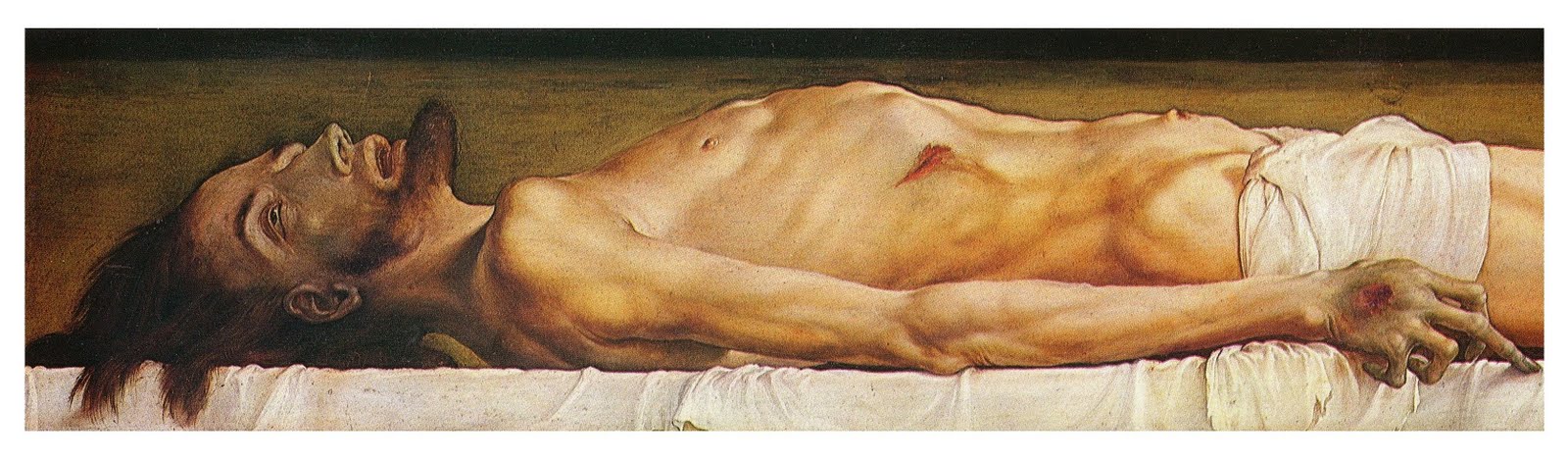
Saturday, April 7, 2012

The Problem of Sin, and Its Answer: Good Friday, Holy Saturday and ...

I don't know about you, but I grow weary of sin; I (we) face an ongoing battle every breath that we take. Whether it be perverse thoughts, dark deep secrets that plague the conscience, actions that result in destruction for you and all those related to you, systemic evil that permeates the very fabric of society (this is probably most insidious since we are conditioned by it in ways that give it a normalcy and thus societal and then personal acceptance); the Apostle can relate,

23But I see another law in my members, warring against the law of my mind, and bringing me into captivity to the law of sin which is in my members. 24O wretched man that I am! who shall deliver me from the body of this death? Romans 7:23, 24


 We battle on. But how do we know what we battle; how do we gauge the target, how do we even know that there is a target to hit? How do we realize that evil isn't some just mysterious lurking principle 'out there' that ultimately is outside of me, and not something that actually implicates my very being to its deepest depths---even when I engage in the evil 'out there' occasionally or situationally? How do I know, even if I can index concrete and ongoing instantiations of evil 'out there, that the evil is indeed me? And that this all encompassing wickedness and deprivation consumes my inner self, which organically shapes my outer self---since really ourselves (body/soul) are integrated wholes. In other words, I am sin to the depths, and the reason there is sin, evil, wickedness 'out there'; it is mostly because it has a context 'in here', in me. But how can I say such things, how can I ground such assertions beyond some sort of psychological intuition? We know that we are blind when the impression of light intensifies our darkness; when Jesus acts the way he does, and did, we know we are indeed blind. We come to the realization that for all our good, for all our posturing toward ourselves; that the next to the last word is that we live in a state of No, or blindness to the fact that what we see the Apostle Paul giving voice to can only come when faced with the depth of our problem as we participate in the life of Christ. The One who took our No, our blindness, and indeed our sin unto himself 'by becoming sin for us that we might become the righteousness of God in him' (II Cor. 5:21). As Calvin so perceptively knew, we only truly have knowledge of ourselves (and our abysmal state), when we first have knowledge of God through Christ, God the Redeemer.

It is this that John Webster masterfully elucidates as he engages Karl Barth's vision of a christologically conditioned knowledge of sin in its most depth dimension. Let me quote Webster, who is commenting on Barth's Church Dogmatics & Ethics, and the moral anthropology embedded therein:

[B]arth's Christological determination of sin is not so much an attempt to dislocate 'theological' from 'empirical' reality, as an argument born of a sense that human persons are characteristically self-deceived. Human life is a sphere in which fantasy operates, in which human persons are not able to see themselves as they truly are. The 'man of sin'

thinks he sits on a high throne, but in reality he sits only on a child's stool, cracking his little whip, pointing with frightful seriousness his little finger, while all the time nothing happens that really matters. He can only play the judge. He is only a dilettante, a blunderer, in his attempt to distinguish between good and evil, right and wrong, acting as though he really had the capacity to do it. He can only pretend to himself and others that he has the capacity and that there is any real significance in his judging. (CD IV/1, p. 446.)

This theme of concealment surfaces frequently in paragraph 60 (and elsewhere). Believing ourselves to see clearly, even allowing ourselves to suppose our sight to be sharper than that of our fellows, we are blind to the reality of our own selves. Barth acutely perceives that moral earnestness frequently rests upon clouded vision and lack of self-awareness and self-distrust. And so, once again, we return to the Christological basis for the treatment of human sin: 'Compared with Him we stand there in all our corruption ... The untruth in which we are men is disclosed ... We are forced to see and know ourselves in the loathsomeness in which we find ourselves exposed and known.'

Human sinfulness, then, entails an ability to disentangle ourselves from our acts in such a way that they are no longer really ours. As Barth puts it in a passage in Church Dogmatics IV/2, we allow ourselves to believe that:

The sinful act is regrettable but external, incidental and isolated failure and defect; a misfortune, comparable to one of the passing sicknesses in which a healthy organism remains healthy and to which it shows itself to be more than equal. On this view, the individual --- I myself --- cannot really be affected by the evil action. I do not have any direct part in its loathsome and offensive character. In the last resort it has taken place in my absence. I myself am elsewhere and aloof from it. And from this neutral place which is my real home, I can survey and evaluate the evil that has happened to me in its involvement with other less evil and perhaps even good motives and elements; in its not absolutely harmful but to some extent positive effects; in its relationship to my other much less doubtful and perhaps even praiseworthy achievements; and especially in my relationship to what I see other men do or not do (a comparison in which I may not come out too badly); in short, in a relativity in which I am not really affected at bottom. I may acknowledge and regret that I have sinned, but I do not need to confess that I am a sinner.  (CD IV/2, p. 394)

These clarifications of the forms of human self-deception (which are by no means intended to underrate the ambiguity of the moral situation) are an important background to Barth's treatment of original sin. His objection to some formulations of that doctrine is, at heart, that they are deficient in their account of positive evil. And his refusal of an independent locus peccati, his rejection of anything other than a Christologically determined account of sin, is directed by precisely the same concern. Far from averting attention from evil as fact, Christology is intended to furnish a means of clarifying our vision and dissolving our illusions about our own moral integrity. [John Webster, Barth's Moral Theology: Human Action in Barth's Thought, 69-70.]

The Apostle Paul concurs with this kind of assessment about the deleterious effects of sin upon a life that knows that it only knows its true state of affairs because of the One who finally has given the last word  to our No-being by his Yes to the Father for us---viz. a Yes that is given concrete form through his death, burial, and most importantly resurrection-ascension. The Apostle Paul, with his eyes wide open, as we noted earlier, gives a final sigh of relief when he writes:

 25I thank God through Jesus Christ our Lord. So then with the mind I myself serve the law of God; but with the flesh the law of sin. Romans 7:25

The Apostle knew, that he knew sin, not ultimately because of the Law; but ultimately, because of Christ who penetrated deeper than the Law could on its own---viz. into the cavernous depths of the human soul which left to itself continues to look at evil and wickedness as if its 'out there', while all along failing to realize that they've never even seen sin and evil and wickedness in its most grotesque form; that's because they've never presumed that maybe, just maybe the most insidious form of evil, in the end, dwells where they can't peer, where they dare not, in themselves.

Friday, April 6, 2012

Why Charles Spurgeon is Wrong: On the Atonement and God

I just read this over at the Pyromaniacs, from Phil Johnson's weekly practice of posting quotes from his teacher, Charles Spurgeon. There are some things that Spurgeon writes and preaches that are edifying, but I am afraid the following will be representative of something that might only be half-baked; or maybe not baked at all. The concern I have with the following quote is the concept of God that must be present in order for Spurgeon to write what he does; let's take a look at that right now, and then pick it up afterward with a brief comment:

[O]h! my hearers, if you are trusting in the unconditional mercy of God, you are trusting in a myth. Has someone buoyed you up with the thought of the infinite goodness of God, I would remind you of his infinite holiness. Hath he not declared that he will by no means spare the guilty? No debt due to God is remitted unless it be paid. It must either be paid by the transgressor in the infinite, miseries of hell, or else it must be paid for him by a substitute. There must be a price for the ransom, and evidently, according to the text, that price must be a soul, a life. Christ did not give his body merely, nor his stainless character, nor merely his labors and sufferings, but he gave his soul, his life, a ransom. Oh! sinner, Almighty God will never be satisfied with anything less than thy soul.

"... Has someone buoyed you up with the thought of the infinite goodness of God, I would remind you of his infinite holiness. . . ." 

Here is a classic example of how a classic usage of Divine Simplicity can run awry; wherein the modes of God's attributes are played off against each other as if there is a schism in God's actions towards his creation (and I think without proper nuance thus implicating God's being ... even though Divine Simplicity is intended to thwart my concern). Anyway, unlike Spurgeon's usage of this, I think a proper Christian Trinitarian construing of God's life is one that grounds all of God's activity from his interpenetrating life of self-giveness one for the other (the Father, Son and Holy Spirit all living in koinonial 'fellowship' one with the other ... it is this kind of life that shapes His holiness [or which is His holiness], His justice, His mercy, His creating etc.). If this is the case we never concluded what Spurgeon has about God's holiness somehow working against or trumping God's goodness; these aren't competing realities. God's life is loving grace to begin with; everything else is butter after that! Meaning, God's wrath and justice must be understood to only come within his very life; which again is love, full of grace and truth. Spurgeon is wrong on this point.

"...  No debt due to God is remitted unless it be paid. It must either be paid by the transgressor in the infinite, miseries of hell, or else it must be paid for him by a substitute. There must be a price for the ransom, and evidently, according to the text, that price must be a soul, a life. . . ."


Here we have, even for the Baptist, Spurgeon, the lingering effects of Covenant Theology; such that (to be crude), the atonement is framed in a purely forensic and monetary mode. So that Jesus in the Incarnation and Atonement becomes nothing more than the instrument or Divine debit card by which God purchases the elect for himself; allowing him at that point (once the demands and the conditions of the Law have been met) to love his brand new people, but not until these conditions have been met. Jesus then becomes subordinated and abstracted from God's life, placing a rupture between God in eternity and Jesus in creation-time; Jesus becomes who he is dictated to become by creation itself.

I could say more, but on this Good Friday, it grieves me to think that folk accept what Spurgeon (and others like him) has to say about such things uncritically. I think this could be devastating to the Christian's daily walk and spirituality 'in Christ'.