Showing posts with label Christology. Show all posts

Thursday, July 12, 2012

You Can't Have Jesus Without Faith

You can't simply do historical analysis of the New Testament and expect to come to right conclusions about Jesus. And yet this is where so much of 'Evangelical' scholarship (and Christian scholarship in general) resides. You can't use analogies that start with yourself and work your way to Jesus from there, and expect to find the genuine Jesus; you'll just end up finding the Jesus who looks oh so much like yourself--the Jesus molded in your own image. So the irony of what I just asserted is that I am saying that you can't 'solely' rely on historical Jesus studies and expect to find the true Jesus, and at the same time I am asserting that we must avoid somehow importing our own historical culturally situadedness back onto the face of Jesus. So what's the answer to this dilemma? What get's us beyond this impasse of dualism between studying Jesus through historical empericism and isolated subjectivism? I mean isn't Christianity a religion based in history? Yes. But history by itself does not have the proper traction or orientation to provide humanity--embedded within history--with the proper epistemological antennae needed to penetrate the depths which gives history its right relation to the one who gave us history to begin with. Am I speaking too cryptically for you yet?

Here Thomas Torrance speaks somewhat less cryptically about how we ought to dogmatically consider the relation between history and revelation through the optic of Faith:

All this means that any christological approach that starts from the man Jesus, from the historical Jesus, and tries to pass over to God, and so to link human nature to God, is utterly impossible. In fact it is essentially a wrong act: for it runs directly counter to God's act of grace which has joined God to humanity in Christ. All Attempts to understand Jesus Christ by starting off with the historical Jesus utterly fail; they are unable to pass over from man to God and moreover to pass man to God in such a way as not to leave man behind all together, and in so doing they deny the humanity of Jesus. Thus though Ebionite christologies all seek to go from the historical Jesus to God, they can make that movement only by denying the humanity of Jesus, that is by cutting off their starting point, and so they reveal themselves as illusion, and the possibility of going from man to God is revealed as likewise illusory.

No, it is quite clear that unless we are to falsify the facts from the very start, we must face with utter and candid honesty the New Testament presentation of Christ to us, not as a purely historical figure, nor as a purely transcendental theophany, but as God and man. Only if we start from that duality in which God himself has already joined God and man, can we think God and humanity together, can we pass from man to God and from God to man, and all the time be strictly scientific in allowing ourselves to be determined by the nature of the object. [Thomas F. Torrance, Incarnation, edited by Robert Walker, 10]

So Torrance's premise is that what has happened in the incarnation is totally unique, and has only been made accessible through the purview of faith. Not blind faith, but faith that takes it shape as it is given to us through the revelation of God himself in and through the vicarious humanity of Christ for us; the humanity that grounds all of humanity as the image of God (Colossians 1:15)--so faith is the eyes to see and the ears to hear with that Jesus so often challenges his audiences to employ.

What does this tell us about historical Jesus studies that seek to tell us the truth about Jesus, but then fail to do so through the mode of faith? It tells me that these approaches are trying to find a public square, a common ground through which to substantiate and situate Jesus in such a way that he has respectability amongst the world. Once this respectability has been established, and Jesus rightly reconstructed, then we can attend to the issues of faith (so there is an implicit competition, then, in this scenario, between the Jesus of Faith and History). To be clear, none of this is to reject the usage of historical tools, but it is to call attention to the need that these tools have; the need is to provide for them a prior Christian dogmatic order that will allow those tools to not chisel a Jesus into something he is not (e.g. first a man, then God added on). He is God first, who becomes man; and this is such a unique event that it in itself can only be its own analogy.

There is more to say about the TF Torrance quote above; especially about the affirmation of creation and humanity that is provided for it through the incarnation of Christ. Maybe another time, or in the comments. 

Tuesday, July 10, 2012

The Jesus of History & Faith, Conjoined

I wanted to address something that dovetails with a recent mini-essay that Darren Sumner wrote on Karl Barth's understanding of history and revelation. What I want to do is provide a counter-part post that underscores and articulates Thomas F. Torrance's view on the same subject. If you read Darren's post alongside this post; what you'll notice is that both Torrance and Barth share a very similar understanding on the relationship between how revelation and history work together, and how the former ultimately must be said to condition the latter; and not vice versa. Here is TF Torrance, at length (I will highlight the significance of this relative to the normal ways that Evangelicals and some of the Reformed use history as the foundation for their view of revelation---which is really backwards from a genuinely Christian order of things):

The mystery of Christ is presented to us within history --- that historical involvement is not an accidental characteristic of the mystery but essential to it. That is the problem.
Let us first put it this way, recalling the bi-polarity of our theological knowledge. If God has become man in the historical Jesus, that is an historical event that comes under our historical examination so far as the humanity of Jesus is concerned, but the fact that God became man is an event that cannot be appreciated by ordinary historical science, for here we are concerned with more than simply an historical event, namely, with the act of the eternal God. So far as this event is a fact of nature it can be observed, and so far as it is historical in the sense that other natural events are historical, it can be appreciated as such; but the essential becoming behind it cannot be directly perceived except by an act of perception appropriate to the eternal event. That act of perception appropriate to an eternal act, or divine act, would surely be the pure vision of God, which we do not have in history. Here on earth and in time we do not see directly, face to face, but see only in part, as through a glass enigmatically, in a mystery. We see the eternal or divine act within history, within our fallen world where historical observation is essential. Faith would be better described then as the kind of perception appropriate to perceiving a divine act in history, an eternal act in time. So that faith is appropriate both to the true perception of historical facts, and also to the true perception of God's action in history. Nor is it the way we are given within history to perceive God's acts in history, and that means that faith is the obedience of our minds to the mystery of Christ, who is God and man in the historical Jesus. What is clearly of paramount importance here is the holding together of the historical and the theological in our relation to Christ.

If the two are not held together, we have broken up the given unity in Christ into the historical on the one hand, and the theological on the other, refracting it into elements which we can no longer put together again. We then find that we cannot start from the historical and move to the theological, or from the theological and move to the historical without distortion, and nor can we rediscover the original unity. We can only start from the given, where the historical and the theological are in indissoluble union in Christ. [Thomas F. Torrance, Incarnation, 6-7]

So there is no analogy for the incarnation. And for Torrance, the incarnation must be the definitive touchstone for how we start to conceive of a knowledge of God (the Old Testament then is seen as the pre-incarnation of God in Christ); and since there is not human analogy for this reality to be found in the history of history (i.e. God and humanity united in a single person), the only 'foundation' that can be used to justify our belief about God must be given its shape and reality through the given reality of the incarnate Christ---which means, faith.

This means that we cannot start with an abstracted history (like a naked evidentialism) and seek to attach this to the history of Jesus, but the history we have, in itself, of Christ's revelation is the given reality itself; there is nothing else that can be determinate of that, other than the truly and self-determinately free God himself.

*A repost for those who may have not read this, I once posted this not too long ago at my EC (Wordpress) blog.

Sunday, July 8, 2012

Too Much Jesus in the Bible?

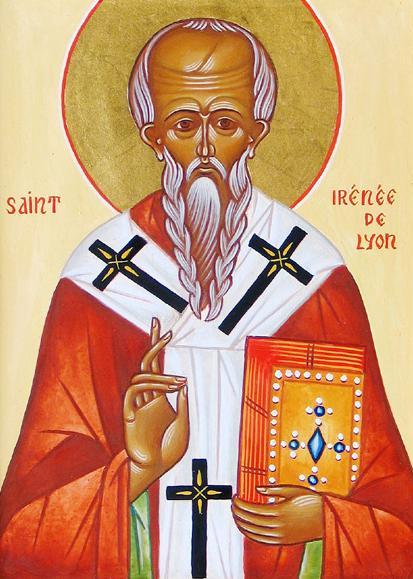
I would like to expose you all to Thomas Torrance's take on Irenaeus' understanding on what could be called a Christocentric Hermeneutic. As you read Torrance's account of Irenaeus, understand that you are reading Torrance too. Here is Torrance on Irenaeus:

It is, then, to the Incarnation that Irenaeus turns for the clue to the interpretation of the history of creation and redemption and therefore for the clue to the interpretation of the Scriptures. The essential order and connection of things is embodied in Jesus Christ and it is by reference to him that the economic ministrations of God in humanity and the historical covenants are to be understood aright, and therefore the interconnection between the scriptures of the prophets and the scriptures of the Apostles, 'the Gospel and the Apostles. Even the Scriptures of the old covenant have to be read in the light of Christ's advent in the flesh, for his coming connected the end with the beginning and made the beginning predictive of the end, thus showing that the faith of the patriarchs and prophets and ours is one and the same. They sowed the seed, the word about Christ (sermonem de Christo), but it is in us that the fruit is reaped and received, and only in the Church is the truth of the things prefigured realised. 'Certain facts had to be announced beforehand by the fathers in a paternal manner, (paternaliter), and others prefigured by the prophets in a legal manner (legaliter), but others delineated according to the pattern of Christ (deformari secundum formationem Christi) by those who perceived the adoption, for in one God are all things shown forth.' [Thomas F. Torrance, Divine Meaning, 122-23]

How does this strike you? Do you think this is too intense for a hermeneutic or mode for interpreting Scripture? Is your method of biblical interpretation this intensively Christ focused? I am really curious how you all think of this; I obviously highly appreciate this kind of 'Patristic' method of interpreting and reinterpreting (the OT) Scripture in light of  its fulfillment in Christ. This rubs against the method of interpretation I learned (by and large) in Bible College and Seminary; which is the Literal Grammatical Historical method (the kind that leads to and from Dispensationalism).

Saturday, July 7, 2012

Knowledge of God for Thomas Torrance

Here is a video I did about 2 years ago (forgive my haircut, this is actually just after I finished my chemo treatments, so my hair is growing back :-). Anyway, I am interacting with Paul Molnar's book Thomas F. Torrance: The Trinitarian Theologian. I think the material covered in this video is apropos towards providing more insight into some of the issues that seem to be arising for Roger Olson as he interacts with our book. Furthermore, the material covered in this video is what I develop further in my personal chapter in our book.


So knowledge of God can only come through knowledge of God as it is Self-revealed and determined to be in Jesus Christ (cf. Jn. 1:18). Knowledge of God can only be regulated by his own Self-revelation, and thus other modes for providing grammar and content for knowledge of God cannot be entertained (such as using philosophical categories like appealing to Aristotle etc. appeal to).

Sunday, June 3, 2012

The Centrality of The Vicarious Humanity of Christ for EC

Here is a repost that some of you may have not ever read, so thus the repost. It touches upon the centrality that the vicarious humanity of Christ has within the theology offered from the mood of Evangelical Calvinism. You will notice a polemical bite towards the end of the post, as I contrast EC with what I usually call classic Calvinism (I do this intentionally as a riff on this version of Calvinism's dependence upon 'classical theism' in general). Don't stumble unnecessarily over the polemical bite; the bite simply is taking notice of the fact that there truly is a real and material difference between EC and classic Calvinism. And the vicarious humanity of Christ is a pivotal point of departure between the two, and its implications for soteriology as it is framed from a christologically conditioned notion of our triune God. Here is the post.

Here is a great summary of how Thomas Torrance understood the biblical realities of:justification, reconciliation, and redemption. This summary is provided by Robert Walker, TFT's nephew and editor of Torrance's book Atonement. Of note is thevicarious nature of all three concepts, all grounded in Jesus Christ as our priest and mediator:
(ii) Justification, reconciliation and redemption are the act of God and man in Christ
Again throughout his theology, Torrance emphasises that in Jesus Christ we have the act of God and of man, of God as man in his one person. Justification, reconciliation and redemption therefore must be thought of not simply as the act of God for our salvation, but also as the real act of man, of God as man for us. the importance of this for Torrance's theology and for understanding it cannot be overstated. Justification is not simply the act of God judging sin, atoning for it himself and declaring us righteous in his beloved Son, it is man saying amen to the righteous judgement of God and at the same time fulfilling all righteousness in his own perfect life and humanity. Reconciliation is thus not simply God reconciling the world to himself in Christ, but reconciliation worked out, achieved and realised by Christ as man within his own person, in his own mind, life, heart and soul. Redemption is the mighty act of God in which mankind is liberated from bondage and decay into the new creation through the resurrection of the man Jesus Christ from the dead in the fullness of physical existence. [T. F. Torrance, ed. Robert T. Walker, "Atonement," xlv]
This is the stuff (the guts) of Evangelical Calvinist thought on salvation. If you fail to grasp this, then you will fail to see how EC is indeed distinguishable from Classic Calvinism, in general; and most Christian soteriological understandings, in particular. Furthermore, if you fail to engage the material here, then at the same time, you'll also fail to realize 'how' Calvinist this actually is.

First, there is a grounding of all salvation in God's life alone, in Christ; thus the reason EC stresses the vicarious humanity of Christ for us. We press this, because if we don't, we leave open the possibility for man to have some objective part in salvation (i.e. cooperate with God kind of soteriology). If Christ truly assumed humanity --- and He did --- and if He truly is our priest and mediator --- and He is --- then He, as the firstfruits from the dead, accomplished every aspect of salvation (in Himself). He trusted the Father for us, He first loved the Father, that we might love Him; He repented in our stead, He resurrected that we might resurrect, etc. etc. How this is appropriated is through the Holy Spirit's creativity and otherness (who brings us into communion with the Father and the Son, just as sure as He is the bond of communion and union between the Son's divine and human natures) --- Myk Habets alerts us to the language of theosis and theopoieses in the theology of Torrance [fodder for another post] --- the Spirit provides the space (as He did in the Son) for humanity to 'respond' out of Christ's faith on our behalf.

Second, I say you'll realize how Calvinist this is because it places a genuine primacy on Christ's life. It places a supremacy on God's life as salvation and grace, as the origination of all that is. That without God's unilateral activity in salvation, there, indeed, is no salvation; after all, God's life is salvation. I say these markers are benchmarks of Calvinism because of Calvinism's goal, historically, to speak of salvation in terms that magnify Jesus alone. Now, just because all Calvinists would say these are the touchstones, does not mean all versions or instantiations of Calvinism reach these marks. My contention is that Federal/Classic Calvinism does not; and it is simply because Classic Calvinism has a flawed doctrine of God that does not allow fluid discussion about salvation, because it will not allow for a dynamic understanding of God's trinitarian and relational life.

Friday, June 1, 2012

Rational V. Rationalism in the Theology of Karl Barth

A friend, Travis McMaken a recent PhD grad from Princeton Theological Seminary offered this really great quote from Karl Barth on being rational V. rationalistic:

Karl Barth
All dogmatic formulations are rational, and every dogmatic procedure is rational to the degree that in it use is made of general concepts, i.e., of the human ratio. It can be called rationalistic, however, only when we can show that the use is not controlled by the question of dogma, i.e., by subordination to Scripture, but by something else, most probably by the principles of some philosophy. If it is clearly understood that dogmatics generally and necessarily involves rational formulation, a rational formulation which is, of course, related to a completed proof and which takes account of Scripture, then no objection can be taken to logical and grammatical formulae as such, for we fail to see why these should be especially suspect more than certain legal formulae. The only thing is that we must ask whether in a given case they are appropriate to the matter or not, which means, concretely, whether it is an arbitrary anticipation, simplification, or even complication . . . [of] what Holy Scripture tells us. [Karl Barth, Church Dogmatics 1.1, 296-7] [full post by Travis can be found here]

This is an important qualification brought to mind by Barth (thanks to Travis). I don't think this is probably a problem people often associate with me---that is being irrational (although my wife often thinks so ;-)---but I don't traffic in the kind of theological discourse (analytic theology) that is normally associated with being rational or rationalist; instead I follow a kind of theological method that is known as dialectic, where paradox is often celebrated as a virtue instead of a vice in theological thinking. And yet, it should be clear that I am not interested in irrational or non-realist types of theological thinking; instead I want to be very rational only because to be rational is to participate in a God of order and thoughtfulness. But that said, there is a difference between being rational (thoughtful and coherent in thought) V. rationalistic. Rationalism, as a thought-system, takes shape by grounding its method in philosophical abstraction instead of Christological particularity and concreteness. It is as Barth underscores above, a system of thought that does not situate itself, primarily within a properly oriented dogmatic schema; which is 'in Christ', in principle.

So I am really only interested in doing theology from a rational point of view, but not a rationalistic one. To me, this means, that everything becomes 'Christ-conditioned'; meaning that hermeneutics, a doctrine of God, a doctrine of Scripture, a doctrine of salvation, a doctrine of eschatology will all take shape with Christ as front-and-center.

Everyone say thank you to Travis for providing this quote for us ;-).

Saturday, May 26, 2012

Following Calvin and the "Five Points"

Calvinism is a variegated thing, but in its American instantiation, it has come to be most 'popularly' identifiable by its unbreakable relationship with that ubiquitous acronym, TULIP, or the Five points. Not just that, but there has always been a question related to how far Calvinists, today, proximate the actual teaching of their name-sake, John Calvin. Indeed, to the surprise of many an American Calvinist, there are many more layers and strands that make up Calvinism in general; indeed, one of those strands is what we are calling 'Evangelical Calvinism,' a strand that presses and develops one of Calvin's most endearing themes; his teaching on union with Christ, and double grace theology. Nevertheless, the Five points of Calvinism continue to retain the most glaring meaning for what it means to be a Calvinist; at least in America. Yet, as so many Calvinists want folk to know, the Five points ought not be understood as what it means to be Calvinist, in toto. Instead, as many a Calvinist are prone to press; they would rather be defined by what they call 'The Doctrines of Grace' shaped by God's unrelenting Sovereignty. It is this reality that is well articulated by Dewey Wallace:

The 'Young Calvin' painted by Theologian, Oliver Crisp
[T]he extent to which later Calvinists were faithful to Calvin has been a matter of considerable argument. Calvin wrote his theology in the context of the excitement of the striking insights of the early Reformation, and a later Reformed scholasticism developed that was methodologically at some remove from Calvin and sometimes less flexible in its formulations. Nonetheless, Reformed theology was a living tradition and not just the theology of Calvin, so that development, both as the unpacking of the implications of the early Reformed theologians, including Calvin, and as the need to adapt the Reformed outlook to new conditions and challenges, was inevitable. Thus Calvinism came to stand  for a position that emphasized the doctrinal points enshrined confessionally in the most international of the Reformed statements of faith, the Canons and Decrees of the Synod of Dort of 1618. And while the decrees of Dort as a definer of Calvinism can be exaggerated, insofar as there were many strands of Reformed theology, this doctrinal statement articulated what came to be known as the "five points" of Calvinism: unconditional election (predestination), total depravity, limited atonement, irresistible grace, and perseverance of the saints, that is the indefectibility of the elect---what some later Calvinists called "once saved, always saved." But these points were a kind of carapace surrounding and protecting the softer body of Reformed religiosity and teaching, which consisted of an overwhelming sense of divine sovereignty and of the pure gratuitousness of the saving grace of God, both of which were soteriological in focus. [Dewey D. Wallace, Jr., Shapers of English Calvinism 1660-1714: Variety, Persistence, and Transformation, (New York: Oxford University Press, 2011), 12-13]

As Dewey notes, for one thing, there are more strands that make up the Reformed Faith, and/or Calvinism, than many people think (which is where you can insert 'Evangelical Calvinism' or 'Scottish Theology'). But, it is also a reality (esp. in America), that "five point" Calvinism is the most dominate and recognizable and apparently self evident of the Calvinist expressions around today. Something that Dewey highlights, that I think is very significant, is taken up in his last clauses, when he writes; 'which consisted of an overwhelming sense of divine sovereignty and of the pure gratuitousness of the saving grace of God, both of which were soteriological in focus.' This is where the contours of Evangelical Calvinism (the kind we advocate in our book and here at the blog) touch in common with all the varied strands of the Calvinist tradition. Yet, as Evangelical Calvinists, we see God's sovereignty and saving grace shaped by who he is as Triune Love. We have a unique way of articulating and emphasizing this; such that God is seen in a very intimate personal way, wherein the decrees and any such talk are all reduced and collapsed into the person of Jesus Christ. This subtle, but profound difference in shaping the way we understand God's sovereignty and grace makes our approach primarily christological in focus V. the soteriological (that Dewey notes) focus of the "five point" variety of Calvinism.

Anyway, just trying to draw continued attention to how Evangelical Calvinism works a bit differently than its "five point" cousin. We take many of our cues from Calvin, just as much, if not more so than our "five point" brethren---of course this is a contentious assertion ;-).

Thursday, May 24, 2012

A Christ-Conditioned Interpretation of Scripture, As Literature

Of course in light of my last post; scripture is literature, and so I should be clear that I am not in anyway suggesting a rejection of that more than obvious reality. Instead, that there is an ontology of Scripture that flows from within a properly construed concept of God's triune life and Self-revelation of himself in Jesus Christ. It is this framework that ought to tense the way we approach scripture as the literature that it is, and appreciate that the singular meaning of scripture is centered in Jesus Christ and the God revealed in and through Jesus Christ (Triune). As Thomas Torrance has said, this is scriptures 'depth dimension', and one that framing and understanding scripture in the way that Ernst Käsemann cannot appreciate. Scripture is about Jesus, and I think it is about Jesus in an intensively, principial way; meaning that Jesus and God's Triune life is what holds all of scripture together. If this is the case, and I think it is, then this ought to impinge on the way we interpret scripture (as it did for Karl Barth for example in his Commentary on Romans). Here is how David Gibson describes Barth's approach to biblical interpretation, and in particular, his interpretation of Romans 9--11 as a case study:

Karl Barth
 A good example can be found in the way Barth approaches Romans 9–11. When his thesis of biblical text as witness to revelation is read in conjunction with his understanding of Jesus Christ as the object of that witness, and with his understanding of Jesus Christ as therefore the electing God and the elected man, then a particular set of theological lenses for reading Romans 9–11 come into view. Barth’s approach is well stated by Douglas Sharp:
[Barth's] exegesis [of Rom. 9--11] presupposes the identity of revelation/incarnation and election, and can be seen to consist in the interpretation of an objective reality (Israel and the Church) which he finds imaged in the text. The truly significant element of the exegesis is the fact that it is not so much the intepretation of biblical revelation as it is an interpretation of a medium which is itself an interpretation of revelation. This is to say that the exegesis of Romans 9–11 is an interpretation of an interpretation. Jesus Christ is the revelation, and Barth views the existence of the community as an interpretation of that revelation. Thus Barth interprets the community in its two forms in terms of the primary reality of Jesus Christ’s election.
This argument corresponds with what we discovered in reading Barth’s exegesis of Romans 9–11. The two forms of the community, Israel and the church, were read by Barth as witnesses to the two-fold determination of Jesus Christ for both judgment and mercy; here Christology intensively occupies the horizon of interpretation. We may recall how different this is to Calvin’s approach. Calvin’s covenant hermeneutic for Romans 9–11 (arguably the most salient feature of his exegesis) is influenced by Christology. But his hermeneutic is not christologically intensive, because he does not see Christology as the meaning of certain verses where Christ himself is not mentioned or as providing the typological structures for Israel and the church within the details of the text.

It is now clear that Barth’s reading of the Bible displays a heremeneutical paradigm that is created not just by Barth’s doctrine of election as it has emerged out of his reading of the Johannine Prologue, but just as closely by a tightly related set of well developed and consistently applied hermeneutical convictions that have operated at least as far back as CD I/2. As Barth comes to provide extended exegesis of biblical texts as part of his doctrine of election, his understanding of interpretive freedom and responsibility ensures that his exegesis of election will be carried out in a manner that may be described as intensively christocentric. This is because his account of the required subordination of the biblical interpreter to the witness of revelation is itself intensively christocentric. [David Gibson, Reading The Decree: Exegesis, Election, and Christology in Calvin and Barth, (London: T&T Clark, A Continuum imprint, 2009), 190-91]

I am actually not totally sure I am altogether comfortable with interpreting scripture the way Barth does, in toto, but I am quite close. I see all of the OT, for example, prefiguring the preincarnate Christ; and then the OT given it's proper orientation in its fulfillment in and through Jesus Christ's actual incarnation (and all the attendant realities associated with that). Nevertheless, in gist, I am heading more in the direction of Barth, than what Gibson describe's of Calvin's approach as soteriological-extensive (which we can get more into later); if possible, I might be somewhere in between Barth and Calvin. Which really, that's right about where T.F. Torrance was at.

PS. Just so you all know, if not apparent, I often work through my thinking right here at the blog, in the open. So, a post like this represents that mode of my blogging existence; I'm in process here.


Wednesday, May 23, 2012

Knowledge of God From John Knox through Thomas Torrance

I am on a bit of a posting blitz, but here is a post I wrote quite some time ago that I really like; enjoy:

In commenting on Evangelical Calvinist, John Knox’s understanding of God; Thomas Torrance offers a profound statement of what all of this entails:


Young, Thomas Torrance
[K]nowledge of the one and only God, as far as it is true knowledge, enshrines the mystery of God, and so is confessed and acknowledged as God eternal, infinite, immeasurable, incomprehensible, omniscient, invisible. This God whom we know cannot be fitted into our knowledge. God cannot be commanded by our reasons — cannot be comprehended by our minds. It is certainly to our minds that God reveals himself but only in such a way that he remains eternal, infinite, incomprehensible, etc. Knowledge of God cannot be put into precise words. God’s majesty defies definition or description — all theological language is apocalyptic in so far as it is genuine. That is true above all of the Trinity — knowledge of this God is infinitely open. Thus in faith the human reason is opened wide to the infinite and incomprehensible being and majesty of God as the Father, the Son and the Holy Spirit. [Thomas F. Torrance, Scottish Theology: From John Knox to John McLeod Campbell, (T&T Clark: Edinburgh, 1996), 6 -- A review copy provided graciously by T&T Clark]

You will quickly notice which direction Torrance believes knowledge of God comes from; not from our epistemological schemas, but from God to us through Christ and into the Triune life of God himself. This approach to knowing God runs against the construing God from thinking of him through his works in creation or something. Or trying to find analogies in creation, or in humanity that in latent ways allow us to think and speak about God. No! Knowledge of God for Torrance, and as he would contend, John Knox, is a gift from God in Christ for us through the Spirit. There is never one-to-one correspondence between our theological language and God’s being. Instead, theological language is something that is constantly given to us anew as God continues to break in on our world, on our conceptions; and re-orders and re-orientates our grammar in a way that puts to death anything we had conceived of prior to this encounter in Christ. He provides a ground for knowing him that is completely out of this world (but decidedly and concretely in this world); the God-Man. He presents us with concepts that breaks up and re-orders our imaginations in ways that place us upon the precipice of heaven’s throne; Ezekiel knows what I’m talking about.
Just a little reflection . . .

Saturday, May 12, 2012

My Conscience Won't Let Me: Still Amillennial

You know, I just put a post up that said I was reverting back to historic premil, post trib; but I simply cannot do that! I am amillennial in my eschatological perspective, through and through. Hermeneutically, theologically, christologically, etc.; I cannot countenance a premil perspective anymore. It would certainly make it easier for me if I was still a dispensational premil (pre-trib to boot), given the church circles I am in (Calvary Chapel which is staunchly dispy, premil, pretrib); but I simply, by conscience, cannot make this move. I am convinced for many many reasons that the amil hermeneutic (which it is, a hermeneutic that ultimately, I think, takes shape theo-logically from a properly construed christological understanding) is the most biblical! There are various ways to construe amillennialism (just like there are many variations amongst dispy premillers etc); I am most comfortable with the way that Richard Bauckham develops this in his books, The Theology of the Book of Revelation & The Climax of Prophecy. Let me close this with something I wrote years ago as a bit of a synopsis of amillennialism (monergism.com picked it up as their synopsis for their amil category):

Fall of Jerusalem, 70 AD
The Amillennialist affirms that the people of Israel have not been cast off or replaced, but rather, that the Gentiles have now been included among the Jews in God's Covenantal promises. In other words, not replacement but expansion. God's redemptive plan, as first promised to Abraham, was that "all nations" would be blessed through him. Israel is, and always has been, saved the same as any other nation: by the promises to the seed, Christ. Amillennialists, do not believe in a literal 1000 year reign of Christ on earth after His second coming. Rather, they affirm that when Christ returns, the resurrection of both the righteous and wicked will take place simultaneously (see John 5), followed by judgment and and the eternal state where heaven and earth merge and Christ reigns forever.

  1. It is highly Christocentric: it makes Christ the center of all the biblical covenants (even the “Land” covenant or Siniatic).
  2. It notes the universal scope of the Abrahamic Covenant (as key) to interpreting the rest of the biblical covenants.
  3. It sees salvation history oriented to a person (Christ), instead of a people (the nation of Israel).
  4. It emphasizes continuity between the “people of God” (Israel and the Church are one in Christ Eph. 2:11ff).
  5. It provides an ethic that is rooted in creation, and “re-creation” (continuity between God’s redemptive work now, carried over into the eternal state then).
  6. It emphasizes a trinitarian view of God as it elevates the “person”, Christ Jesus, the second person of the trinity as the point and mediator of all history.
  7. It flows from a hermeneutic that takes seriously the literary character of the Scriptures (esp. the book of Revelation).
I would probably revise a few things here, but I still think most of this is pretty accurate, for me. I am not saying that a historic premil wouldn't be able to affirm all of the above, but I just think the amil can affirm it with much more ease ;-).

Wednesday, May 9, 2012

Thinking Like a Christian: Obedience Unto Death

Here is Alan Torrance (nephew of Thomas Torrance and son of James Torrance) developing Barth's understanding, basically, of what Thomas Torrance has called Theological Science (which is developed further by Torrance in his so called 'epistemological inversion'); which has to do with how we know things or persons (in brief). Here is Alan Torrance:

[T]his requires a reassessment of the question of truthfulness such that it is conceived neither in terms of successful, objective reference projecting across the gulf between the human and the divine (i.e. in terms of a 'correspondence theory of truth'), nor in terms of internal consistency within a system of propositions or ideas (i.e. in terms of a 'coherence theory of truth'), but in terms of what is customarily assumed to be a quite foreign category, one that is subjective and ethical, namely obedience --- the obedience of thought and of mind. Theological truthfulness is a form of intellectual obedience before the Reality of God. Here, Barth comes close to interpreting truth in 'performative' terms. However, the truth-performance connection here is not bound up with any autonomous human performance, but with the divine speech-act performed in and through the ambiguous event of God's Self-veiling/unveiling in the human context. Truthfulness is ultimately to be found, therefore, in and through the divine event of Self-communication in the Church, where the obedience of the human hearer is included within the divine speech-act and where God is 'heard', and therefore conceived, in a creative divine act of the reconciliation of the human mind to himself. [Alan Torrance, Persons In Communion: Trinitarian Description And Human Participation, 14]

Obedience Unto Death
Once again, as I have frequently noted here, the engagement of the reality of God (coram Deo) cannot be detached from God's own Self-givenness in his Self-revelation in Jesus Christ. This calls for a certain posture and attitude toward the reality of God that is participatory, personal, and present in and from the life of God mediated to and for us in the humanity of Christ (I Timothy 2:5,6). The reality of God is outside of us, and comes apocalyptically to us in the person of Christ (along with the Holy Spirit). We only hear from God, moment by moment, through his Word for us; and this then becomes the 'place' wherein dogmatic knowledge and formulation comes to the fore. That is, through a loving intimate relationship with God in Christ by the Spirit. We are not Lord, he is; and this must shape the way we speak and act theologically. Here is how A. Torrance follows his development of Barth here, by quoting from Barth's Church Dogmatics:

... what is under debate in dogmatics is the Church's fundamental relation of obedience to its Lord in respect of its proclamation ... A dogmatics which it (the Church) might  not pursue, in whose enquiry it did not wholly participate as in the enquiry about its whole existence, a dogmatics which might let itself be crowded into the corner of religious intellectuals or the intellectually religious, could only be a poor, useless and tedious dogmatics which it would be better not to pursue at all. We pursue dogmatics because, unconstrained by the fact of the Bible, we cannot shake off the question of the obedience of Church proclamation. The question of its obedience includes that of its truth. But the question of its truth can be put only as the question of its obedience. As the question of its obedience it is the question of its dogma. [Karl Barth, CD 1.1, 274-5 cited by Alan Torrance, Persons In Communion: Trinitarian Description And Human Participation, 15]

Thomas Torrance calls this approach 'repentant thinking'; the point is that unlike most of propositionally-philosophically-analytically derived approaches to 'knowing' (and knowing God), this paradigm believes that Christian truth, in particular, only comes as we are conditioned and put 'under' and brought into the environs of truth as it is opened up in Jesus Christ. We don't first construct a matrix and then try to fit God into that matrix; instead we are the ones placed into the matrix of God in Jesus Christ. This requires, at least, an analogy of faith (V. an analogy of being), or analogy of relation; or as A. Torrance will develop in this book an 'analogy of communion'. So we obey because God first loved us that we might love him.

There are many contemporary applications of this for the American (Western) Evangelical church, but I will have to put this off for another time.

Tuesday, May 8, 2012

Reading Scripture is a truly Christian Event

I remember my undergrad days in Bible College; one of the perennial questions (at least during our pneumatology section/semester) was:  If indeed the non-Christian, un-regenerate person could access and interpret Scripture in a way that appreciates the point and depth of Scripture? Or, could they understand the primary signification that the Scripture's ontology rises from; viz. Jesus Christ.

Jesus Christ God's Son Savior
We had some profs who would argue that clearly there are non-Christian biblical students and exegetes who can offer exegetical insight into the text of Scripture. But to me, this was always skirting the question. The question isn't if the non-Christian can 'offer exegetical insight into the Text,' but if that same person can understand and 'know' what in fact is significant about Scripture's primary intention; i.e. to tell us about, and invite us into an intimate and ongoing-evergrowing relationship with God in Jesus Christ by the Holy Spirit.

So the question that I was usually interested in was on what has been called in the Christian Tradition, illumination. John Webster offers a good word of knowledge (for all my charismatic brothers and sisters ;-) on this:

[C]orresponding to the perfect and wholly sufficient work of the Son in the redemption of fallen creatures, there is a further mission of God in their regeneration and restoration to intelligent, consensual, affective and active fellowship with God. This is the mission of the Holy Spirit, by whose grace it comes about that there is a company of creatures in whom redemption is brought to full realisation in the renewal of creaturely nature. The Spirit ‘perfects’ the work of the Son by bringing his work to its creaturely term, manifesting its virtue, distributing its benefits, and establishing a creaturely subject to receive, know and act out of its grace. The renewal of creaturely nature includes renewal in the knowledge of God, for the Spirit is ‘the spirit of wisdom and of revelation’ (Eph 1.17). This work of the Spirit is the environment for a theology of revelation, and therefore of Holy Scripture as its prophetic and apostolic form, and therefore of the illumination of the regenerate mind for the reading of Scripture. The Spirit is given that, having the eyes of their hearts enlightened, the saints may know. [John Webster, Journal of Reformed Theology 5 (2011) 325-340, Illumination, p. 328-29

Webster, would answer, in a dogmatically nuance way---answer my question---that it is not the prerogative of the non-Christian to 'know' what Scripture is about, because Scripture is about Jesus Christ. And if the non-Christian by definition (Rom. 8.11) does not have the Spirit of God in Christ; then they, like the Pharisees (Jn. 5) can get at the 'letter' of the Scripture. But they certainly cannot get at the 'Spirit' of the Scripture, sense the Spirit is absent; de facto Christ is absent (for them), because Christ did not come without the Spirit, but with the Spirit full of grace and truth.

The conclusion is that the non-Christian cannot truly engage in biblical hermeneutics, given Scripture's ontology and situadedness from the Spirit's breath, and the Son's humanity; both of these realities being absent, by definition in the non-Christian's life. Clearly the non-Christian exegete can do lexical and syntactical analyses of the Sciptures, etc. But, again, given the dogmatic ordering of things (and Scriptures placement within that through the analogy of faith etc.); they cannot do Christian hermeneutics which flows from the Spirit's authorship of Scripture (through the humanity of Christ and the sending of the Prophets and Apostles), and the corresponding authorship of human salvation in and through Christ. The one correlates to the other; in short, if you don't know the author's intent, then you can't truly appreciate what the author intended and meant (means). Reading the Bible is a truly Christian event. 

Sunday, May 6, 2012

Tom McCall and the Need for Scholasticism in Trinitarian Theology

I am just starting to read Tom McCall's book, Which Trinity? Whose Monotheism?: Philosophical and Systematic Theologians on the Metaphysics of Trinitarian Theology. McCall is associate professor of biblical and systematic theology at TEDS (Trinity Evangelical Divinity School), in Chicago. I am friends with McCall on Facebook; so I offer this initial impression to the introduction to his book as a friend :-).

McCall opens his book on the Trinity, as any good analytic theologian might do; by setting up the dialogical landscape (or lack thereof) that has inhered (or not) between constructive/dialectic theologians (which is where I am coming from), and McCall's camp, the analytic/philosophic theologians. He introduces his book this way to be clear about one of his intentions for writing this book, and for writing it in the way he does; one of the reasons he is writing this book is to bridge the chasm that is in place between the constructive/dialectic theologian and the analytic. With this context understood, let me quote some of the sentiment that McCall thinks would be good for Systematic Theology in general (it is something that repels me, just to give you a heads up):

[...] The theologians need --- sometimes desperately need --- the kind of assistance that might be found in the analytic toolkit. The theologian R. R. Reno sees this clearly, and he sounds a clarion call for theologians to employ the conceptual tools offered by the analytic tradition. As he sees things, analytic methodology bears a close resemblance to scholasticism, and he thinks contemporary theology could use a good does of it. He says that although the "overwhelming majority of theologians today sift through Heideggar and his philosophical children and grandchildren to try and find useable material," this impulse is fundamentally "misguided." Reno concludes that analytic philosophy might be an important ally for theology, and this is "because analytic philosophy is unequivocally and fundamentally a force for the strengthening of truth, not its weakening. [emphasis mine] [Thomas H. McCall, Which Trinity? Whose Monotheism?, 4-5]

Without wanting to be too foreboding, and wanting to give McCall a fair reading; let me just assert up front that exactly what contemporary theology does not need is a good dose of scholasticism! If what Tom means by this is that contemporary theology needs to constructively retrieve the substance metaphysics that classical theism hath bequeathed to us in Christian Theology through the seminal kind of work in this direction provided by the Thomist synthesis with Aristotelian categories and Christian Theology; then I object! I think this is what Reno means, and thus what McCall thinks is clarion.

What we need is an onto-relational metaphysic (or some such nomenclature) that emphasizes a Trinitarian theology that is given shape by an understanding of a personal God who has his being as a Subject-in-Being distinctiveness. In other words, we don't need to work from philosophical categories, like substance metaphysics offers up, that primarily think of God through monadic (unitary) categories. It is this ground that Federal Calvinism (amongst other developments within the Christian theological tradition) has developed; which has given us a God who must relate to his creation through impersonal decrees and Law-like precision.

So, four and five pages in; I object, Tom McCall! We'll see where you lead me ...

A Clarification: Christ Centered Exposition

Let me make this clarification in regard to my last post.

When I speak of interpreting Scripture christocentrically, in a Christ conditioned manner; by and large this has to do with a macro-hermeneutical level instead of a micro-exegetical level. Meaning that, for example, what I am calling for is a hermeneutic, in contrast to something like Dispensationalism or classic Covenantalism, that does not see the nation of Israel (Dispy) or the Church (simpliciter) as the key to understanding Scripture; but as theologian Kathryn Tanner has aptly entitled one of her books: Christ The Key. And this should have a drastic impact upon the way we think hermeneutically. I am not suggesting that we abandon our literary tools, grammatical and historical tools, etc.; but that the frame within which these tools are employed need to be cognizant of and take shape from the fact that Scripture is intentionally and self consciously given by the second person of the Trinity, Christ Jesus himself!

It is only from within this kind of interpretive framework that an orthodox understanding of various issues can be discerned (and I mean ethics, holiness, etc.). Only as relationship and encounter with God in Christ are seen as the ultimate ground and reality of all of Scripture's disclosure. I am not saying there is nothing to be applied to our personal lives, for example, from Scripture; to the contrary! I am suggesting that the only way we will have sound things to apply from Scripture is when we see our lives grounded from and within the Spirit anointed humanity of Jesus Christ. It is as we encounter and cultivate relationship with Christ through meeting him through the Spirit's witness in the Scripture that our lives will be transformed from glory to glory into the image of the Son; and it is this kind of recreated humanity wherein application of God's Word is living and active.

Hope that helps clarify a little further.

Saturday, May 5, 2012

Christ Centered Exposition Juxtaposed with Principle-Application Centered Exposition: My Response to my Pastor

My pastor, Daniel Gettemy, made these points and asked this question in response to this post:

[...] I think you're making a pretty clear case for how one's grasp/view of Inspiration (or lack thereof) is feeding their exegetical approach. What role do you think, if any, ones view of Pastoral responsibility plays in the development of a series such as "The Coming Financial Armageddon"? In other words, do you think that such an exegetical approach (as the two had above) develops primarily as a consequence of a low view of inspiration? Or, do you think there are multiple factors, such as one's view of the pulpit's place in congregational ministry that are at play as well? I see both in play - even in my own ministry. There's certainly a tension that exists that has to be managed. I'd love to hear your view on how the Primary can and should feed the secondary issues in exegesis and (even) pulpit ministry.

Thanks brother!
Daniel

The following is my response to his points and query.

I think that both John MacArthur and David Jeremiah both operate from a typical Evangelical concept of inspiration---which as a friend of mine has noted, usually mistakes inspiration for incarnation; meaning that the text of Scripture is mistakenly imbued with properties that solely should belong to Jesus Christ as God's own personal Self-revelation of himself to humanity, of which Scripture then is taken up into as his Spirit breathed act of bearing witness to his own inerrant Word (so to speak), in Christ. So in other words, revelation becomes depersonalized (in the MacArthurite/Jeremiahite construal); and it is reduced to a set of impersonal logically deduced (postivistic) propositions which we squeeze axioms and principles from as a road-map for our daily lives (so the Bible becomes an answer book like the Reader's Digest or something, or a how to book for "Dummies"). This is a hang-over from the rationalist Fundamentalist hermeneutics that folks like MacArthur, Jeremiah, and almost all Evangelicals have inherited from this bygone era in our relatively recent past (e.g. the Fundamentalist reaction to the so called 'Liberalism' and higher criticism that penetrated American Christianity at the turn of the 19th and 20th centuries). This in a nutshell serves as the backdrop to MacArthur's and Jeremiah's interpretive moves today.

So I think, in response to your question, that their hermeneutics have resulted from a defective view of inspiration or a bibliology or doctrine of Scripture that is built upon a rationalist/reactionary edifice that reduces and depersonalizes revelation to propositions instead of the person, Jesus Christ. Which explains quite a bit, relative to the way that both MacArthur and Jeremiah have proceeded in their "exegesis" of the text. They both presume that Scripture is our source-bed for providing a set of values and propositions that needs to be discerned (e.g. exegesis), principalized, and then given up for application for their listener's lives.

So the only solution, that I see, is to abandoned the defective edifice upon which Evangelical's understandings on a doctrine of Scripture (and thus hermeneutics) is built; and re-orientate oneself in a way that sees Scripture within the personal triune speech act of God to us, given to us through his Son, in and through the creative activity of the Holy Spirit. This way Scripture is no longer understood as a proposition book which humanity can master; but instead, Scripture is understood as the God ordained place wherein God in Christ by the Spirit contradicts and confronts our "human mastery" through direct encounter with him, in Christ (wherein Scripture finds its Spirit breathed voice through the resurrected humanity of Jesus Christ). This will set up a hermeneutical framework that methodologically seeks to lay bare the inner reality of Scripture, which finds its ground in Jesus Christ himself (in principle, quite intensively!). So the exegete and expositor won't be seeking to figure out how a particular text (like in the OT for example) is "relevant" or answers people's particular questions today. Instead, the exegete will trust that God alone knows all of our hearts, and his answer to our deepest longing is personal encounter with Him. That is what Scripture is for; to lead us to him in Christ. So when teaching an OT passage, for example (or even a NT one), the expositor will use a hermeneutical practice that exemplifies the kind that we see the NT authors using; it will interpret the OT promises in light of their fulfillment in Christ. For example, it will tie the suffering and rebellion we see happening over and again amongst God's people in the OT; into what Jesus elected for himself as he elected our humanity/reprobation for himself and gave us his elect status as our vicarious representative in his resurrected humanity (so the exegete would emphasize that God humbled himself, and in that humbling he exalted humanity in the resurrected humanity of Christ ... something like that).

So this requires a massive paradigm shift for the expositor's hermeneutical practice. It requires that the Pastor believe that God knew best when his prescription for humanities' daily longings and issues was who he revealed, himself, in Jesus Christ. It is this encounter alone that will set the captives free, and provide the deep kind of perspective and spirituality that God wants for all of his people (on a day to day basis)! MacArthur and Jeremiah (and any Evangelical pastor, in particular, that follows in their footsteps, methodologically) have missed the boat I have been describing. Does this help clarify?

Friday, May 4, 2012

The Vicarious Humanity of Christ for us in the Theology of John Calvin

John Calvin
I just finished reading a really provocative and intriguing essay by Ho-Jin Ahn in the Scottish Journal of Theology. In it he takes Oliver Crisp to task (at least at the ground clearing level) on Crisp's argument that Christ could not have assumed a fallen sinful humanity in the incarnation; since according to Crisp (and the scholastic [speculative] tradition from which he argues), if Christ truly took on a depraved humanity, then he would have needed a Savior himself. Ahn helpfully relocates Crisp's placement of this discussion from the Augustinian "original sin," and moves it into the realm of christology (which is where this dialogue ought to take place!). Ahn, in the process of relocating this discussion, develops John Calvin's understanding on this issue; Ahn looks, in a dialectical way, at Calvin's commentaries and his Institute. In a nutshell, what Ahn concludes is that Calvin might 'appear' to hold to something like Crisp (that Christ assumed an unfallen human nature), but in the final analysis, and at an interpretive/functional level, Calvin thinks from a view that sees Christ entering into the depths of our fallen humanity and redeeming us from the inside out through his vicarious humanity for us. Here is Ahn's conclusion:

[I]t is unreasonable for some theologians to argue for Christ’s unfallen humanity in the context of the doctrine of original sin because Christ himself overcame the power of sin and death in his fallen humanity. In the case of Calvin’s understanding of Christ’s humanity, we see that there is a tension between the nature and the state of Christ’s person. Calvin believes that Christ assumed our true humanity, lived a perfect life, and was sinless according to the Chalcedonian Definition. Thus, Calvin denies the fallenness of Christ’s humanity in order to preserve the doctrine of Christ’s perfect innocence. However, unlike others who are in favour of Christ’s unfallen humanity, Calvin forcefully affirms the vicarious humanity of Christ in our corrupted state. Calvin affirms that Christ had to suffer from our existential problems according to the narratives of the Gospels. Moreover, the mortal human nature which Christ assumed shows solidarity with sinners and the vicarious humanity of Christ pro nobis. If Calvin were to accept the idea of the fallen nature of Christ, his thoughts on Christ’s humanity for us would be more persuasive. Yet it is noted that Calvin’s theological logic is ‘anti-speculative’ in that he focuses on what Christ has done for us in his true humanity.

Nevertheless, Calvin argues that the body of Christ himself is the temple of God through which we can come to the throne of God’s grace. Although Christ assumed our mortal body controlled by the power of sin and death after the Fall, Christ sanctified the body in his own person as the Mediator between God and all the fallen humanity and decaying creation. Furthermore, the reconciliation with God is not just attributed to the crucifixion of Christ in an external and forensic way but to the perfectly holy life of Christ who assumed our mortal body as a saviour in an internal and ontological perspective. Calvin’ s biblical views on the mortal body and its sanctification through the whole life fully describes the paradoxical character of Christ’s mystical incarnation in which Christ became a true human being like one of us without becoming a fallen sinner. I conclude that, according to Calvin, the vicarious humanity of Christ means that for the sake of our salvation Christ assumed a mortal body like ours and lived a perfect life in our miserable state. Therefore, Christ’s fallen humanity for us is the guarantee of reconciliation. [Ho-Jin AhnSJT 65(2): 145–158 (2012) C Scottish Journal of Theology Ltd 2012 doi:10.1017/S0036930612000026, Ahn's bio/contact: Korean Central Presbyterian Church of Queens, Bayside, NY 11364, USA ho-jin.ahn@alum.ptsem.edu]

I concur with Ahn, and appreciate his insightful analysis on Calvin's view of the vicarious humanity of Christ. Ahn would make a great Evangelical Calvinist; since the vicarious humanity of Christ is one of the touchstones of what it means to work within the mood of Evangelical Calvinism. It is this kind of Christ conditioned view of salvation that gets us into the trinitarian depth dimension of salvation that the classic forensic-juridical view of salvation simply cannot provide. Calvin is front and center for us, and shines brightest right here; that is when he emphasises the center of salvation in Christ.

The reality is, as Ahn develops in his essay, as Gregory of Nazianzus is oft quoted 'the unredeemed is the unhealed'; and if Christ did not vicariously (participatorily-representatively) enter our fallen human state, then we are of all men most to be pitied. Alas, we remain in our sins, and we have no real hope or answer to our sin problem; which is a depraved heart toward God (who is salvation in his very life!). If Christ does not participate with us (fully), then we cannot participate with him fully in the divine plenitude of his shared life with the Father and Holy Spirit; in other words, we are not saved. This is why understanding and meditating on the vicarious humanity of Christ is so fundamental to the Christian's life and spirituality; because it represents the very heart and deep caverns of the Gospel itself.

PS. This is the doctrine, The Vicarious Humanity of Christ, I am slowly researching towards my PhD. If you would like to help provide funding for me towards the PhD, please contact me via email (growba@gmail.com). Blessings.


Wednesday, May 2, 2012

Getting Beyond Us-Them and the Bible

Something that would go a long way in allowing Christians to dialogue with each other instead of at each other is to come to terms on what Scripture actually is. As an Evangelical Christian (maybe you can relate), I have far too often been party to moments wherein a particular doctrinal topic is under consideration. Both sides, as Evangelical Christians, believe they have Scripture on their side; and thus each side appeals disparately to Scripture as their silver bullet (to win the argument, and substantiate their point). And yet, there is obviously a problem here; since both can provide apparent cogent and coherent intepretations of the same text which apparently favor their doctrinal point---then the question is: how do we adjudicate who is right and who is wrong? But, really, the question needs to step back further; we need to get to the first order issue prior to the second (which is where the debates and arguments and back-and-forths take place). The first order issue is to come to terms with what indeed Scripture is, and where it has its place relative to God and his communication to us through his Son by the Holy Spirit. While discerning this, at the same moment, we should realize that even articulating 'what' Scripture is and 'where' it is placed relative to God; won't end all debate (we'll just end up debating about Scripture's place). Nevertheless, this will help us to deal with deeper issues instead of secondary issues that at the end of the day have more to do with philosophy of history and literature rather than Jesus Christ. I understand that I am being rather oblique in this post (or vague), but I would like to continue to build on the trajectory that this post sets in the days and months to come. I was prompted to write this post because of John Webster; here's what I read, and here's what he wrote in this regard:

With respect to Scripture, for example, lack of clarity about the tasks of biblical interpretation (in which the tug-of-war between "historical" and "theological" interpretation is but one episode) is symptomatic of the absence of shared conceptions of the nature of Scripture and of the tasks which it undertakes in the divine economy. The absence of bibliology, and the widespread assumption that a doctrine of Scripture is exegetically and hermeneutically otiose, cannot be compensated for by further refinement of strategies of interpretation. We need to figure out what the text is in order to figure out what to do with it; and we determine what Scripture is by understanding its role in God's self-communication to creatures. John Webster, ATR/90:4, 734-35.

The short answer is that Scripture is about Jesus; it is from Jesus, given by Jesus, and takes us beyond itself to its reality in Jesus. This will reframe multiple things, like; 1) Ontology of Scripture, 2) Hermeneutics 3) Biblical Theological Grammar, 4) Usage of Scripture, 5) Christian Spirituality/Doxology, 6) etc. 

Tuesday, May 1, 2012

Speaking Biblically is Speaking Theologically

John Webster offers a very precise way to conceive of what 'Biblical Reasoning' is. He does so in a way that sees Scripture as the final point of authority and witness through which we encounter the living God in Christ by the Holy Spirit's inspiration of the text of Scripture. Here is what Webster writes:

Christian theology is biblical reasoning, in which human intelligence responds to the intelligible divine Word spoken through the prophets and apostles. This conception of theology rests upon an ontology and teleology of Scripture and reason, shaped by an understanding of their place in the divine economy in which God establishes fellowship with human creatures, including the rational fellowship of which Christian theology is an instance. The divine economy, grounded in God's immanent life, unfolds as a history in which human creatures are summoned to know and love God. This history is redemptive and revelatory. The revelation takes form in the embassy of the prophets and apostles, superintended by the Spirit. Reason, corrupted by sin, is renewed by divine grace and participates in redeemed existence. Christian theology is the redeemed intellect's apprehension of God's address through his scriptural ambassadors, and takes the form of exegetical and dogmatic reasoning. [John Webster, ATR/90:4, 733]

One of my concerns is that too many Evangelical (Fundyish type, Conservative) Christians presume that they don't talk or think theologically; instead they talk and think, Biblically. But this is to engage in a false dichotomy. The second anyone begins to engage Scripture through their voice; they have engaged Scripture theo-logically. In other words, even the finest exegetes in the world must engage Scripture, Theo-logically. That is, we can do all of our syntactical analyses, lexical analyses, narratival analyses, literary analyses, etc; but the moment we seek to provide a cogencey and coherency to the findings and implications of said analyses we are reflecting on God's Word, theo-logically. We are doing this, in part, because we have already been brought into a gracious relationship of communion with God through union with Christ. So he has already brought us into his divine-human life resulting in a capacity and desire (on our part) to articulate and seek to understand what it is that he has communicated to us through his given Word through Scripture for us.

In short: To speak Biblically, is to speak Theologically; this is an inescapable reality because the ontology (or being) of Scripture has its location in Christ---and to be 'in Christ' is under the subheading of christology, and we all know that christology is a Christian Dogmatic or Systematic Theological category; and it is only 'After christology' that we have the placement of Scripture, not before. In other words, a doctrine of Scripture is a highly charged theological category in and of itself; we cannot abstract that out of its proper theological placement if we are going to truly going to engage Scripture as it ought to be---that is, as a Theological communication of which we've been taken up into in and through Christ by the Holy Spirit.

Saturday, April 28, 2012

The Great Hijacking: Christ the Abstraction and Not The Center

The Westminster Confession of Faith in its first article (chapter II) on a doctrine of God starts with God, simpliciter. There is a long history of this method for thinking of God in the Christian Tradition. Peter Lombard in his Sentences employed this methodology for ordering his thinking about God; indeed, John Calvin himself---in his late Medieval situation---orders his Institute in similar fashion. I have heard it argued from folk who follow this classic methodology that this really isn't a stretch at all; in fact, this (they argue) is the order that God himself has provided in his own disclosure in Scripture (starting in Genesis through Revelation). Here is the Westminster Confession of Faith (WCF):

I. There is but one only, living, and true God, who is infinite in being and perfection, a most pure spirit, invisible, without body, parts, or passions; immutable, immense, eternal, incomprehensible, almighty, most wise, most holy, most free, most absolute; working all things according to the counsel of His own immutable and most righteous will, for His own glory; most loving, gracious, merciful, long-suffering, abundant in goodness and truth, forgiving iniquity, transgression, and sin; the rewarder of them that diligently seek Him; and withal, most just, and terrible in His judgments, hating all sin, and who will by no means clear the guilty. (see full citation, here)

It is not until article III of this same chapter that the WCF speaks of God as triune. And this is my short critique of this methodology; even if it had started with God as triune---which would have been laudable---where a doctrine of God ought to start---for the Christian---is with Christ. This is not to go outside of Scripture's order, but to follow it in the way that it re-interprets everything through its fulfillment in Christ. John 1:1 is a primary example of this kind of re-interpretation (or as one of my favorites, Irenaeus of Lyons, has named it, recapitulation); the theologian, The Apostle John Writes:

In the beginning was the Word, and the Word was with God, and the Word was God. John 1:1

This, as many commentators have noted throughout the history of biblical interpretation, is a Christian re-reading and direct allusion to Genesis 1:1 ('In the beginning God created the heavens and the earth'). And this helps illustrate what I am after relative to articulating a proper order to constructing a genuinely Christian theology. The WCF does not start with Christ. Indeed, it doesn't even start with God as Trinity; instead it appeals to classic Greek philosophical categories for its understanding of what God must be like. But this is not Christian; it does not honor the New Testament's mode of reinterpreting the Old Testament promises in light of their fulfillment in Jesus Christ. No, the WCF, and the whole classical theistic tradition (of which it is a part) can only, logically, think of Christ as an abstraction; as an addition to its concept of Godness; only to be spoken of later, like a dangling participle. So we end up, if we follow the WCF (and classical Christianity), with, at best, a theocentric ('god-centred') religion; but not a christocentric ('Christ-centred') belief structure, that is genuinely Christian. Donald Bloesch emphasizes the importance of following a Christ-centred methodology as the starting point for beginning our theological studies (even our Theology Proper/Doctrine of God):

[C]hristology constitutes the heart of theology, since it focuses on God's work of salvation in the historical figure Jesus of Nazareth and the bearing that this has on the history of humankind. To know the nature of God we must see his face in Jesus Christ. To know the plan of God for the world we must see this plan realized in the cross of Christ and fulfilled in his resurrection and second advent. Whereas philosophy ponders the nature of God in the abstract, theology reflects on the divine-human encounter in history as we find this in Jesus Christ. The way to knowledge of God is through knowledge of Christ, and the way to knowledge of Christ is by faith in his promises as revealed in the Bible. Donald G. Bloesch, "Jesus Christ: Lord & Savior," 16-7. 

This is quite radical! Being a Christian ought to be radical. So you have a choice; are you going to be a classical or radical Christian? The former means you will be entrenched in philosophical abstraction seeking a way to integrate Christianity into that mould; the latter means that you will start with Jesus Christ as God's Self-revelation, and it will be here that knowledge of God as triune will become the touchstone upon which a Christian theology can genuinely move forward as, Christian. 

I grow weary of the great hijacking of the Christian faith, and the implications this has for regular Christian folk who sit in the pew. To be sure, most Evangelicals in America aren't even getting theology or doctrine anymore; if they are though, it is steeped in the heritage that something like the WCF hath bequeathed upon us---viz. the god of the philosophers, not the God known to us in and through, Jesus Christ! What a tragedy  . . . 

Wednesday, April 25, 2012

A Reflection: On Suffering and the Cross

Life is really hard! We have been going through it lately; my cancer, unemployment, less than desirable employment ("but it's a job" kind of job), financial struggles, our daughter's recent accident and emergency brain surgery (and now really hard recovery; esp. mentally and emotionally for her, and us!). We all have trials and tribulations; in fact the New Testament is clear that this is our lot. Indeed it is the muck of this life that is 'working for us a far more exceeding eternal weight of glory'. And yet Jesus said, 'take heart, I have overcome this world!' So we try to take heart; not by might, nor by power, but by the Spirit!

So what's the meaning of all of this? Jesus wondered this in Gethsemane; he cried out for another way, but there was none. As participants in Christ, constantly being given over to his death that his life might be manifested in our mortal bodies, having the sentence of death written upon us that we might not trust in ourselves but in the One who raises the dead, experiencing the tribulation of Christ that we might experience his comfort so that we can comfort others with the same comfort we have been comforted with ourselves; these are some of the reasons, the blessings, the purposes and points of suffering now. Indeed, this is it! We are participants with Christ all the way down; in his death, and now, AMEN!, resurrection life. But we live in the in the between time; praise the LORD that in his wisdom, he has met us right where we are, in our suffering and despair. Martin Luther understood this; he understood that the place, the person where we know and meet God is in the midst of the cross of Christ. This is God's grace, wisdom, and love demonstrated; he has become sin that we might become the righteousness of God in him. He has penetrated the depths of our wounded and dead selves so that we might penetrate the wonders of his life giving throne of Grace; next to the Father. Luther understood that we can quit striving to have relationship with God through what man perceives as glory; that is through the praise of others. Luther understood that it's not the fancy ideas of men that get us into the heavenlies, but, indeed, it is the putting to death of humanities' ideas, and bringing humanity into HIS ideas, his life wherein we know God. We don't have to perform, or orchestrate anything for this to happen; we're born into the muck of sin and disorder. This is the grace of God in Christ; this is the wisdom of God in Christ! He has come to us, become us, and through adoption made us what he is by nature, by grace. It is when things 'look' the most sideways that we, by faith, look beyond and see the One who is right side up for us in the midst of trial and the dark nights of the soul. Here is what Randall Zachman has written on Luther's theology of the cross:


In the context of theologia crucis, faith means believing with certainty that God’s Word is true even when the whole world, the heart of the believer, and even God himself contradict the truth that is revealed in the Word, particularly the Word of promise. Thus, when God begins to show mercy, God does so by first revealing wrath (in law); when God makes alive, God does so by slaying. The same contradictions apply especially to those who have already come to faith. God promises the forgiveness of sins, yet our conscience feels nothing but sin and wrath; God promises life, yet we see nothing but death. Faith, therefore, is the art of believing the Word while experiencing, seeing, and feeling the opposite. We believe that Christ is the Son of God, even though we see and abandoned man on the cross; we believe that God cares for the church, even though we see nothing but a church persecuted by the world and apparently abandoned by God; we believe in eternal life, even though we see and feel nothing but death.

However, the primary locus of the theology of the cross is the experience of trial or tribulation (Anfechtung), when the very heart and conscience of the believer sense that God’s promise of grace and forgiveness is a lie. The believer must regard the promise of forgiveness as true and certain even though the conscience testifies to the contrary.
But under the cross which we experience, eternal life lies hidden. . . . We, too, experience the cross, and death appears to us, if not in fact, yet in our conscience through Satan. Death and sin appear, but I announce life and faith, but in hope. Therefore, if you want to be saved, you must battle against your feelings. Hope means to expect life in the midst of death, and righteousness in the midst of sins.
This is the very meaning of being simultaneously righteous and a sinner (simul iustus et peccator): to believe that we are righteous coram Deo even though we feel like condemned sinners.
Within the context of the theology of the cross, the grace of sanctification and its attestation in the testimony of a good conscience would necessarily be subordinated to the grace of justification and the promise of the forgiveness of sins. This is because the testimony of the good conscience confirms one’s faith in the promise, whereas the theology of the cross emphasizes that testimony of the conscience that contradicts faith in the promise; that is, Anfechtung. Therefore, although Luther continually insisted upon the necessity of sanctification and of the testimony of the good conscience, within the framework of theologia crucis he could not help but consistently subordinate the grace of sanctification to that of justification.

Luther’s concentration on the theology of the cross also accounts for his refusal to involve the Reformation directly in the external reform of the church. The Word of God does not deal with external, temporal things, but rather with invisible, eternal things; and such invisible things are revealed under an external appearance that contradicts what is being revealed. The theology of glory, in contrast—such as Luther found in the papacy—emphasizes externals to the point of neglecting the invisible truths revealed by the Word: indeed, to the point of calling God’s Word a lie. Thus, those in the Reformation who would introduce concern for externals—such as Karlstadt with his rejection of idols and the papal mass—misunderstanding the whole nature of the Word of the cross, and divert the attention of believers from the invisible, eternal things of God’s promises to the visible, temporal things of human reason and senses. Yet it is precisely reason and the senses that must be mortified if we are to believe that the Word of the cross is true.

Luther’s theologia crucis also explains his suspicion of those, such as the Anabaptists, who emphasized the external holiness and moral behavior of the church. If the Word of the cross reveals the truth of God under a contrary appearance, then one would expect the true church not to look like the church at all, but rather to look like God-forsaken sinners. The “synagogue of Satan,” on the other hand, with its theology glory, would look like the true church of God and would demonstrate a superior holiness externally—as in the monks and friars—but inwardly it would be rejected by God. The theology of the cross would therefore lead one not to stress the conformity of the appearance of the church with its faith, but rather stress the ways in which the appearance of the church denies its claim to be the people of God. The church looks like a gathering of sinners rejected by God and the world, whereas it is in truth the beloved people of God. The church cannot be judged by its appearance, but only by whether it has the Word of Christ crucified. Hence the primary task of the church is to preach the Word of God, while letting externals take their course. [Randall C. Zachman, The Assurance of Faith, 9-10]

There is a lot in what Zachman highlights in regards to Luther's theology of the cross (try to absorb it all at some point). But what I want to stay focused on is knowing God; seeing God in Christ, even when everything looks just the opposite! Isn't this how most of life looks? Just the opposite of what religion and even forms of Christianity tell us it should look like. We shouldn't be surprised at the fiery ordeal which comes upon us; for to us it has been granted on behalf of Christ, not only to believe in him, but to suffer for his sake. Unfortunately, it's when we are in the depths, that usually we are right where the LORD wants us; if only so that we will look at him, and ultimately look more like him as he transforms us from glory to glory. amen.