Showing posts with label Holiday. Show all posts

Sunday, April 22, 2012

Earth Day: 'Worshipping the Creation Rather than the Creator'

The problem with ‘Earth Week’ (or day), as it is ‘framed’ today, is basic; it is shaped and informed by an naturalist understanding of the universe (and thus earth). It is based upon assumptions that believe that all reality is reducible to material; here is a succinct summary of this perspective, provided by James Sire:
1. Matter exists eternally and is all there is. God does not exist.
As in theism and deism, the prime proposition concerns the nature of basic existence. In the former two the nature of God is the key factor. In naturalism it is the nature of the cosmos which is primary, for now, with an eternal creator-God out of the picture, the cosmos itself becomes eternal—-always there though not necessarily in its present form, in fact, certainly not in its present form. Carl Sagan, astrophysicist and popularizer of science, has said it as clearly as possible: “The Cosmos is all that is or ever was or ever will be.” (James W. Sire, “The Universe Next Door,” 54)

The consequence of living as if there is no God is to fill that void with [an]other god; that is, material “creation” itself becomes God, but not without us. In other words, man becomes the center of the universe, and the earth becomes his sustenance — ‘Mother Earth’. This way of thinking is not ‘new’, it is not progressive or ‘cutting-edge’; it is as old as the ‘Fall’ itself (see Gen. 3 and the ensuing story [the rest of the scriptures, esp. the OT]). In fact the LORD admonishes his people, contrary to the ‘natural way of thinking’, not to lift up ‘nature’ as if that is all there is; He says:
15“Therefore watch yourselves very carefully. Since you saw no form on the day that the LORD spoke to you at Horeb out of the midst of the fire, 16beware lest you act corruptly by making a carved image for yourselves, in the form of any figure, the likeness of male or female, 17the likeness of any animal that is on the earth, the likeness of any winged bird that flies in the air, 18the likeness of anything that creeps on the ground, the likeness of any fish that is in the water under the earth. 19And beware lest you raise your eyes to heaven, and when you see the sun and the moon and the stars, all the host of heaven, you be drawn away and bow down to them and serve them, things that the LORD your God has allotted to all the peoples under the whole heaven. 20But the LORD has taken you and brought you out of the iron furnace, out of Egypt, to be a people of his own inheritance, as you are this day. ~Deuteronomy 4:15-20
The negative of what Yahweh admonishes His people “not to do” (in the passage above) is the “natural orientation” of Fallen man. It is to worship the creation rather than the Creator (cf. Rom. 1); and this is what ‘Earth day (week, year)’ actually pivots upon.

Christians should not confuse stewardship of God’s creation with being ‘Green’. And really the only, and most basic reason for this, is what I have been trying to distinguish in my previous narrative; and that is, that ‘being Green’ is informed by an ‘worldview’ that is incompatible with the ‘Christian trinitarian’ perspective. The ‘Green’ approach “starts” out with the assumption that there is no God; the Christian, or what I like to call, ‘the Red’ approach, assumes just the opposite —- that there is a creator God, and He has revealed Himself to us in Christ.

In my view, it is irresponsible for Christians to take up the mantle of the ‘Green approach’, and assume that there is compatibility simply in the name of being ‘good stewards’. We need to be good ‘Stewards’ indeed, but in the name of Christ; and not simply by adopting the approach offered by the ‘unbelieving world’ (Christologically this is akin to the adoptionist heresy known as Ebionitism), and thus ‘Christianizing’ the pagan way of doing and thinking things.

**My next post will be on how to think about this stuff through the analogy of the incarnation (or Christologically); Colossians 1 is key for the Christian understanding at this juncture. If Christ is supreme over all creation, both as Creator and Redeemer, then as Christians it behooves us to think this issue out of that paradigm. Really this whole discussion orbits around that classic discussion between the relationship of nature and grace; the answer to that question must be centered in the life of Christ and how His hypostatic union (the relationship between his divine and human natures) should inform our approach to being stewards of this ‘creation’ or ‘recreation’ through Him. Instead of ‘Green’ I think Christians should call themselves ‘Red’, because without the shedding of God’s blood in Christ all we really have is ‘Black’ — which is what I think ‘Earth Day’ and its approach should really be called [not 'green']. Anyway, more to come.**

Sunday, April 8, 2012

Χριστος ανεστη! Resurrection and Ascension, Where Would We Be Without Him?

We just finished watching The Passion of the Christ, a very hard movie to watch! But, tonight it was fitting to watch a movie that sketched the last hours and Passion of our Lord and Savior Jesus Christ! Praise the LORD he did not stay dead, but He is Risen, Χριστος ανεστη! The reality of this is overwhelming, and in light of the continued plight of human suffering and angst in the world it is the only news that makes sense of any and all of this. Thomas Torrance has written this as he comments on Scottish Theologian John Knox's understanding of the Resurrection, and then Justification:

[J]ustification is regarded as importing new humanity. The resurrection means that our redemption, our salvation by the death of Christ, is carried through death and hell into the new realm, into the Kingdom where there is no possibility of defeat, decay or destruction. As believers in the death of Christ we believe that we are forgiven, while we remain in the world of sin and decay. But the Resurrection of Christ assures us that the death of Jesus, that the atonement, is not involved in any passing world of decay. Our atonement is Christ and he has by his resurrection passed beyond the read of any defeat – hence the complete finality of atonement and salvation. This resurrection imports more than the victory over death and damnation, for it establishes the fact that just as in his Incarnation the Son of God was really made man as one of us, so we are united with him in his risen humanity and may therefore ever live before God as those whose humanity has been recreated and renewed. We died when Christ died, but we rose again when he rose again.... [Thomas F. Torrance, Scottish Theology: From John Knox to John McLeod Campbell, 20-1]
This truly is worth getting up to hear; isn't it? Jesus went through tormentuous depths to bring us, his beloved into his throne room, with the Father and by the communion of the Holy Spirit. He is seated there now, for real; it all to often seems like, at least to me, that when we talk about 'Theology' and things like this that we end up thinking about all of this in abstractions, even mythically; but NO! He is risen in concrete particular historical physical bodily reality; and in this resurrected glorified body he sits always living to make intercession for us. I know that today we remember his resurrection, but this would remain incomplete without his intercession; wherein his Priestly mode of mediation ensues for us at the right hand of the Father (cf. Heb. 7:25). Torrance writes this as he reflects on hyper significance of the ascension (his points are answering the question "What did the ascension do?"):

(1) It was the completion of the Incarnation event. He who descended also ascended. The very same body which had been born of the Virgin Mary, was crucified, and died was buried, ascended into heaven, for the accomplishment of all things. Thus the saving work of Christ reaches up into eternity, into the ultimate mystery of God.

(2) The union of God and man in Christ was assumed into the immediate presence of God the Father on his throne – there Christ wears our human life, and it is in our name that he is there at the right hand of God the Father Almighty, standing in for us.

(3) In our name and for our comfort he ascended to take possession of his Kingdom, to inaugurate it and enlarge it. There he is given and receives all power in heaven and on earth – there the crucified Christ sits at the right hand of power and glory.

(4) The Heavenly Session of Christ speaks of the fact that he ever lives to make intercession for us as our Advocate and High Priest and only Mediator, and prays and intercedes for us. This is the teaching of the Epistle to the Hebrews, and plays a central role in Knox's doctrine of the Lord's Supper.

(5) In his ascension Christ opened the heavens into which we may appear in him before the throne of the Father's mercy. Christ's ascension is the ground of our comfort and assurance. It is the ascended Christ who sends us his Spirit, the Comforter. Thus the full meaning of the ascension is to be discerned in relation to the outpouring of the Holy Spirit upon the Church. It is in this light that the Church of Christ is to be understood, as 'the blessed society which we the members have with our Head and only Mediator Christ Jesus, whom we confess and avow to be the Messiah promised, the only Head of his Kirk, our just Lawgiver, our only High Priest, Advocate and Mediator. [Torrance, Scottish Theology, 21-2]

A lot to be thankful for this resurrection morning and day and life! Not only could death not hold Jesus down, but the heavens could not but receive him into the presence of the Father for us. This is our great hope, and joy and source of deep comfort; Jesus is in the heavenlies, having ripped them open through the veil of his flesh, his broken but now glorified body. We are not orphans, and this all because He is Risen, Χριστος ανεστη!


Saturday, April 7, 2012

The Problem of Sin, and Its Answer: Good Friday, Holy Saturday and ...

I don't know about you, but I grow weary of sin; I (we) face an ongoing battle every breath that we take. Whether it be perverse thoughts, dark deep secrets that plague the conscience, actions that result in destruction for you and all those related to you, systemic evil that permeates the very fabric of society (this is probably most insidious since we are conditioned by it in ways that give it a normalcy and thus societal and then personal acceptance); the Apostle can relate,

23But I see another law in my members, warring against the law of my mind, and bringing me into captivity to the law of sin which is in my members. 24O wretched man that I am! who shall deliver me from the body of this death? Romans 7:23, 24


 We battle on. But how do we know what we battle; how do we gauge the target, how do we even know that there is a target to hit? How do we realize that evil isn't some just mysterious lurking principle 'out there' that ultimately is outside of me, and not something that actually implicates my very being to its deepest depths---even when I engage in the evil 'out there' occasionally or situationally? How do I know, even if I can index concrete and ongoing instantiations of evil 'out there, that the evil is indeed me? And that this all encompassing wickedness and deprivation consumes my inner self, which organically shapes my outer self---since really ourselves (body/soul) are integrated wholes. In other words, I am sin to the depths, and the reason there is sin, evil, wickedness 'out there'; it is mostly because it has a context 'in here', in me. But how can I say such things, how can I ground such assertions beyond some sort of psychological intuition? We know that we are blind when the impression of light intensifies our darkness; when Jesus acts the way he does, and did, we know we are indeed blind. We come to the realization that for all our good, for all our posturing toward ourselves; that the next to the last word is that we live in a state of No, or blindness to the fact that what we see the Apostle Paul giving voice to can only come when faced with the depth of our problem as we participate in the life of Christ. The One who took our No, our blindness, and indeed our sin unto himself 'by becoming sin for us that we might become the righteousness of God in him' (II Cor. 5:21). As Calvin so perceptively knew, we only truly have knowledge of ourselves (and our abysmal state), when we first have knowledge of God through Christ, God the Redeemer.

It is this that John Webster masterfully elucidates as he engages Karl Barth's vision of a christologically conditioned knowledge of sin in its most depth dimension. Let me quote Webster, who is commenting on Barth's Church Dogmatics & Ethics, and the moral anthropology embedded therein:

[B]arth's Christological determination of sin is not so much an attempt to dislocate 'theological' from 'empirical' reality, as an argument born of a sense that human persons are characteristically self-deceived. Human life is a sphere in which fantasy operates, in which human persons are not able to see themselves as they truly are. The 'man of sin'

thinks he sits on a high throne, but in reality he sits only on a child's stool, cracking his little whip, pointing with frightful seriousness his little finger, while all the time nothing happens that really matters. He can only play the judge. He is only a dilettante, a blunderer, in his attempt to distinguish between good and evil, right and wrong, acting as though he really had the capacity to do it. He can only pretend to himself and others that he has the capacity and that there is any real significance in his judging. (CD IV/1, p. 446.)

This theme of concealment surfaces frequently in paragraph 60 (and elsewhere). Believing ourselves to see clearly, even allowing ourselves to suppose our sight to be sharper than that of our fellows, we are blind to the reality of our own selves. Barth acutely perceives that moral earnestness frequently rests upon clouded vision and lack of self-awareness and self-distrust. And so, once again, we return to the Christological basis for the treatment of human sin: 'Compared with Him we stand there in all our corruption ... The untruth in which we are men is disclosed ... We are forced to see and know ourselves in the loathsomeness in which we find ourselves exposed and known.'

Human sinfulness, then, entails an ability to disentangle ourselves from our acts in such a way that they are no longer really ours. As Barth puts it in a passage in Church Dogmatics IV/2, we allow ourselves to believe that:

The sinful act is regrettable but external, incidental and isolated failure and defect; a misfortune, comparable to one of the passing sicknesses in which a healthy organism remains healthy and to which it shows itself to be more than equal. On this view, the individual --- I myself --- cannot really be affected by the evil action. I do not have any direct part in its loathsome and offensive character. In the last resort it has taken place in my absence. I myself am elsewhere and aloof from it. And from this neutral place which is my real home, I can survey and evaluate the evil that has happened to me in its involvement with other less evil and perhaps even good motives and elements; in its not absolutely harmful but to some extent positive effects; in its relationship to my other much less doubtful and perhaps even praiseworthy achievements; and especially in my relationship to what I see other men do or not do (a comparison in which I may not come out too badly); in short, in a relativity in which I am not really affected at bottom. I may acknowledge and regret that I have sinned, but I do not need to confess that I am a sinner.  (CD IV/2, p. 394)

These clarifications of the forms of human self-deception (which are by no means intended to underrate the ambiguity of the moral situation) are an important background to Barth's treatment of original sin. His objection to some formulations of that doctrine is, at heart, that they are deficient in their account of positive evil. And his refusal of an independent locus peccati, his rejection of anything other than a Christologically determined account of sin, is directed by precisely the same concern. Far from averting attention from evil as fact, Christology is intended to furnish a means of clarifying our vision and dissolving our illusions about our own moral integrity. [John Webster, Barth's Moral Theology: Human Action in Barth's Thought, 69-70.]

The Apostle Paul concurs with this kind of assessment about the deleterious effects of sin upon a life that knows that it only knows its true state of affairs because of the One who finally has given the last word  to our No-being by his Yes to the Father for us---viz. a Yes that is given concrete form through his death, burial, and most importantly resurrection-ascension. The Apostle Paul, with his eyes wide open, as we noted earlier, gives a final sigh of relief when he writes:

 25I thank God through Jesus Christ our Lord. So then with the mind I myself serve the law of God; but with the flesh the law of sin. Romans 7:25

The Apostle knew, that he knew sin, not ultimately because of the Law; but ultimately, because of Christ who penetrated deeper than the Law could on its own---viz. into the cavernous depths of the human soul which left to itself continues to look at evil and wickedness as if its 'out there', while all along failing to realize that they've never even seen sin and evil and wickedness in its most grotesque form; that's because they've never presumed that maybe, just maybe the most insidious form of evil, in the end, dwells where they can't peer, where they dare not, in themselves.

Friday, April 6, 2012

The At-one-ment for this Holy Weekend

Thomas Torrance elucidates the Atonement for us during this solemn time of reflecting on this very act of God in Christ for us, At-one-ment!


[S]everal comments on this understanding of Christ’s sacrifice may be in place. While traditional forensic language is used, the atoning sacrifice is not to be understood as fulfilled by Christ merely as man (which would imply a Nestorian Christology), but of Christ as the one Mediator between God and man who is himself God and man in one Person. This means that ‘the joyful atonement made between God and man by Christ Jesus, by his death, resurrection and ascension’, is not to be understood in any sense as the act of the man Jesus placating God the Father, but as a propitiatory sacrifice in which God himself through the death of his dear Son draws near to man and draws man near to himself. It is along these lines also that we must interpret the statement of the Scots Confession that Christ ‘suffered in body and soul to make the full satisfication for the sins of the people’, for in the Cross God accepts the sacrifice made by Christ, whom he did not spare but delivered him up for us all, as satisfaction, thereby acknowledging his own bearing of the world’s sin guilt and judgment as the atonement. As Calvin pointed out in a very important passage, God does not love us because of what Christ has done, but it is because he first loved us that he came in Christ in order through atoning sacrifice in which God himself does not hold himself aloof but suffers in and with Christ to reconcile us to himself. Nor is there any suggestion that this atoning sacrifice was offered only for some people and not for all, for that would imply that he who became incarnate was not God the Creator in whom all men and women live and move and have their being, and that Jesus Christ our Lord and Saviour was not God and man in the one Person, but only an instrument in the hands of the Father for the salvation of a chosen few. In other words, a notion of limited atonement implies a Nestorian heresy in which Jesus Christ is not really God and man united in one Person. It must be added that the perfect response offered by Jesus Christ in life and death to God in our place and on our behalf, contains and is the pledge of our response. Just as the union of God and man in Christ holds good in spite of all the contradiction of our sin under divine judgment, so his vicarious response holds good for us in spite of our unworthiness: ‘not I but Christ’. . . . (T. F. Torrance: From John Knox to John McLeod Campbell,” 18-19)

A lot here! This would be the way I, as an Evangelical Calvinist, would understand what is going on in the Atoning work of Christ. You see an implicit critique of Federal Calvinism by Torrance in the quote. The fear is that classic Calvinism does not go far enough in thinking into and then out of the atonement; that is to say that if the atonement was merely meeting the conditions required by a legal penal substitutionary theory of the atonement, alone; then Christ's atoning work did not do the deed that was really required to reconcile us to God. That is, we don't just need our bad behaviors paid for (although this is an aspect); we need new hearts (at least that's what the Apostle Paul writes in II Corinthians 3). So we need our ontology rearranged, or better, recreated in the and through the vicarious and victorious humanity of Christ. We contemplate his death today and tomorrow, but look forward to the resurrection this early Sunday! The Good News is that Jesus entered into the depths of our humanity and changed us from the inside out; from the guts and all the way down.

Good Friday

17 And He, bearing His cross, went out to a place called the Place of a Skull, which is called in Hebrew, Golgotha, 18 where they crucified Him, and two others with Him, one on either side, and Jesus in the center. 19 Now Pilate wrote a title and put it on the cross. And the writing was:
JESUS OF NAZARETH, THE KING OF THE JEWS.
20 Then many of the Jews read this title, for the place where Jesus was crucified was near the city; and it was written in Hebrew, Greek, and Latin.
21 Therefore the chief priests of the Jews said to Pilate, “Do not write, ‘The King of the Jews,’ but, ‘He said, “I am the King of the Jews.”’”
22 Pilate answered, “What I have written, I have written.”
23 Then the soldiers, when they had crucified Jesus, took His garments and made four parts, to each soldier a part, and also the tunic. Now the tunic was without seam, woven from the top in one piece. 24 They said therefore among themselves, “Let us not tear it, but cast lots for it, whose it shall be,” that the Scripture might be fulfilled which says:
“They divided My garments among them,
And for My clothing they cast lots.”
Therefore the soldiers did these things.

 Picture HT: Darren

25 Now there stood by the cross of Jesus His mother, and His mother’s sister, Mary the wife of Clopas, and Mary Magdalene. 26 When Jesus therefore saw His mother, and the disciple whom He loved standing by, He said to His mother, “Woman, behold your son!” 27 Then He said to the disciple, “Behold your mother!” And from that hour that disciple took her to his own home.

28 After this, Jesus, knowing that all things were now accomplished, that the Scripture might be fulfilled, said, “I thirst!” 29 Now a vessel full of sour wine was sitting there; and they filled a sponge with sour wine, put it on hyssop, and put it to His mouth. 30 So when Jesus had received the sour wine, He said, “It is finished!” And bowing His head, He gave up His spirit.

31 Therefore, because it was the Preparation Day, that the bodies should not remain on the cross on the Sabbath (for that Sabbath was a high day), the Jews asked Pilate that their legs might be broken, and that they might be taken away. 32 Then the soldiers came and broke the legs of the first and of the other who was crucified with Him. 33 But when they came to Jesus and saw that He was already dead, they did not break His legs. 34 But one of the soldiers pierced His side with a spear, and immediately blood and water came out. 35 And he who has seen has testified, and his testimony is true; and he knows that he is telling the truth, so that you may believe. 36 For these things were done that the Scripture should be fulfilled, “Not one of His bones shall be broken.” 37 And again another Scripture says, “They shall look on Him whom they pierced.”

38 After this, Joseph of Arimathea, being a disciple of Jesus, but secretly, for fear of the Jews, asked Pilate that he might take away the body of Jesus; and Pilate gave him permission. So he came and took the body of Jesus. 39 And Nicodemus, who at first came to Jesus by night, also came, bringing a mixture of myrrh and aloes, about a hundred pounds. 40 Then they took the body of Jesus, and bound it in strips of linen with the spices, as the custom of the Jews is to bury. 41 Now in the place where He was crucified there was a garden, and in the garden a new tomb in which no one had yet been laid. 42 So there they laid Jesus, because of the Jews’ Preparation Day, for the tomb was nearby. John 19


Thursday, April 5, 2012

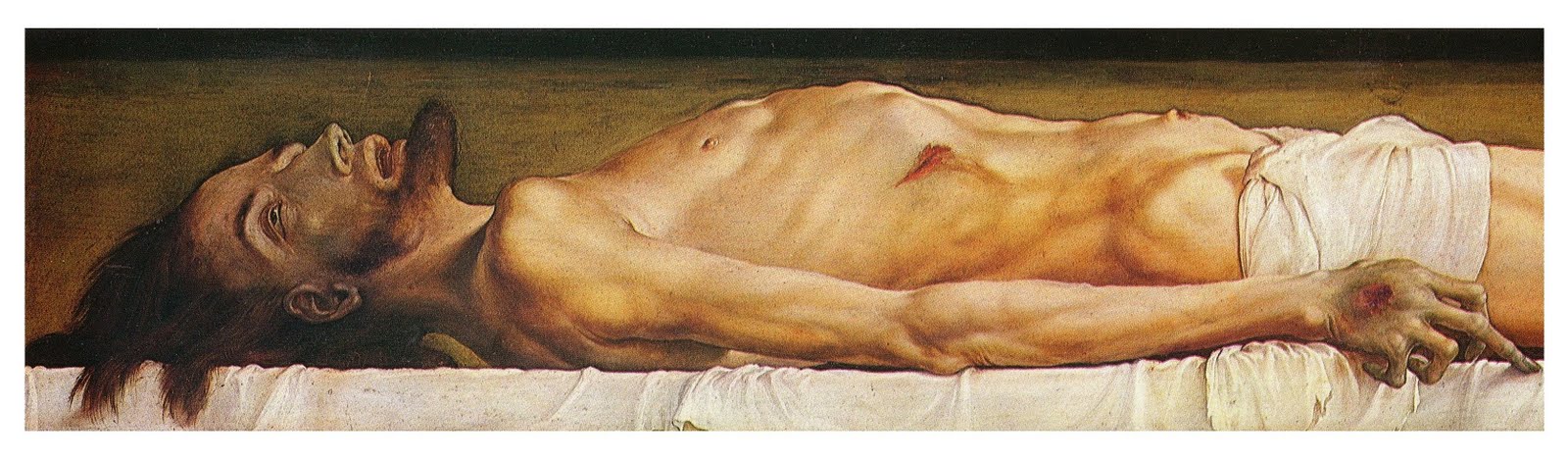
Holy Saturday: A Reflection on the Chasm Between the Now and the Not-Yet

Holy Saturday is the time that the “Western Church,” Protestants included (well some), contemplate the moment between the death and resurrection of Jesus. It is the contemplation of the burial in 1 Corinthians 15:3, 4:

For what I received I passed on to you as of first importance: that Christ died for our sins according to the Scriptures, 4. that he was buried, that he was raised on the third day according to the Scriptures, . . .

What a time to contemplate the time between the now and the not yet. This time between Christ’s cross and humiliation of unspeakable depths, and the glories’ of His coming resurrection and ascension; analogically represent the time we inhabit now. We currently wait to fully realize the glory that Jesus has shared with the Father before the world began. And like the Apostles, Disciples, and hopefuls who followed Jesus to the cross, during this time of Jesus’ silence we can despair, be full of fear, angst, anxiousness, etc. We often wonder is this it? We face circumstances that seem overwhelming, that seem to eclipse and overcome the life of Christ . . . that make it seem as if Christ stayed in the grave. As Christians in this big world, some-times like the disciples of Christ (during this time in history), we can cower behind locked doors, scratch our heads, and wonder, “what now?”

If only the disciples would have remembered, and put 2 + 2 together, what Jesus had said to them in the past (easy for me to say):

As they were coming down the mountain, Jesus instructed them, ‘Don’t tell anyone what you have seen, until the Son of Man has been raised from the dead.’ ~ Matthew 17:9

Maybe their despair, their bewilderment, would be turned to joy. Maybe their burden would have been light. Maybe they would have been grieving as ones with real hope. But they forgot, at that moment of time they became so gripped with fear they could not really function (at least some of them, His closest). Even though we know the story, because we can read about it at one sitting, don’t we live like Jesus’ end was the grave? We fall into caverns of unbelief that seem to eclipse and overshadow what we know to be true . . . if only we would remember the hope, the hope that Jesus spoke of in Matthew 17, and the hope that was realized in Matthew 28:1-10.

As we look forward to Sunday, lets not grow weary by the unanswered questions and grief of Saturday. Instead of forgetting what Jesus has said about the resurrection (i.e. His second advent), lets glory in advance, in anticipation of the glory that will be revealed in us, as we are hidden in Christ. While we live in Saturday, in anticipation, lets rest with Jesus, lets, with Jesus say: ” . . . Father, into your hands I commit my spirit (Lk 23:46).” 

I think the best thing about this analogy, of “Holy Saturday,” is that it breaks down at a point. We don’t despair as if there is no resurrection, in fact as Christians we have been brought into the heavenly places with Christ (cf. Eph. 1), now; we have intimate union with Him now (cf. I Cor. 6:17); we have been given the Holy Spirit now (cf. Jn 14–16); and a whole array of distinguishing factors from those disciples of the first century. So take heart, don’t forget, this Holy Saturday, Jesus’ words of glory in humility:

. . . I have told you these things, so that in me you may have peace. In this world you will have trouble. But take heart! I have overcome the world. ~ John 16:33