Showing posts with label Patristic Theology. Show all posts

Monday, July 9, 2012

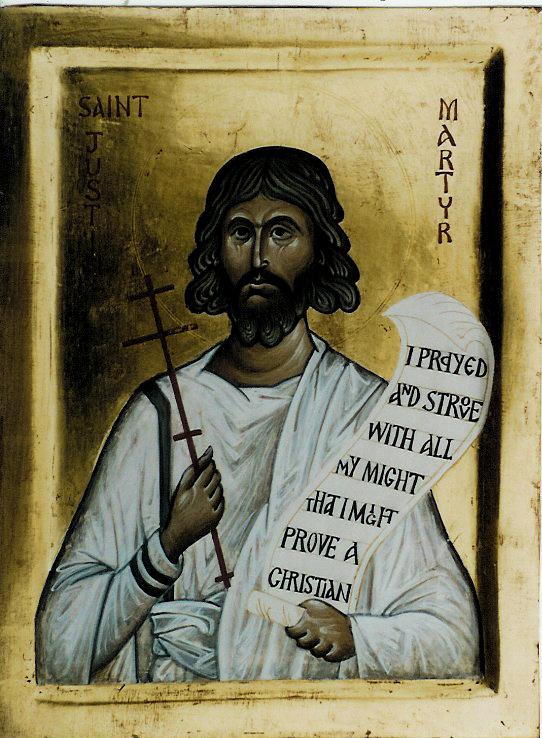
Thomas Torrance on Justin Martyr and "Proving Jesus" as Hermeneutic

Justin Martyr
Thomas Torrance, in his Theological Science (his theological method, and a title of one of his books), follows what he calls an epistemological inversion; in short, epistemological inversion is the approach that holds out that an object or subject (or both as in the case of Christian Theology) acts upon us (the knowers and inquirers), such that it itself opens up to us its own reality and structures of thought—this process remains an open structured event. It is from within this context that we can better understand Thomas Torrance’s appropriation of someone like Justin Martyr, and his defense of Christian reality and the Christic event itself (one and the same). Let’s follow along as Torrance engages Martyr, this quote will end with Torrance quoting Justin (which is the piece I really want to get to with this post—viz. Martyr’s “argument”):
The distinctive feature of this Word is its relation through the Spirit to historical facts and events. It is when we allow the Scriptures to direct us to these facts and events that our minds fall under the power of their truth and we are compelled to believe for they carry in themselves their own demonstration. This is not, of course, any kind of logical proof, but the kind of demonstration that arises immediately out of the facts and events themselves through their self-evidence. This is particularly well expressed in a fragment of a lost work on the resurrection that has survived through John of Damascus and attributed to Justin.
[T]he Word of truth is free, and carries its own authority, disdaining to fall under any skilful argument, or to endure the logical scrutiny for its hearers. But it would be believed of its own sake, and for the confidence due to him who sends it. Now the Word of truth is sent from God, wherefore the freedom claimed by the truth is not arrogant. For being sent with authority, it were not fit that it should be required to produce proof of what is said, since neither is there any proof beyond itself, which is God. For every proof is more powerful and trustworthy than that which it proves, since what is disbelieved, until proof is produced, gets credit when such proof is produced, and is recognised as being what it was stated to be. But nothing is more powerful or more trustworthy than the truth; so that he who requires proof of this, is like one who wishes it demonstrated why the things that appear to the senses do appear. For the test of those things which are received through the reason, is sense; but of sense itself there is not test beyond itself. As then we bring those things which reason hunts after, to sense, and by it judge what kind of things they are, whether the things spoken be true or false, and then sit in judgment no longer, giving full credit to its decision; so also we refer all that is said regarding men and the world to the truth, and by it judge whether it be worthless or no. But the utterances of truth we judge by no separate test, giving full credit to itself. And God, the Father of the universe, who is the perfect intelligence, is the Truth. And the Word, being his Son, came to us, having put on flesh revealing  both himself and the Father, giving to us in himself resurrection from the dead and eternal life afterwards. And this is Jesus Christ our Saviour and Lord. He, therefore, is himself both the faith and the proof of himself and of all things. [Thomas F. Torrance, Divine Meaning, 95-6; the quote from Justin, De resurrectione, 1.1f, from the Sacra Parallela of John of Damascus. E.T. from Ante Nicene Christian Library, vol. 2, pp. 341ff. This is not generally accepted as Justin's
own work, but like the Cohortatio ad Graecos was at least written under his influence.]

For all those weary souls who have labored under the Evangelical mantle of ‘Fighting Fundamentalism’ and the Apologetic Faith (as Warfield called it); won’t you join me in commending yourself to a more Christian Way? A ‘Way’ that does not entangle itself in the realm of rationalist-historicism, that seeks to ‘prove’ Jesus to themselves and the world. I am sure that it is the other way around … we are in need of ‘proving’. And I think the “Martyr” quote helps us to think in this order, and not the order of the “world.”

Sunday, July 8, 2012

Too Much Jesus in the Bible?

I would like to expose you all to Thomas Torrance's take on Irenaeus' understanding on what could be called a Christocentric Hermeneutic. As you read Torrance's account of Irenaeus, understand that you are reading Torrance too. Here is Torrance on Irenaeus:

It is, then, to the Incarnation that Irenaeus turns for the clue to the interpretation of the history of creation and redemption and therefore for the clue to the interpretation of the Scriptures. The essential order and connection of things is embodied in Jesus Christ and it is by reference to him that the economic ministrations of God in humanity and the historical covenants are to be understood aright, and therefore the interconnection between the scriptures of the prophets and the scriptures of the Apostles, 'the Gospel and the Apostles. Even the Scriptures of the old covenant have to be read in the light of Christ's advent in the flesh, for his coming connected the end with the beginning and made the beginning predictive of the end, thus showing that the faith of the patriarchs and prophets and ours is one and the same. They sowed the seed, the word about Christ (sermonem de Christo), but it is in us that the fruit is reaped and received, and only in the Church is the truth of the things prefigured realised. 'Certain facts had to be announced beforehand by the fathers in a paternal manner, (paternaliter), and others prefigured by the prophets in a legal manner (legaliter), but others delineated according to the pattern of Christ (deformari secundum formationem Christi) by those who perceived the adoption, for in one God are all things shown forth.' [Thomas F. Torrance, Divine Meaning, 122-23]

How does this strike you? Do you think this is too intense for a hermeneutic or mode for interpreting Scripture? Is your method of biblical interpretation this intensively Christ focused? I am really curious how you all think of this; I obviously highly appreciate this kind of 'Patristic' method of interpreting and reinterpreting (the OT) Scripture in light of  its fulfillment in Christ. This rubs against the method of interpretation I learned (by and large) in Bible College and Seminary; which is the Literal Grammatical Historical method (the kind that leads to and from Dispensationalism).

Monday, July 2, 2012

On Biblical Studies and Systematic Theology: Their Marriage

I just finished reading a really helpful essay that was jointly written by, C. Kavin Rowe and Richard B. Hays; their chapter is in the 'Biblical Studies' category for The Oxford Handbook of Systematic Theology. They offer a sketch of development relative to the historical and contemporary relationship (or not) between so called 'Biblical Studies & Systematic Theology'. They seek to broach how it is that these two relative disciplines indeed have come to be separate, even competitive disciplines; such that the biblical/exegetical student could be as far apart from the systematic theologian as could the analytic theologian be apart from his counterpart, the so called dialectic theologian. In other words, they seek to both descriptively and constructively engage this so called divide; and in the end, they offer a constructive proposal that seeks to place biblical studies and systematic theology in dialectical and dialogical relation (such that they are no longer in a competitive relationship) – which correlates, by the way, with our thesis 9; that Evangelical Calvinism is a form of dialectical/dialogical theology and understanding. Let me share, the summarizing and concluding thoughts of Rowe and Hays; thoughts that I concur with and find quite encouraging, personally:

[...] where the subject matter of biblical exegesis and of dogmatic theology is thought to be the same, the two disciplines are of necessity inseparable. In this respect, to refuse interdisciplinary work between biblical interpretation and constructive theology is to deny the coherence of the subject matter itself. Today, however, the complexity of the interpretive task may warrant a continued, though always provisional and cooperative, division of labour between biblical scholars and systematicians. The exegete concentrates upon the refraction of the subject matter through particular witnesses, thereby penetrating more deeply into the particular shape of the subject matter and helping to avoid banal theological  generalities (Childs 2004: xi). And the theologian concentrates more upon the whole of the subject matter as it is expressed through the understanding of scripture in the dogmatic tradition, thereby helping to avoid the tendency toward fragmentation in exegesis (the old problem of losing the forest for the individual trees).

Yet, in continuity with the ancient church, there is no final division between biblical interpretation and theological reflection, for they are united in the common task of attending to the subject matter of scripture. Their actual relationship is thus dialectical, in the sense that within their respective foci there exists a constant movement between the particulars of the biblical text and the whole of systematic reflection in an effort to do justice both to the exegetical thickness of doctrine and the theological coherence of biblical exegesis. [C. Kavin Rowe and Richard B. Hayes, Biblical Studies: Chapter 24, in The Oxford Handbook of Systematic Theology, edited by Webster, Tanner, Torrance, p. 452]

In the essay, both Rowe and Hays speak quite approvingly of both Barth and Bultmann of being thinkers who brought together (in their own ways) the task of theologizing and biblical studyizing; that in the modern period (from which they both were birthed) had been divided  – as much as the 'historical Jesus' had been from the 'Jesus of faith'. To see biblical studies and systematic theology implicating each other – as we ought – is really to engage in a 'theology of retrieval. Meaning, as Rowe and Hays suggest through their historical development, that Barth & co. engaged in the process of retrieving the doing of biblical exegesis and theology (together) from the Patristic and Reformed periods; but in a way that also did the "retrieving" from a particular situation of development itself. So that this "retrieval" of thinking biblical studies and systematic theology together has taken shape with the full realization of all of the interpretive advances made, even in the modern period itself. The result, really, is that theological exegesis should be the only way Christian thinkers and readers engage the text of scripture and their respective thinking of the God revealed in Christ that scripture finds its scope through.

Tuesday, May 15, 2012

Trinity: Tom McCall Critiques Zizoulas as Tom Torrance Critiques the Cappadocians

In Tom McCall's critique of Eastern Orthodox and Trinitarian theologian, John Zizoulas; McCall offers a proposal that is highly similar (if not self-same) with that of Thomas F. Torrance's. McCall is appreciative of Zizoulas' emphasis on Being-As-Communion as definitive for how we should conceive of the divine Monarchia or God-head, but like Torrance, contra the Cappadocians; McCall finds concern with Zizoulas' retrieval, as it were of the Cappadocian grounding of the God-head in the Person's, or Person (the Father), instead of the Being of God (ousia) which is given shape by the mutual in-dwelling, subject-in-being kind of onto-relating (as Torrance calls it) that as Torrance has highlighted someone like Epiphanius or Athanasius has offered in the Patristic Tradition. McCall sketches, and develops what is called the Sovereign Aseity Conviction, which is the belief that God alone gives himself his own being. McCall is worried that when this reality is correlated with Zizoulas' belief that 'Being-As-Communion' is understood as definitive for God, and further, when the conception of Sovereign Aseity is grounded in the Person of the Father, rather than an actual Being that is indeed in communion; that we end up with a non sequitur (and I share his worry). For if the definition of God-ness is indeed given primary shape by BAC, then to posit (as Zizoulas does) that there is principle of God-ness, such as Father, prior to the possibility for genuine communion to inhere; then we end up with a non-starting conception of God-ness if this conception is going to be defined by being-in-communion. [There is further discussion needed to parse this out further, and McCall provides it; discussion on person-hood in the Monarchia etc. But I am not going to provide that here, at the moment---maybe in the comments if someone wants. I am highlighting McCall's critique of Zizoulas here because it sounds very very similar to Thomas Torrance's critique of the Cappadocians in his book Trinitarian Faith]. Here is McCall on Zizoulas, and McCall's counter-proposal to Zizoulas:

[T]he first adjustment [to Zizoulas' view] is this: the SAC [Sovereign Aseity Conviction] must be seen as a property of the triune God rather than as a property of the Father alone. As we have seen, to predicate the SAC of the Father alone is to raise several concerns, not least of which is whether this means that the Father is of a different essence than is the Son or Spirit. To assert that the Father alone is unthrown and a se is to say that the Father has different essential properties than does the Son or Spirit --- properties that are not either accidental properties (after all, this seems to be what it means to be the Father) or "onto-relational" properties. But to predicate the SAC of the Trinity alleviates this problem; it makes the SAC an essential property of divinity, one that is had by each and all of the divine persons. Furthermore, the ascription of the SAC to God is the way the biblical writers think of it (e.g., Exod. 3:14). [Thomas H. McCall, Which Trinity? Whose Monotheism?, 207]

I agree with McCall's call for an adjustment relative to Zizoulas' conceiving of things; just as I agree with Thomas Torrance's call for a dependence on Athanasius, Epiphanius, Didymus the Blind, et alia in contrast to the Cappadocians. A contrast that sees the importance of grounding God's being-in-communion in the Sovereign-Aseity of all the Persons mutual-indwellment of the other; instead of annexing this to the person of the Father alone (which would be contradictory because of prior conflict given the defined premises).

Anyway, besides the important theology being noted here; it makes me wonder how much McCall has depended on Thomas Torrance's proposal, contra the Cappadocians, for his (McCall's) own proposal contra Zizoulas? Let me close with a quote from Torrance, quoting Epiphanius, in Torrance's 'Trinitarian Faith':

[G]od is one, the Father in the Son, the Son in the Father with the Holy Spirit . . . true enhypostatic Father, and true enhypostatic Son, and true enhypostatic Holy Spirit, three Persons, one Godhead, one being, one glory, one God. In thinking of God you conceive of the Trinity, but without confusing in your mind the Father, the Son and the Holy Spirit. The Father is the Father, the Son is the Son, the Holy Spirit is the Holy Spirit, but there is no deviation in the Trinity from oneness and identity. (Epiphanius, “Anc., 10,” cited by T. F. Torrance, “The Trinitarian Faith,” 234-35)