Showing posts with label Historical Theology. Show all posts

Monday, July 9, 2012

Thomas Torrance on Justin Martyr and "Proving Jesus" as Hermeneutic

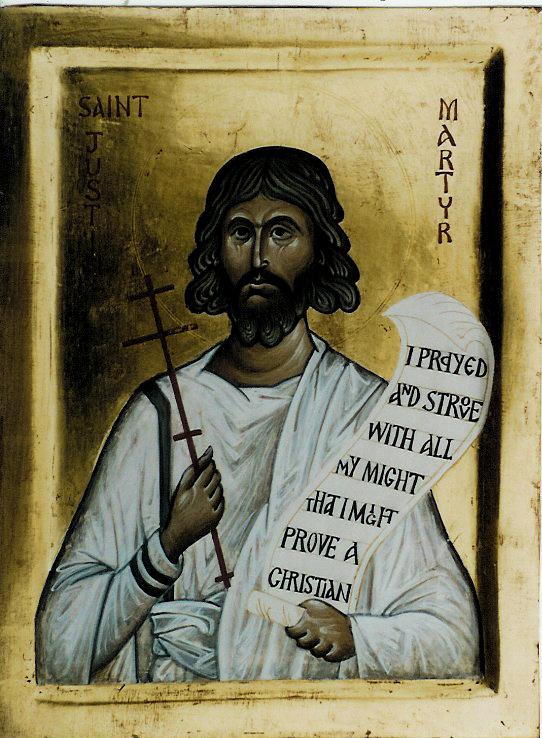
Justin Martyr
Thomas Torrance, in his Theological Science (his theological method, and a title of one of his books), follows what he calls an epistemological inversion; in short, epistemological inversion is the approach that holds out that an object or subject (or both as in the case of Christian Theology) acts upon us (the knowers and inquirers), such that it itself opens up to us its own reality and structures of thought—this process remains an open structured event. It is from within this context that we can better understand Thomas Torrance’s appropriation of someone like Justin Martyr, and his defense of Christian reality and the Christic event itself (one and the same). Let’s follow along as Torrance engages Martyr, this quote will end with Torrance quoting Justin (which is the piece I really want to get to with this post—viz. Martyr’s “argument”):
The distinctive feature of this Word is its relation through the Spirit to historical facts and events. It is when we allow the Scriptures to direct us to these facts and events that our minds fall under the power of their truth and we are compelled to believe for they carry in themselves their own demonstration. This is not, of course, any kind of logical proof, but the kind of demonstration that arises immediately out of the facts and events themselves through their self-evidence. This is particularly well expressed in a fragment of a lost work on the resurrection that has survived through John of Damascus and attributed to Justin.
[T]he Word of truth is free, and carries its own authority, disdaining to fall under any skilful argument, or to endure the logical scrutiny for its hearers. But it would be believed of its own sake, and for the confidence due to him who sends it. Now the Word of truth is sent from God, wherefore the freedom claimed by the truth is not arrogant. For being sent with authority, it were not fit that it should be required to produce proof of what is said, since neither is there any proof beyond itself, which is God. For every proof is more powerful and trustworthy than that which it proves, since what is disbelieved, until proof is produced, gets credit when such proof is produced, and is recognised as being what it was stated to be. But nothing is more powerful or more trustworthy than the truth; so that he who requires proof of this, is like one who wishes it demonstrated why the things that appear to the senses do appear. For the test of those things which are received through the reason, is sense; but of sense itself there is not test beyond itself. As then we bring those things which reason hunts after, to sense, and by it judge what kind of things they are, whether the things spoken be true or false, and then sit in judgment no longer, giving full credit to its decision; so also we refer all that is said regarding men and the world to the truth, and by it judge whether it be worthless or no. But the utterances of truth we judge by no separate test, giving full credit to itself. And God, the Father of the universe, who is the perfect intelligence, is the Truth. And the Word, being his Son, came to us, having put on flesh revealing  both himself and the Father, giving to us in himself resurrection from the dead and eternal life afterwards. And this is Jesus Christ our Saviour and Lord. He, therefore, is himself both the faith and the proof of himself and of all things. [Thomas F. Torrance, Divine Meaning, 95-6; the quote from Justin, De resurrectione, 1.1f, from the Sacra Parallela of John of Damascus. E.T. from Ante Nicene Christian Library, vol. 2, pp. 341ff. This is not generally accepted as Justin's
own work, but like the Cohortatio ad Graecos was at least written under his influence.]

For all those weary souls who have labored under the Evangelical mantle of ‘Fighting Fundamentalism’ and the Apologetic Faith (as Warfield called it); won’t you join me in commending yourself to a more Christian Way? A ‘Way’ that does not entangle itself in the realm of rationalist-historicism, that seeks to ‘prove’ Jesus to themselves and the world. I am sure that it is the other way around … we are in need of ‘proving’. And I think the “Martyr” quote helps us to think in this order, and not the order of the “world.”

Sunday, July 8, 2012

Too Much Jesus in the Bible?

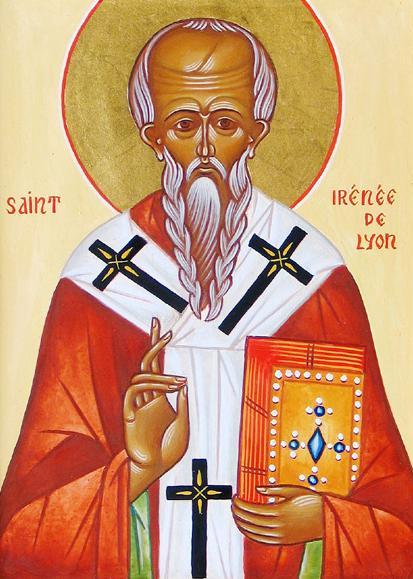
I would like to expose you all to Thomas Torrance's take on Irenaeus' understanding on what could be called a Christocentric Hermeneutic. As you read Torrance's account of Irenaeus, understand that you are reading Torrance too. Here is Torrance on Irenaeus:

It is, then, to the Incarnation that Irenaeus turns for the clue to the interpretation of the history of creation and redemption and therefore for the clue to the interpretation of the Scriptures. The essential order and connection of things is embodied in Jesus Christ and it is by reference to him that the economic ministrations of God in humanity and the historical covenants are to be understood aright, and therefore the interconnection between the scriptures of the prophets and the scriptures of the Apostles, 'the Gospel and the Apostles. Even the Scriptures of the old covenant have to be read in the light of Christ's advent in the flesh, for his coming connected the end with the beginning and made the beginning predictive of the end, thus showing that the faith of the patriarchs and prophets and ours is one and the same. They sowed the seed, the word about Christ (sermonem de Christo), but it is in us that the fruit is reaped and received, and only in the Church is the truth of the things prefigured realised. 'Certain facts had to be announced beforehand by the fathers in a paternal manner, (paternaliter), and others prefigured by the prophets in a legal manner (legaliter), but others delineated according to the pattern of Christ (deformari secundum formationem Christi) by those who perceived the adoption, for in one God are all things shown forth.' [Thomas F. Torrance, Divine Meaning, 122-23]

How does this strike you? Do you think this is too intense for a hermeneutic or mode for interpreting Scripture? Is your method of biblical interpretation this intensively Christ focused? I am really curious how you all think of this; I obviously highly appreciate this kind of 'Patristic' method of interpreting and reinterpreting (the OT) Scripture in light of  its fulfillment in Christ. This rubs against the method of interpretation I learned (by and large) in Bible College and Seminary; which is the Literal Grammatical Historical method (the kind that leads to and from Dispensationalism).

Saturday, June 9, 2012

Some Calvinist Hymns AGAINST the Arminians

I just finished a really interesting book, Arnoud S. Q. Visser, "Reading Augustine in the Reformation: The Flexibility of Intellectual Authority in Europe, 1500~1620," (New York: Oxford University Press, 2011). The book offers an analysis of Augustine's reception in the Reformation period (both Roman Catholic and Protestant sides) by looking at the publishers and editors of Augustine's works; by looking at the development of text and reading habits in this period; by doing some case studies on Augustine's usage and application (based on the previous realities of his publishing/editing and reading habits) in the works of Vermigli, Cranmer, & Laud; and finally by looking at the consumption of Augustine in debate, in particular he looks at how this plays out both in the Catholic center of Leuven, and the Protestant center of Leiden. It is this latter center that I want to highlight by noting a popular way in which Augustine's reception played itself out in the so called Remonstrance (Arminians), and counter-Remonstrance (Calvinists) debates about predestination, free-will and God's grace---for those unaware, this is where the whole 5 Points of Calvinism find their conceptual genesis (in the 'counter-Remonstrance' movement, given voice in the Canons of Dort).

What I am drawing our attention to, is really just an interesting instance of how a counter-Remonstrant (5 Point Calvinist in our contemporary parlance) sought to undercut the teachings of the Remonstrants (or Arminians) as a song-writer. He wrote some hymns against the 'Pelagians' (a label used often---still to this day---by Calvinists of their Arminian opponents [for those unaware, Pelagius was a 4th century monk who taught that man, by his own nature, could receive God's salvation or not; i.e. that there was no such thing as God's predestination of some to eternal life and salvation]); here are those 5 Point (to speak anachronistically) hymns---the song writer (who was eventually condemned) is Pieter Martens 'from the town of Lekkerkerk in the province of Holland' (Visser, p. 127). Here we go, the tune is set to Martin Luther's hymn on the Lord's prayer, "Vater unser im Himmelreich" (Visser, p. 127); so if you know it, sing along as you put these words to that tune ;-), here we go:

O God, who is our Father,
We thank you through Jesus Christ,
That you saved us so mercifully from Pelagius's reign,
Which has now forcefully and collectively
Emerged again....

[The holy Spirit] who causes in us a stable, unshakeable faith, so that we resist through God's great power evil Pelagius and the devil, however deceptive he may be, for God comes to the rescue of his people.

The Second song, "to the tune of the second psalm," is of a more didactic nature (Visser, p. 127):
Why are these troublemakers raging frantically
Why are the Pharisees gathering
What makes them rave so much collectively
About things of which they should surely be ashamed?
All those Pelagians are united
Against Gods [sic] word and His correct doctrine;
They attempt  hurridedly to fight these,
And all His annointed.
~Pieter Martens cited by Arnoud S. Q. Visser in, Reading Augustine in the Reformation, 127

So next time you encounter a rambunctious Arminian (and we know they usually are ;-), just plug your ears and start singing these hymnodies, at them; it is sure to repel them ;-).

Seriously, it is interesting, to see how, at a popular (and even intellectual-academic) level nothing has really changed. These hymns come directly within the immediate time frame which the most acute Protestant form of this Augustinian-Pelagian inspired debate took its shape; the time frame in the early 17th century (1618 and immediately prior). The debate, of course, is the classically breathed Arminian and Calvinist debate; a debate, as I just noted that started with Augustine and Pelagius. Then given expression within Roman Catholic circles (which Visser discusses), taken up again by Calvin V. Pighius and Georgius (as my last post was noting something of), and given (for Protestants) a final form (which continues until today for many Protestants) in this Remonstrant, counter-Remonstrant movment (of Arminians V. Calvinists).

I just thought these hymns were an interesting insight into the early popular culture of this whole debate. Things, for many, unfortunately, really haven't changed much! But you could become an Evangelical Calvinist ...


Calvin: Right and Wrong on Predestination, Election-Reprobation

Calvin was right and wrong on that most controversial issue that still plagues the Church of Jesus Christ in some quarters. Of course, the issue which I am referring to is the doctrine of God's eternal Predestination (of which election and reprobation serve as prominent places under this umbrella teaching). Calvin wrote  A Treatise of the Eternal Predestination of God, which was his diatribe against his interlocutors, Pighius & Georgius; both who forwarded a doctrine of Predestination and election that would look more like what we would consider Arminian today. Here is what Calvin writes in his Treatise:

John Calvin
[W]hat my mind on this momentous subject is, my "Institute" furnishes a full and abundant testimony, even if I should now add nothing more. I would, in the first place, entreat my readers carefully to bear in memory the admonition which I there offer: that this great subject is not, as many imagine, a mere thorny and noisy disputation, nor a speculation which wearies the minds of men without any profit; but a solid discussion eminently adapted to the service of the godly, because it builds us up soundly in the faith, trains us to humility, and lifts us up into an admiration of the unbounded goodness of God towards us, while it elevates us to praise this goodness in our highest strains. For there is not a more effectual means of building up faith than the giving our open ears to the election of God which the Holy Spirit seals upon our heart while we hear, shewing us that it stands in the eternal and immutable goodwill of God towards us; and that, therefore, it cannot be moved or altered by any storms of the world, by any assaults of Satan, by any changes, or by any fluctuations or weaknesses of the flesh. For our salvation is then sure to us, when we find the cause of it in the breast of God. Thus, when we lay hold of life in Christ, made manifest to our faith, the same faith being still our leader and guide, our sight is permitted to penetrate much farther, and to see from what source that life proceeded. Our confidence of salvation is rooted in Christ, and rests on the promises of the Gospel. But it is no weak prop to our confidence, when we are brought to believe in Christ, to hear that all was originally given to us of God, and that we were as much ordained to faith in Christ before the foundation of the world, as we were chosen to the inheritance of eternal life in Christ. [John Calvin, A Treatise of the Eternal Predestination of God, (Barnes & Noble Nook edition, p. 3-4]

Calvin was mostly right, since he attempts to ground election in Christ. But where he is wrong is where Karl Barth identified where he was wrong; by operating with a view of election that in the end does not ground election in Christ, in principle. That is to say, that Calvin still is working from a soteriological V. christological paradigm of how to construe predestination and election; such that people are seen as either in election or out based upon an arbitrary choice of God in his secret will (remote). And yet, if we were truly to ground election in Christ, we would think through the implications of what has been called the homoousion person of Jesus Christ. So that in the incarnation we have the exemplification of what God had already pre-destined for himself, in Christ, by choosing our humanity for himself, and in so doing choosing our reprobate status (all of humanity) for himself; and by virtue of this he in the atonement takes this sinful humanity to death, and in his resurrection-recreation gives us his first fruits of election to be children and participants with him (by grace and adoption, on our end) in the glory he shared with the Father before the creation of all things.

So in line with, and to Calvin's credit, we have a set of contours that would make Calvin happy, I think. This includes an emphasis on God's choice in salvation for all of humanity, God's grace as the basis for this salvation in Christ, and God's acting this out for us in the mediating (priestly) humanity of Jesus Christ. All we can do is leave Calvin where he left us, but that's not to say that we can't constructively work After Calvin in a way that honors his own thinking and emphases. This notwithstanding, we still have a Calvin who thinks in very Augustinian terms when it comes to this issue; we have a Calvin who sees this doctrine (for the 'elect') as something that is pastorally edifying for the laity to consider relative to the surety of their own salvation, won for them in Christ (and this was how Augustine tried to spin his teaching on predestination, in a way that was positive for the faithful and/or elect).

It would be really interesting to have Calvin come into the 21st century and see what he thinks about the kind of 'Christ-grounded' view of predestination and election that I have sketched above (which, basically, is from within the Barthian realm---Myk Habets offers a really good chapter on this in our soon to be released book). I actually think he might call those who advocate what I sketch above 'unclean beasts' as he calls his two interlocutors, Pighius and Georgius; but on second thought, if Calvin came into the 21st century now, he would have already been talking to Barth, and been set straight, so he might just say amen.

No matter what Calvin might say today; this issue remains a contentious issue amongst many within the Christian faith. And yet, if we are going to follow a view that takes serious the incarnation & atonement of Christ (and its attendant implications), then we must see election and reprobation grounded in Jesus Christ alone (instead of thinking of some people elect and the rest reprobate---this seems to make a dogmatic mistake by way of misconstruing a proper order---i.e. christology ought to precede and inform soteriological concerns, instead of vice versa [which is the usual way to construe this i.e. reading soteriological questions back into christological questions, and thus shaping Christ through that lens instead of having Christ shape the questions of salvation]). I think EC has something substantial to offer towards our consideration of this issue ...

Saturday, June 2, 2012

The Westminster Confession of Faith

Here is the Westminster Confession of Faith given in comic relief:

ht: Jason Goroncy

This that historic document of the classic Reformed that continues to impose its long reach on many a Presbyterian and Christian Reformed, and many others assimilated in hybrid forms.

[click on image for larger size]

Thursday, May 31, 2012

Back to the Text! Amerbach's Augustine, and the Protestant Reading-Textual Ethic

I once wrote a post entitled A Brief Introduction to Christian Humanism: As the Social Impetus for the Protestant Reformation. In that same mood, this post briefly considers the textual culture that helped foster, even more directly, a fresh reading of Augustine by Martin Luther. At the end of this post I will offer a quick reflection on the impact ad fontes or to the sources continues to have on the Protestant reading and textual ethic.

If you read that other post of mine first (the one I link to above on 'Christian Humanism') you will appreciate the climate which someone like Martin Luther found himself situated. It was an atmosphere filled with the excitement and 'modern' freedom of going beyond the received ecclesio and hermeneutical tradition; going beyond the 'authority' and 'magesterial' reading and interpretation of both the scriptures and so called 'Church Fathers', of whom Augustine was prime. Luther, amongst his other contemporaries had access to the actual Augustine because of the work of a printer named Johann Amerbach. Amberbach's edition and compilation of Augustine's writings allowed people like Luther (an Augustinian monk) a door into the world of Augustine like never before; and thus a door that would only corroborate Luther's fresh reading of the New Testament (again something given impetus for Luther because of the Humanist movement of back to the sources V. back to the Roman Catholic Church as 'the' authoritative interpreter), a corroboration that made Luther believe that Christianity, even amongst one of the most revered Church Fathers---Augustine---was much different than he had been lead to believe by his Augustinian tutors. Here is how Arnoud Visser sketches the impact that Amberbach's edition of Augustine's writings had on the one who would be the lightening rod of the soon to be Protestant Reformation:

[...] Luther's reading of Augustine, for one, was transformed after he gained access to the Amerbach edition, around 1515. In 1516, for example, while still an Augustinian Hermit and Professor of Biblical Theology on behalf of his Order, Luther wrote to his humanist friend Georg Spalatin: "I defend Augustine not because I am an Augustinian; before I began to deal with his writings, he did not mean anything to me." Luther's words flatly contradict his earlier statements, dating from 1509, made in the margins of his copy of a selection of Augustine's works. Here, Luther in fact criticized Wimpfeling's claim about Augustine's lay status, defending the claims of his Order. Clearly in this period, when he was studying theology at Erfurt, Luther still read Augustine as an Augustinian. Once he could access the entire set of the church father's collected works, however, he started to see another Augustine, namely the author of the anti-Pelagian works. [Arnoud S. Q. Visser, Reading Augustine in the Reformation: The Flexibility of Intellectual Authority in Europe, 1500-1620, (New York: Oxford University Press, 2011), 25].
[In the quote, Wimpfeling was a scholar in the Roman Catholic Church who challenged the authority of the Church by suggesting that Augustine was not a monk, but a lay theologian who finally of course became one of the great Bishops. This did not sit well with the RCC, because it challenged a fundamental conception about one of their fundamental teachers, Augustine; thus challenging a dearly held paradigm about being a 'monk' and devotee to the Church.]

It is interesting, at least to me, to see the impact that printed texts and words can have. There is an ethic illustrated by Amberbach as the printer, and Luther as the reader; I would suggest a Protestant one. One that desires to 'go to the sources'; one that seeks to get beyond the muddle of mediation (insofar as this is possible), and subordinate all of our thinking to the 'source'. For the Protestant this ends in sola scriptura, and listening to the 'Church Father's and the ecumenical councils convened under their watchful eyes (at least this is the historical 'end' of what it meant to go back to the sources). It is going back to the sources that we can engage in semper reformanda (always reforming); subordinating our creeds and confessions to the authoritative Word in Scripture, Jesus Christ. It is this Protestant move and reading-texutal ethic which finally leads us to the logical conclusion of the 'Text'; that is, the Text points beyond itself, even, and finally finding its full orientation in God's, Word, Jesus Christ. And yet without this Protestant (Christian-Humanist) turn to the text of scripture and her progeny (the Patristics, for example); the Text (Jesus) behind the text would remain clouted in the layers of tradition and popery which would leave our lives awash in the mire of textual abuse---because the text (scripture) would be cut off from her meaningful Text (Jesus) and replaced by a vicar who really is no vicar at all!

In the end, there is a Protestant reading-text ethic; one that gives rise to a mood of 'always reforming', and thus one that has given rise to what Myk Habets and I (and our authors) are trying to do in our soon to be released book: Evangelical Calvinism: Essays Resourcing the Continuing Reformation of the Church.