Showing posts with label Karl Barth. Show all posts

Tuesday, July 10, 2012

The Jesus of History & Faith, Conjoined

I wanted to address something that dovetails with a recent mini-essay that Darren Sumner wrote on Karl Barth's understanding of history and revelation. What I want to do is provide a counter-part post that underscores and articulates Thomas F. Torrance's view on the same subject. If you read Darren's post alongside this post; what you'll notice is that both Torrance and Barth share a very similar understanding on the relationship between how revelation and history work together, and how the former ultimately must be said to condition the latter; and not vice versa. Here is TF Torrance, at length (I will highlight the significance of this relative to the normal ways that Evangelicals and some of the Reformed use history as the foundation for their view of revelation---which is really backwards from a genuinely Christian order of things):

The mystery of Christ is presented to us within history --- that historical involvement is not an accidental characteristic of the mystery but essential to it. That is the problem.
Let us first put it this way, recalling the bi-polarity of our theological knowledge. If God has become man in the historical Jesus, that is an historical event that comes under our historical examination so far as the humanity of Jesus is concerned, but the fact that God became man is an event that cannot be appreciated by ordinary historical science, for here we are concerned with more than simply an historical event, namely, with the act of the eternal God. So far as this event is a fact of nature it can be observed, and so far as it is historical in the sense that other natural events are historical, it can be appreciated as such; but the essential becoming behind it cannot be directly perceived except by an act of perception appropriate to the eternal event. That act of perception appropriate to an eternal act, or divine act, would surely be the pure vision of God, which we do not have in history. Here on earth and in time we do not see directly, face to face, but see only in part, as through a glass enigmatically, in a mystery. We see the eternal or divine act within history, within our fallen world where historical observation is essential. Faith would be better described then as the kind of perception appropriate to perceiving a divine act in history, an eternal act in time. So that faith is appropriate both to the true perception of historical facts, and also to the true perception of God's action in history. Nor is it the way we are given within history to perceive God's acts in history, and that means that faith is the obedience of our minds to the mystery of Christ, who is God and man in the historical Jesus. What is clearly of paramount importance here is the holding together of the historical and the theological in our relation to Christ.

If the two are not held together, we have broken up the given unity in Christ into the historical on the one hand, and the theological on the other, refracting it into elements which we can no longer put together again. We then find that we cannot start from the historical and move to the theological, or from the theological and move to the historical without distortion, and nor can we rediscover the original unity. We can only start from the given, where the historical and the theological are in indissoluble union in Christ. [Thomas F. Torrance, Incarnation, 6-7]

So there is no analogy for the incarnation. And for Torrance, the incarnation must be the definitive touchstone for how we start to conceive of a knowledge of God (the Old Testament then is seen as the pre-incarnation of God in Christ); and since there is not human analogy for this reality to be found in the history of history (i.e. God and humanity united in a single person), the only 'foundation' that can be used to justify our belief about God must be given its shape and reality through the given reality of the incarnate Christ---which means, faith.

This means that we cannot start with an abstracted history (like a naked evidentialism) and seek to attach this to the history of Jesus, but the history we have, in itself, of Christ's revelation is the given reality itself; there is nothing else that can be determinate of that, other than the truly and self-determinately free God himself.

*A repost for those who may have not read this, I once posted this not too long ago at my EC (Wordpress) blog.

Wednesday, July 4, 2012

Happy Human Independence/Freedom Day, from Karl Barth

Since it is 'Independence Day' here in America, today, I thought I would repost a reflection and response on 'Human Freedom' that I posted at my older EC blog quite a few months ago now. As you will see, these reflections are in response to a brother (in Christ) of mine. Happy 'Freedom Day'!

36 So if the Son sets you free, you will be free indeed. ~John 8.36

Silhouette of Barth, Garbed in the 'Colors'
I am reposting the following because I am working the next couple of days, and so don’t have the time to develop some things I would like to in response to the discussion I have been having with Nathan in this thread. Some have asked what ‘grace all the way down’ might mean (in the thread and post I am referencing). Some of you are wondering how I might move differently than a classic Calvinist or Arminian in framing human action as grounded in a theological-christological anthropology—thus ultimately recasting, and somewhat avoiding the usual categories of working out of ‘the bondage of the will’ dialogue. So in lieu of me writing an actual post that would articulate how I might proceed; this post, and maybe one more tomorrow will have to suffice until I can do a proper (new) one. Somebody might think that some of the language from Barth sounds like what Billings is critiquing in the Arminian, but it’s not. Since Barth’s construct grounds what it means to be human, dogmatically, in the elect humanity of Christ for us. This is the piece that classic Arminianism (and Calvinism) is missing; i.e. ‘the classic way’ operates with a competitive view between Divine-human action vis-á-vis human action simpliciter. Meaning that the classic approach, does not ground humanity from the humanity of Christ in an objective gracious way. Instead, it sees humanity as abstracted from the humanity of Christ in need of union with his humanity which is only actualised through their cooperation with God in salvation by habituating in the ‘created grace’ (which becomes the impersonal intermediary that binds elect or foreknown humanity to Christ’s humanity). More to be said. Here’s Barth on the vicarious humanity of Christ as ‘God with us’, which becomes the recreated humanity through which our humanity elevated to what it means to be human; or free for God.

Here is a great statement from Barth on the vicarious humanity of Christ,

[T]he answer is that we ourselves are directly summoned, that we are lifted up, that we are awakened to our own truest being as life and act, that we are set in motion by the fact that in that one man God has made Himself our peacemaker and the giver and gift of our salvation. By it we are made free fro Him. By it we are put in the place which comes to us where our salvation (really ours) can come to us from Him (really from Him). This actualisation of His redemptive will by Himself opens up to us the one true possibility of our own being. Indeed, what remains to us of life and activity in the face of this actualisation of His redemptive will by Himself can only be one thing. This one thing does not mean the extinguishing of our humanity, but its establishment. It is not a small thing, but the greatest of all. It is not for us a passive presence as spectators, but our true and highest activation—the magnifying of His grace which has its highest and most profound greatness in the fact that God has made Himself man with us, to make our cause His own, and as His own to save it from disaster and to carry it through to success. The genuine being of man as life and activity, the “We with God,” is to affirm this, to admit that God is right, to be thankful for it, to accept the promise and the command which it contains, to exist as the community, and responsibly in the community, of those who know that this is all that remains to us, but that it does remain to us and that for all men everything depends upon its coming to pass. And it is this “We with God” that is meant by the Christian message in its central “God with us,” when it proclaims that God Himself has taken our place, that He Himself has made peace between Himself and us, that by Himself he has accomplished our salvation, I.e., our participation in His being. [Karl Barth CD IV/I, p. 12]

This is the kind of stuff I am looking for. A theological anthropology, that is Christological; that honors the integrity of created humanity by giving humanity its place in the recreated humanity of Jesus Christ for us. It is a participationist humanity that we are given as a gift, we don’t possess it in ourselves. The giveness of humanity is where humanity flourishes through its relation in the divine life (i.e. the proper order) in Christ. This early section in IV/I is entitled “God with Us.”


Wednesday, June 27, 2012

Was Karl Barth really a Neo-Orthodox Theologian?, AGAIN

I was reminded, by my friend, Travis, of what prompted me to even think of the question of my last post in the first place. This question (which is really quite technical, and not totally of lasting import, except for the fact that pressing definitional precision on this might result in bearing fruit toward a deeper understanding of who the theologian and man, Barth, were) has been percolating ever since; ever since, Travis mentioned, in what I am going to share from him below, that Barth might have out-paced what it actually means to be neo-Orthodox. Here is what Travis wrote (in this regard), oh so long ago:

Karl Barth
[...] The language of ‘neo-Orthodoxy’ is often used but little understood. My personal take on it is that it most properly refers to the North American appropriation of European dialectical theology. The early Barth was a member of this dialectical theology movement, but he was certainly not the only member. Emil Brunner is perhaps the next best well known of this group and – in fact – his work had a much wider impact on North American theology in the first half of the 20th century than did Barth’s. As to its theological fingerprint, neo-Orthodoxy was concerned with finding a way to reclaim the patristic and Reformation creeds and confessions for their own time. There certainly was a period when this was also Barth’s program, but it is also true that Barth’s work grew, evolved, and took on other aims and emphases. Finally, neo-Orthodoxy can tend to be more existentialist than Barth finally was. In all these ways, the neo-Orthodox movement must be considered sub-‘Barthian’ in the sense employed by Myers. With reference to Torrance, the only way that he can – in my opinion – be classed as neo-Orthodox is with reference to the point concerning the reclamation of patristic and Reformational orthodoxy. Like Barth, however, Torrance finally did not go about this in a simplistic or flatfooted way. [Original posting here, from Travis McMaken, 2008]

Do such questions really matter? Like I said above, if they produce movement that causes us to ask more penetrating questions about Barth's theology---which then ultimately ought to cause us to ask more penetrating questions about Jesus Christ (the material and formal reality of Barth's theological focus)---then yes, seeking to understand Barth's placement within the history of ideas and theological movements can bear fruit (just ask Bruce McCormack if he thinks questions like this matter ... he wrote his PhD dissertation on Barth entitled Karl Barth's Critically Realistic Dialectical Theology: Its Genesis and Development 1909-1936, engaging in the kind of historical/theological work that seeks to place Barth's theology on a continuum of a period's theological movement).

I realize, in the grand scheme of things, thinking about this kind of stuff might not matter to some; but then, it is probably thinking about this kind of stuff that differentiates someone from being a formal V. informal theologian (take those designations however you like, in a dialectical sense). Or it is thinking about this kind of stuff that differentiates someone from being a geek V. normal ;-).

[So for Travis, being neo-Orthodox means to place the emphasis on Orthodox; and of course the method of being Orthodox in the Neo mode---which is what makes it 'Neo' relative to its "perioded" context---is to reclaim Patristic and Reformed categories and emphases through a Continental/Dialectical & Modern set of expectations. And I agree with this definition.]

Tuesday, June 26, 2012

Was Karl Barth really a Neo-Orthodox Theologian?

Was Karl Barth Neo-Orthodox, and not just Neo-Orthodox; but as many insinuate, was Karl Barth The Neo-Orthodox? As I mentioned in a previous post (in passing), I was in conversation with a guy who is a missionary in Germany; and Karl Barth came up as a result of that conversation. My interlocutor asserted that Barth, as he understood him (as do so many American Evangelicals), was The Neo-Orthodox theologian par excellence. And yet, by way of intonation, body language, and understood implication; what my interlocutor intended was to immediately shut down conversation by appealing to a caricature view of Barth by appealing to a caricature conception of what it means to be Neo-Orthodox. My retort to my interlocutor is that there is debate amongst Barth scholars whether or not Barth was actually Neo-Orthodox. Of course the underlying nagging question in all of this, is; what in fact does it mean to be Neo-Orthodox? Does it mean, simply, that this kind of theologian is a 'Liberal' demon, who denigrates a "high view" of scripture (read 'innerant'), and who probably isn't really even a Christian (if so, just barely)? Or should understanding Neo-Orthodox, definitionally, place more of an emphasis on Orthodox; such that being Orthodox then becomes implicating of the Neo (and in Barth's case, his doctrine of 'Election' stands out here!)?

Emil Brunner & Karl Barth

I have understood someone like Emil Brunner (a contemporary and interlocutor of Barth's) to be truly Neo-Orthodox, and Barth not really. My reasoning on this has been that Brunner left a place (anthropologically) for a so called 'Natural Theology' (and thus a place for a 'classical theistic' mode in his theology, and thus truly repetitive of the inherited 'Protestant Orthodox' mantle, theologically) in his prolegemona to his doing of theology; whereas Barth did not. And thus based upon this (and some other prolegemonological principle, such as Barth's dialecticism etc.), I have concluded, if in fact my thinking on definition for Neo-Orthodox is stout, that Barth really isn't Neo-Orthodox after all; because he rejects a place for Natural Theology in his theological methodology.

For any of you, my Barthian readers, let me know what you think of my thinking on this ...

Sunday, June 24, 2012

A Barthian & Calvinian Devotional Moment

This is the kind of stuff every Christian should appreciate Karl Barth for:

Lecture V

(Art. 203)

The Way Of Man

2. By revealing Himself to man in Jesus Christ, God brings against man the accusation that his own way is the way of ingratitude towards God's grace. Man, unfaithful to his calling, which is to serve God's glory, makes himself the lord of his life, as if he were God. What he does thereby, he would have to be, without prospect of deliverance, if God withdrew His hand from him, viz. deprived of his own glory, i.e. a prisoner to the contradiction of his own nature, lost in a world which has ceased to have a lord and therefore ceased to have a meaning for him and subject to vanity. Man's own way is the way of sin, i.e. of offence against God, which only God can make amends for. [Karl Barth, The Knowledge of God and the Service of God According to the Teaching of the Reformation: Recalling the Scottish Confession of 1560, The Gifford Lectures Delivered in the University of Aberdeen in 1937 and 1938, p. 7 (Nook edition)]

And follow this with John Calvin:

Book One

The Knowledge of God the Creator

Chapter 1
The Knowledge of God and That of Ourselves are Connected. How Are They Interrelated

I. Without knowledge of self there is no knowledge of God
Nearly all the wisdom of we possess, that is to say, true and sound wisdom, consists of two parts: the knowledge of God and of ourselves. But, while joined by many bonds, which one precedes and brings forth the other is not easy to discern. In the first place, no one can look upon himself without immediately turning his thoughts to the contemplation of God, in whom he "lives and moves" [Acts 17:28]. For, quite clearly, the mighty gifts with which we are endowed are hardly from ourselves; indeed, our very being is nothing but subsistence in the one God. Then by these benefits shed like dew from heaven upon us, we are led as by rivulets to the spring itself. Indeed, our very poverty better discloses the infinitude of benefits reposing in God. The miserable ruin, into which the rebellion of the first man cast us, especially compels us to look upward. Thus, not only will we, in fasting and hungering, seek thence what we lack; but, in being aroused by fear, we shall learn humility. For, as a veritable world of miseries is to be found in mankind, and we are thereby despoiled of divine raiment, our shameful nakedness exposes a teeming horde of infamies. Each of us must, then, be so stung by the consciousness of his own unhappiness as to attain at least some knowledge of God. Thus, from the feeling of our own ignorance, vanity, poverty, infirmity, and---what is more---depravity and corruption, we recognize that the true light of wisdom, sound virtue, full abundance of every good, and purity of righteousness rest in the Lord alone. To this extent we are prompted by our own ills to contemplate the good things of God; and we cannot seriously aspire to him before we begin to become displeased with ourselves. For what man in all the world would not gladly remain as he is---what man does not remain as he is---so long as he does not know himself, that is, while content with his own gifts, and either ignorant or unmindful of his own misery? Accordingly, the knowledge of ourselves not only arouses us to seek God, but also, as it were, leads us by the hand to find him.

2. Without knowledge of God there is knowledge of self
Again, it is certain that man never achieves a clear knowledge of himself unless he has first looked upon God's face, and then descends from contemplating him to scrutinize himself.... [John Calvin, Institutes of the Christian Religion V. 1, edited by John T. McNeil, 35-7]

We could reflect on the methodological disparities that inhere between Barth and Calvin reflected in the varied ways that they discuss the same issue; i.e. knowledge of self, only through knowledge of God in Christ. But let's not. Instead I want to do more of a devotional reflection at the behest of these two teachers of the Church of Christ.

Humanity lives in a state of contradiction, constantly! We see the fall out of humanity living out the 'contradiction of their own nature' everyday. Of course, what's the problem? I mean the world can recognize, with utmost fealty to their own natures that they alone are the master's of their universe; even if that results in the hellish and deleterious havoc we see played out in the world over and again. At least they are master's of their universe, at least that's what they think.

So what's the answer to this sorry state of affairs? Jesus. And yet having knowledge of ourselves is not enough, which is what both Barth and Calvin know; that stops short, if we stop there. The answer isn't to have knowledge of ourselves, full stop; the answer is to have knowledge of ourselves in the face of Jesus Christ. Because what comes loaded in this knowledge is a recreation of ourselves in an through the humanity of Jesus Christ; through his resurrection.

Anyway, I don't have anything more profound to offer than what I just did. But I think the two quotes from Barth and Calvin are worthy of our prayerful and thoughtful reflection, this day.


Saturday, June 23, 2012

Bobby's Developing Bible Study: "Jesus is the Key"


I have been seeking a hermeneutic, or a way beyond the impasse created by my move to what Gibson and Muller have called a principial & intensive method of biblical interpretation  (in reference to Barth on their part, no less). I have become disenchanted, over the past few years, with the hermeneutical framework (but not all of the ways) that I was trained in through both Bible College and Seminary; that is, the Literal, Grammatical, Historical method. Certainly, though, I cannot, nor do I want to fully abandon the Grammatical, Historical, and Canonical realities that make up the shaping of what we call the Bible. So in other words, I have been in some personal conflict when it comes to my theory of hermeneutic; wanting to affirm a methodologically and principled way of reading scripture, in Christ. And on the other hand, not also wanting to reject the historical and canonical aspects of scripture that repose in it its Christic shape; so I want to continue to use the grammar, the syntax, the lexical, and the canonical markers of scripture that serve instrumentally to point beyond themselves to the deep reality they signify, in Christ.

The 'Young', Martin Luther
In this seeking of mine, I have been reading Jens Zimmerman’s Recovering Theological Hermeneutics: An Incarnational-Trinitarian Theory of Interpretation. And unlike T. F. Torrance’s book Divine Meaning: Studies in Patristic Hermeneutics (which I thoroughly benefited from, of course, especially in serving the purpose in providing a general theory of hermeneutics that, indeed seeks to present a truly principled christocentric hermeneutic); Zimmerman’s book, and brief development of Luther (thus far in my reading of his chapter on Luther’s hermeneutic) has help to affirm the way that I want to proceed by being principially Christic in my biblical exegesis, and at the same time understanding that within this theoretical hermeneutical framework; that there is a viable way to employ all of the philological tools that one ought to employ when engaging the text of scripture, which is special literature.

The following two quotes from Zimmerman on Luther’s approach to biblical interpretation are the ones thus far that I have benefited from the most in my pursuit to provide some denouement to my, as of late, hermeneutical angst.

[I]t follows that the subject matter of the Bible, the good news of God’s love for humanity shown in the incarnation, cannot be understood through historical research alone. Nor in contrast to the historical school of the nineteenth century is historical distance a problem. The historical distance is nullified (not bridged) by the Word, which first created history and then was spoken into history. Luther concludes that it is the role of the Holy Spirit to make the incarnate Word present to the reader. Thus for Luther; a hermeneutics adequate to interpret the subject matter of the Bible is based on the unity of “Christ, Word, and Spirit” (EE, 365). Luther’s theory differed from a theory of verbal inspiration, for he insisted on a word behind the word that requires from the reader constant revisions in interpreting the written letter. . . . [59]
 In light of this, it is no surprise that someone like my friend, Matt, a Lutheran, is also a Barthian; for the above sketch of Luther’s hermeneutic sounds very much so like Barth’s (and T.F. Torrance’s, no less) approach to understanding the written word as it continually, and ever anew proximate the Living Word in whom the written and proclaimed word find their reality and orientation. As Karl Barth (I believe in his CD I/1) describes this, there is both the ‘outer-logic’ and ‘inner-logic’ of Scripture (playing off the Reformer’s perspicuity ‘outer/inner’ clarity dialectic); such that the written letter (outer logic) remains stable, our understanding of that is provisional and ever changing as we understand more and more the One, the Word, to whom this written word points (this is the ‘inner-logic’ according to Barth … and the reason that ‘theological exegesis’ should be understood as the norm for biblical interpretation).

The, Karl Barth
Here is the second quote that again helps assuage and also confirm me in my own movement forward as a theological/Christological exegete of Holy Scripture; Zimmerman summarizes:

To sum up, for Luther, “the Word of God in the cosmic sense was the eternal Christ, and as the Word of God in the New Testament was essentially the historical Christ. Given his doctrine of the Word, it was logical for Luther to see Christ and the cross as the central theme of God’s redemptive word”…. Luther’s systematic Christological hermeneutic principle does not mean, however, that he simply read his opinion into the text; the assiduous use of all philological aids available at his time in his sermon and lecture preparation demonstrates Luther’s desire to develop theology from the text. That is not to say, of course, that sometimes his vivid imagination saw Christ in the text where modern scholarship does not. However, respected strands of contemporary scholarship have come to agree in principle with Luther’s reading of Paul and the plausibility of the Pauline assertion that Jesus the Christ is the fulfillment of Torah and the messianic promises in Isaiah pertain to his redemption and vindication of humanity … [Jens Zimmerman, Recovering Theological Hermeneutics, 59-60]

 As Zimmerman developed in an earlier iteration of his chapter on Luther; for Luther there is no understanding the historical word of scripture without the Word of Faith breathing life into the history as it is conjoined in Christ as he is the point and purpose of creation and creation’s history unfolded toward and in Christ. If this is the case, the words of scripture cannot have meaning or signification if they are abstracted from their reason for being as they are taken up in Christ. And yet, more constructively, this is exactly how higher-critical and historist approaches to biblical interpretation (some of which I have been discussing in previous posts, whether on the ‘Liberal’ side or the ‘Fundamentalist/Evangelical’ side) have colluded in their adumbration of the text of scripture (adumbrated because these ‘critics’ have place scripture into a pretext of their own construction, one that doesn’t have eyes to see and ears to hear, because if it did, these critics would understand that they can’t understand the text without understanding that it’s all about Jesus).

And so, since this post is now just over the reported attention span of blog readers (which is a 1,000 words, max.); I will close this post. Maybe you can appreciate a little better, then, where I am at in my own development; and maybe you can see why I have jettisoned my beloved LGH and even Dispensational hermeneutical theory.

PS. I am, at the end of the day, really quite pragmatic when it comes to all of this stuff; meaning that I have one principle that guides the way I proceed: "Jesus is the Key". So, if it is Thomas Torrance, Karl Barth, John Calvin, my child-hood Sunday school teacher, or whoever else; if anyone or anyway serves my principle that 'Jesus is the key,' then I am willing to at least listen and test whether what one particular or another teacher communicates actually contributes to this principle or, instead, whether they quench this principle. Luther, and Zimmerman's constructive reading of Luther is helpful towards my principle. That said, the only way we can really know if someone is helpful towards affirming my principle is to truly understand what said teachers really taught and thought; for this is the only way we can potentially benefit from their stated christocentrism. 

Sunday, June 10, 2012

What is the 'Analogy of Faith'? And Why classic Calvinism and Evangelical Calvinism ARE distinct

My personal chapter for our soon to be released book (this month, I venture to say) is entitled: "Analogia Fidei or Analogia Entis: Either Through Christ or Through Nature." In it, I basically provide a comparative sketch between the broader contours that inhere between two disparate methods of engaging in systematic-dogmatic theology. The form of the so called analogia fidei that I describe is of course from the mind of Thomas Torrance; I compare his 'analogy of faith' with Thomas Aquinas' and classical theism's notion of the 'analogy of being' (analogia entis) approach which is embedded within what is often called 'natural theology'. After I briefly describe the two approaches, I then creatively seek to illustrate these methods by doing a comparison of some Reformed Confessions and a Reformed Catechism (e.g. Scot's Confession, 1560 & Heidelberg Catechism V. Westminster Confession of Faith & Belgic Confession---the former two I situate within a more 'analogy of faith' mode, and the latter two in the 'analogy of being' mode ... so a rather suggestive way to re-read these confessions, and an example of how Evangelical Calvinism seeks to carve out Confessional space within the Reformed tradition). That understood, I want to provide some further thought on where someone like Torrance's 'analogy of faith' received its origin. As many of you know, it is from Torrance's teacher, Karl Barth. In light of that, let me quote Bruce McCormack (one of Barth's foremost interpreters today) on what Barth's 'analogy of faith' entailed:


The 'analogy of faith' refers most fundamentally to a relation of correspondence between an act of God and an act of a human subject; the act of divine Self-revelation and the human act of faith in which that revelation is acknowledged. More specifically, the analogy which is established in a revelation event is an analogy between God's knowledge of Himself and human knowledge of Him in and through human concepts and words. There are three aspects of this analogy which need to be highlighted. First, the analogy in question is not posited with creation. It is not an analogy between the being of the Creator and the being of the creature---which Barth refers to as an analogia entis in contrast to an analogia fidei. The focus here is not being but rather a highly concrete event: the event of revelation. Second, there is nothing in the being or knowing of the human subject which helps to bring this event about---no capacity or pre-understanding which might be seen as a necessary precondition to its occurrence. The only capacity needed for the analogy is one which God Himself graciously provides in the event itself as a gift, namely faith. In the event of revelation, human knowledge is made by grace to conform to its divine object. Thus (the reader will forgive an overused metaphor, but it is good Barthian language), the direction in which the analogy works is always 'above to below'. That is to say, God's Self-knowledge does not become analogically related to prior human knowledge of Him in revelation; rather, human knowledge is conformed to His. God's act is the analogue, ours is the analogate; His the archetype, ours the ectype. Third, the 'analogy of faith' is to be understood 'actualistically', that is, strictly as an event. The relation of correspondence which is established in the revelation-event does not become a predicate of the human subject. To put it another way, the "being" of the human subject is not altered through the experience of faith's knowledge of revelation. The analogy endures only so long as the revelation-event endures. Thus, the 'analogy of faith', once realized, does not pass over into human control. It must continue to be effected moment by moment by the sovereign action of the divine freedom if it is to be effected at all. [Bruce L. McCormack, Karl Barth's Critically Realistic Dialectical Theology: Its Genesis and Development 1909~1936, (Barnes & Noble, Nook edition), 32]


I won't try to do an itemized reflection on all that McCormack develops for us, but let me notice something. A very important consequent of Barth's 'analogy of faith' is that God's Self-freedom remains just that. Creation (humanity) in its pursuit to know God is not allowed to construct a prior methodological apparatus that supposes a notion of God (simpliciter) prior to meeting God in Jesus Christ, at least not in Barth's accounting. Instead, the 'analogy of faith' requires that God both confronts and contradicts any conceptions of Godself that humanity has tried to construct on their own as a prius (no, not the Toyota ... silly ;)---this would be idolatry, and the kind of theology that springs from the so called 'analogy of being' (which McCormack touches upon in his development)---the kind of theology that has its high places, like what we see constantly in Israel's history (the syncretization of worshipping God through mixture and integration with human conceptions, using creation with our own hands to ultimately gain mastery and control over the god we [or they, Israel in the OT] worship). 


So this is where Torrance appropriates his own special way of articulating the 'analogy of faith'; from his teacher, Karl Barth. It is one, obviously, that I advocate, and think that it is one that all genuinely Christian Dogmatic & Theological efforts should likewise adopt as their method for 'doing' theology, ethics, and life. 


An aside: I am often accused of, apparently, pitting classic Calvinism against Evangelical Calvinism; as if I am artificially flavoring the waters to the point of making theological kool-aid out of this continuum (of Calvinism). So people often think that I am just naïvely creating a chasm between the two instantiations of Calvinism, either because I must be naïve or just plain antagonistic (both of which may be true, but NOT in this instance!). This issue right here (the topic of this post) is where the definitive distinction and wedge come between the two approaches. When I write classic Calvinism, I am not primarily using this designation to assert that this is the historic version of Calvinism V. Evangelical Calvinism, or something. Instead I am tying this version of Calvinism ('classic') into the system of theology given its first real legs by Thomas Aquinas' synthesis of Christian theology with Aristotelian categories; his integration has become known as classical theism, which spawned the so called analogia entis or analogy of being approach to doing theology. When I use Evangelical in front of Calvinism, I also do this intentionally; and it is derivative of what I consider to be its 'Good News' message, i.e. that God is love and triune, and that he is Sovereign and Free and comes to us in Christ and we have the capacity, through Christ, to participate in his life and answer for life in the life of the eternal Word---this is the kind of positing that supplies us with the 'analogy of faith' approach.

So if you are going to presume that I am naïvely, or unfoundedly pitting classic Calvinism against Evangelical Calvinism; think again. By the way, I realize it's not en vogue for theological types like myself to be so real and impassioned about something; but I actually believe what I am writing, if I didn't, I'd quit writing! Does this kind of topic need more development? Probably, but McCormack has already gone along ways (not to mention Torrance and Barth) in providing a substantial situation from which to draw lines; and so I stand on their shoulders (with a post like this), and refer you to them if you desire a fuller accounting of everything---beyond what my meager out-letting at the blog allows for.

Sunday, June 3, 2012

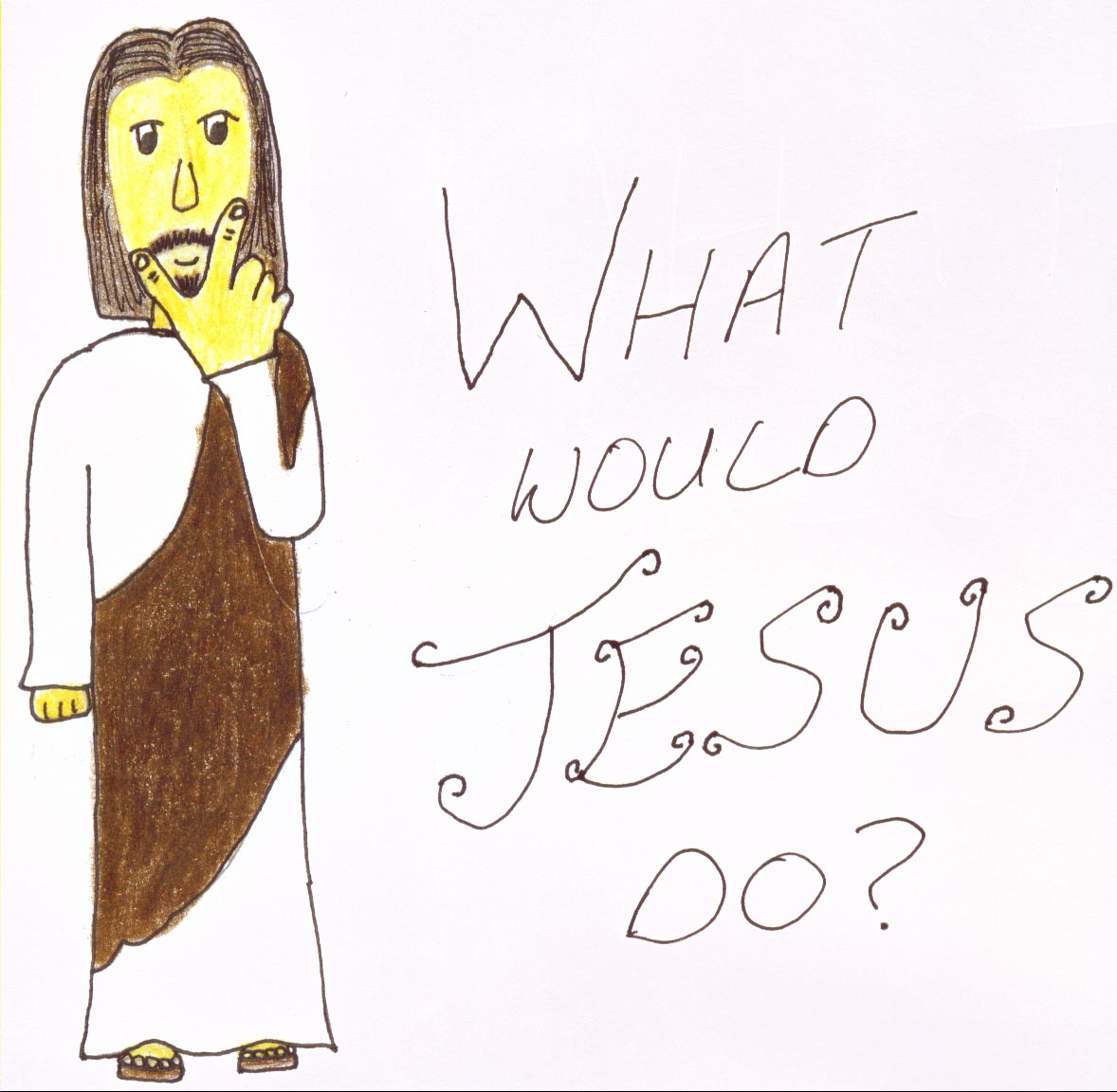
A Critique of the 'What Would Jesus Do?' Society

I really like how John Webster describes Barth's understanding against the Liberal Protestantism of his day. Ironically, I think, that the way Barth understood the Liberal Protestants of his day, could (should) be the way (by and large) that we understand American Evangelicals of our day [please note: I am speaking in generalities, there are obviously many exceptions to this amongst American Evangelicals, just as there was exceptions to the Liberal Protestants in Barth's day]. In fact, I think this dovetails nicely with the post I just posted on Occupy Wall Street. It gets to the question of how it is that "good" honest hard working (even Christian) people can be duped into thinking that the aformentioned attributes serve as the garb that justifies their place in society (i.e. as good honest hard working folk). There is always room for conviction and self-"criticality;" I know we don't like this, and I know that much of this ultimately bothers our sensibilities; but we are Christians, people of love and truth (insofar as we participate in God's life in Christ). As I've already alluded to, the following is Webster commenting on Barth and his critique of the Liberal Protestants (which I am lifting and applying to American Evangelicals). This is intended to decenter our trust in ourselves, and instead cause us to throw ourselves at the mercy of God in Christ. This is intended to turn our lights on so that we can more critically see how what counts as Christian and Ethical (in America and the West), probably is not as ethical and Christian as we think. This is intended to highlight how it is that "we" so easily become the standard for what is good and right in the world instead of our Savior, Jesus Christ.

[A] large part of Barth's distaste is his sense that the ethics of liberal Protestantism could not be extricated from a certain kind of cultural confidence: '[H]ere was ... a human culture building itself up in orderly fashion in politics, economics, and science, theoretical and applied, progressing steadily along its whole front, interpreted and ennobled by art, and through its morality and religion reaching well beyond itself toward yet better days.' The ethical question, on such an account, is no longer disruptive; it has 'an almost perfectly obvious answer', so that, in effect, the moral life becomes too easy, a matter of the simple task of following Jesus.

Within this ethos, Barth also discerns a moral anthropology with which he is distinctly ill-at-ease. He unearths in the received Protestant moral culture a notion of moral subjectivity (ultimately Kantian in origin), according to which '[t]he moral personality is the author both of the conduct with which the ethical question is concerned and of the question itself. Barth's point is not simply that such an anthropology lacks serious consideration of human corruption, but something more complex. He is beginning to unearth the way in which this picture of human subjectivity as it were projects the moral self into a neutral space, from which it can survey the ethical question 'from the viewpoint of spectators'. This notion Barth reads as a kind of absolutizing of the self and its reflective consciousness, which come to assume 'the dignity of ultimateness'. And it is precisely this --- the image of moral reason as a secure centre of value, omnicompetent in its judgements --- that the ethical question interrogates. [John Webster, Barth's Moral Theology: Human Action in Barth's Thought, 35-6]

The 'Human culture building itself up' was the German one (for Barth) that ultimately expressed itself in German bourgeois society, and ultimately Nazi Germany. For Barth, for the Liberal Protestant, because of the collapse of the Christian self into the self as the moral self; there no longer remained space for Christ to break in and speak a fresh word of holiness over and against the established norms of what the Liberal Protestant had come to already think of what counted as such. In other words, Barth was against a What Would Jesus Do? society. I am appropriating this critique from Barth (a la Webster) for the American Evangelical in particular. We have come to think that what counts as moral is captured by the symbol 'Conservative'. It is this absolutized 'Conservative Self' that presumes that what it means to be moral, and Christian is to ask, simply, 'What Would Jesus Do?' This perfectly illustrates Barth's critique of the German Liberal Protestant. For them, as for us, to be Christian, was to be nationalist, exceptional, and normal. It is this posture that negates any space for the Word of God to break in on all of these norms or the status quo; since the status quo is synonymous with being Christian. And it is this self-evidential situation which allows for atrocities to take place in the name of Christ; through the "absolute self."

Is what I am getting at overstated?

A repost

Friday, June 1, 2012

Rational V. Rationalism in the Theology of Karl Barth

A friend, Travis McMaken a recent PhD grad from Princeton Theological Seminary offered this really great quote from Karl Barth on being rational V. rationalistic:

Karl Barth
All dogmatic formulations are rational, and every dogmatic procedure is rational to the degree that in it use is made of general concepts, i.e., of the human ratio. It can be called rationalistic, however, only when we can show that the use is not controlled by the question of dogma, i.e., by subordination to Scripture, but by something else, most probably by the principles of some philosophy. If it is clearly understood that dogmatics generally and necessarily involves rational formulation, a rational formulation which is, of course, related to a completed proof and which takes account of Scripture, then no objection can be taken to logical and grammatical formulae as such, for we fail to see why these should be especially suspect more than certain legal formulae. The only thing is that we must ask whether in a given case they are appropriate to the matter or not, which means, concretely, whether it is an arbitrary anticipation, simplification, or even complication . . . [of] what Holy Scripture tells us. [Karl Barth, Church Dogmatics 1.1, 296-7] [full post by Travis can be found here]

This is an important qualification brought to mind by Barth (thanks to Travis). I don't think this is probably a problem people often associate with me---that is being irrational (although my wife often thinks so ;-)---but I don't traffic in the kind of theological discourse (analytic theology) that is normally associated with being rational or rationalist; instead I follow a kind of theological method that is known as dialectic, where paradox is often celebrated as a virtue instead of a vice in theological thinking. And yet, it should be clear that I am not interested in irrational or non-realist types of theological thinking; instead I want to be very rational only because to be rational is to participate in a God of order and thoughtfulness. But that said, there is a difference between being rational (thoughtful and coherent in thought) V. rationalistic. Rationalism, as a thought-system, takes shape by grounding its method in philosophical abstraction instead of Christological particularity and concreteness. It is as Barth underscores above, a system of thought that does not situate itself, primarily within a properly oriented dogmatic schema; which is 'in Christ', in principle.

So I am really only interested in doing theology from a rational point of view, but not a rationalistic one. To me, this means, that everything becomes 'Christ-conditioned'; meaning that hermeneutics, a doctrine of God, a doctrine of Scripture, a doctrine of salvation, a doctrine of eschatology will all take shape with Christ as front-and-center.

Everyone say thank you to Travis for providing this quote for us ;-).

Thursday, May 24, 2012

A Christ-Conditioned Interpretation of Scripture, As Literature

Of course in light of my last post; scripture is literature, and so I should be clear that I am not in anyway suggesting a rejection of that more than obvious reality. Instead, that there is an ontology of Scripture that flows from within a properly construed concept of God's triune life and Self-revelation of himself in Jesus Christ. It is this framework that ought to tense the way we approach scripture as the literature that it is, and appreciate that the singular meaning of scripture is centered in Jesus Christ and the God revealed in and through Jesus Christ (Triune). As Thomas Torrance has said, this is scriptures 'depth dimension', and one that framing and understanding scripture in the way that Ernst Käsemann cannot appreciate. Scripture is about Jesus, and I think it is about Jesus in an intensively, principial way; meaning that Jesus and God's Triune life is what holds all of scripture together. If this is the case, and I think it is, then this ought to impinge on the way we interpret scripture (as it did for Karl Barth for example in his Commentary on Romans). Here is how David Gibson describes Barth's approach to biblical interpretation, and in particular, his interpretation of Romans 9--11 as a case study:

Karl Barth
 A good example can be found in the way Barth approaches Romans 9–11. When his thesis of biblical text as witness to revelation is read in conjunction with his understanding of Jesus Christ as the object of that witness, and with his understanding of Jesus Christ as therefore the electing God and the elected man, then a particular set of theological lenses for reading Romans 9–11 come into view. Barth’s approach is well stated by Douglas Sharp:
[Barth's] exegesis [of Rom. 9--11] presupposes the identity of revelation/incarnation and election, and can be seen to consist in the interpretation of an objective reality (Israel and the Church) which he finds imaged in the text. The truly significant element of the exegesis is the fact that it is not so much the intepretation of biblical revelation as it is an interpretation of a medium which is itself an interpretation of revelation. This is to say that the exegesis of Romans 9–11 is an interpretation of an interpretation. Jesus Christ is the revelation, and Barth views the existence of the community as an interpretation of that revelation. Thus Barth interprets the community in its two forms in terms of the primary reality of Jesus Christ’s election.
This argument corresponds with what we discovered in reading Barth’s exegesis of Romans 9–11. The two forms of the community, Israel and the church, were read by Barth as witnesses to the two-fold determination of Jesus Christ for both judgment and mercy; here Christology intensively occupies the horizon of interpretation. We may recall how different this is to Calvin’s approach. Calvin’s covenant hermeneutic for Romans 9–11 (arguably the most salient feature of his exegesis) is influenced by Christology. But his hermeneutic is not christologically intensive, because he does not see Christology as the meaning of certain verses where Christ himself is not mentioned or as providing the typological structures for Israel and the church within the details of the text.

It is now clear that Barth’s reading of the Bible displays a heremeneutical paradigm that is created not just by Barth’s doctrine of election as it has emerged out of his reading of the Johannine Prologue, but just as closely by a tightly related set of well developed and consistently applied hermeneutical convictions that have operated at least as far back as CD I/2. As Barth comes to provide extended exegesis of biblical texts as part of his doctrine of election, his understanding of interpretive freedom and responsibility ensures that his exegesis of election will be carried out in a manner that may be described as intensively christocentric. This is because his account of the required subordination of the biblical interpreter to the witness of revelation is itself intensively christocentric. [David Gibson, Reading The Decree: Exegesis, Election, and Christology in Calvin and Barth, (London: T&T Clark, A Continuum imprint, 2009), 190-91]

I am actually not totally sure I am altogether comfortable with interpreting scripture the way Barth does, in toto, but I am quite close. I see all of the OT, for example, prefiguring the preincarnate Christ; and then the OT given it's proper orientation in its fulfillment in and through Jesus Christ's actual incarnation (and all the attendant realities associated with that). Nevertheless, in gist, I am heading more in the direction of Barth, than what Gibson describe's of Calvin's approach as soteriological-extensive (which we can get more into later); if possible, I might be somewhere in between Barth and Calvin. Which really, that's right about where T.F. Torrance was at.

PS. Just so you all know, if not apparent, I often work through my thinking right here at the blog, in the open. So, a post like this represents that mode of my blogging existence; I'm in process here.


Thursday, April 12, 2012

John Webster, Biblical Interpretation: Some Reflection

Here is how John Webster sums up his discussion on the relation of ‘The Word’ (Jesus) to biblical interpretation (hermeneutics). Webster
has been arguing against the usual modes of hermeneutical consideration, as anthropology; and through a resourcement of Barth, he is presenting a ‘way’ that provides for a thick dogmatically oriented mode of hermeneutical theory.

To sum up: because God in Jesus Christ speaks, because Jesus is God’s living Word, then the ‘hermeneutical situation’falls under the rule: ‘We do not know God against his will or behind his back, as it were, but in accordance with the way in which he has elected to disclose himself and communicate his truth’.52 Once this is grasped, then doctrines begin to do the work so frequently undertaken by anthropology or theories of historical consciousness in determining the nature of the hermeneutical situation, thereby making possible the ‘formed reference’ which is the basic mode of theological depiction. [John Webster, "Hermeneutics in Modern Theology: Some Doctrinal Reflections," Scottish Journal of Theology, 328]

In other words, modern hermeneutical proposals that seek to propound a theory of biblical interpretation that aren’t first given shape by a direct encounter with the Word (Jesus), dogmatically; will always fail to encounter Jesus for who he actually is because the interpretive event is not dominated by him, but them.

Saturday, April 7, 2012

The Problem of Sin, and Its Answer: Good Friday, Holy Saturday and ...

I don't know about you, but I grow weary of sin; I (we) face an ongoing battle every breath that we take. Whether it be perverse thoughts, dark deep secrets that plague the conscience, actions that result in destruction for you and all those related to you, systemic evil that permeates the very fabric of society (this is probably most insidious since we are conditioned by it in ways that give it a normalcy and thus societal and then personal acceptance); the Apostle can relate,

23But I see another law in my members, warring against the law of my mind, and bringing me into captivity to the law of sin which is in my members. 24O wretched man that I am! who shall deliver me from the body of this death? Romans 7:23, 24


 We battle on. But how do we know what we battle; how do we gauge the target, how do we even know that there is a target to hit? How do we realize that evil isn't some just mysterious lurking principle 'out there' that ultimately is outside of me, and not something that actually implicates my very being to its deepest depths---even when I engage in the evil 'out there' occasionally or situationally? How do I know, even if I can index concrete and ongoing instantiations of evil 'out there, that the evil is indeed me? And that this all encompassing wickedness and deprivation consumes my inner self, which organically shapes my outer self---since really ourselves (body/soul) are integrated wholes. In other words, I am sin to the depths, and the reason there is sin, evil, wickedness 'out there'; it is mostly because it has a context 'in here', in me. But how can I say such things, how can I ground such assertions beyond some sort of psychological intuition? We know that we are blind when the impression of light intensifies our darkness; when Jesus acts the way he does, and did, we know we are indeed blind. We come to the realization that for all our good, for all our posturing toward ourselves; that the next to the last word is that we live in a state of No, or blindness to the fact that what we see the Apostle Paul giving voice to can only come when faced with the depth of our problem as we participate in the life of Christ. The One who took our No, our blindness, and indeed our sin unto himself 'by becoming sin for us that we might become the righteousness of God in him' (II Cor. 5:21). As Calvin so perceptively knew, we only truly have knowledge of ourselves (and our abysmal state), when we first have knowledge of God through Christ, God the Redeemer.

It is this that John Webster masterfully elucidates as he engages Karl Barth's vision of a christologically conditioned knowledge of sin in its most depth dimension. Let me quote Webster, who is commenting on Barth's Church Dogmatics & Ethics, and the moral anthropology embedded therein:

[B]arth's Christological determination of sin is not so much an attempt to dislocate 'theological' from 'empirical' reality, as an argument born of a sense that human persons are characteristically self-deceived. Human life is a sphere in which fantasy operates, in which human persons are not able to see themselves as they truly are. The 'man of sin'

thinks he sits on a high throne, but in reality he sits only on a child's stool, cracking his little whip, pointing with frightful seriousness his little finger, while all the time nothing happens that really matters. He can only play the judge. He is only a dilettante, a blunderer, in his attempt to distinguish between good and evil, right and wrong, acting as though he really had the capacity to do it. He can only pretend to himself and others that he has the capacity and that there is any real significance in his judging. (CD IV/1, p. 446.)

This theme of concealment surfaces frequently in paragraph 60 (and elsewhere). Believing ourselves to see clearly, even allowing ourselves to suppose our sight to be sharper than that of our fellows, we are blind to the reality of our own selves. Barth acutely perceives that moral earnestness frequently rests upon clouded vision and lack of self-awareness and self-distrust. And so, once again, we return to the Christological basis for the treatment of human sin: 'Compared with Him we stand there in all our corruption ... The untruth in which we are men is disclosed ... We are forced to see and know ourselves in the loathsomeness in which we find ourselves exposed and known.'

Human sinfulness, then, entails an ability to disentangle ourselves from our acts in such a way that they are no longer really ours. As Barth puts it in a passage in Church Dogmatics IV/2, we allow ourselves to believe that:

The sinful act is regrettable but external, incidental and isolated failure and defect; a misfortune, comparable to one of the passing sicknesses in which a healthy organism remains healthy and to which it shows itself to be more than equal. On this view, the individual --- I myself --- cannot really be affected by the evil action. I do not have any direct part in its loathsome and offensive character. In the last resort it has taken place in my absence. I myself am elsewhere and aloof from it. And from this neutral place which is my real home, I can survey and evaluate the evil that has happened to me in its involvement with other less evil and perhaps even good motives and elements; in its not absolutely harmful but to some extent positive effects; in its relationship to my other much less doubtful and perhaps even praiseworthy achievements; and especially in my relationship to what I see other men do or not do (a comparison in which I may not come out too badly); in short, in a relativity in which I am not really affected at bottom. I may acknowledge and regret that I have sinned, but I do not need to confess that I am a sinner.  (CD IV/2, p. 394)

These clarifications of the forms of human self-deception (which are by no means intended to underrate the ambiguity of the moral situation) are an important background to Barth's treatment of original sin. His objection to some formulations of that doctrine is, at heart, that they are deficient in their account of positive evil. And his refusal of an independent locus peccati, his rejection of anything other than a Christologically determined account of sin, is directed by precisely the same concern. Far from averting attention from evil as fact, Christology is intended to furnish a means of clarifying our vision and dissolving our illusions about our own moral integrity. [John Webster, Barth's Moral Theology: Human Action in Barth's Thought, 69-70.]

The Apostle Paul concurs with this kind of assessment about the deleterious effects of sin upon a life that knows that it only knows its true state of affairs because of the One who finally has given the last word  to our No-being by his Yes to the Father for us---viz. a Yes that is given concrete form through his death, burial, and most importantly resurrection-ascension. The Apostle Paul, with his eyes wide open, as we noted earlier, gives a final sigh of relief when he writes:

 25I thank God through Jesus Christ our Lord. So then with the mind I myself serve the law of God; but with the flesh the law of sin. Romans 7:25

The Apostle knew, that he knew sin, not ultimately because of the Law; but ultimately, because of Christ who penetrated deeper than the Law could on its own---viz. into the cavernous depths of the human soul which left to itself continues to look at evil and wickedness as if its 'out there', while all along failing to realize that they've never even seen sin and evil and wickedness in its most grotesque form; that's because they've never presumed that maybe, just maybe the most insidious form of evil, in the end, dwells where they can't peer, where they dare not, in themselves.

Monday, March 26, 2012

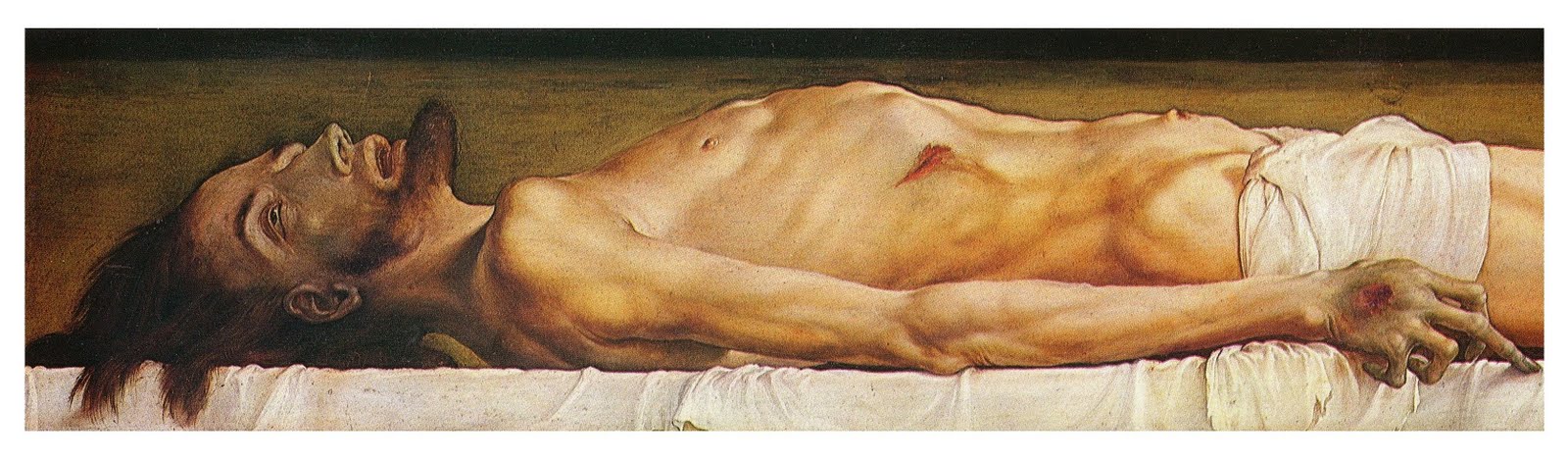
The Death of Death

**This week I am going to hit the motif of death, burial, and resurrection for my posts leading up to Resurrection Sunday. Here is a post I just wrote recently that I thought I would post again because I think it fits in well with the timing of our Christian calendars.

I don't know about you, but I grow weary of sin; I (we) face an ongoing battle every breath that we take. Whether it be perverse thoughts, dark deep secrets that plague the conscience, actions that result in destruction for you and all those related to you, systemic evil that permeates the very fabric of society (this is probably most insidious since we are conditioned by it in ways that give it a normalcy and thus societal and then personal acceptance); the Apostle can relate,

23But I see another law in my members, warring against the law of my mind, and bringing me into captivity to the law of sin which is in my members. 24O wretched man that I am! who shall deliver me from the body of this death? Romans 7:23, 24
We battle on. But how do we know what we battle; how do we gauge the target, how do we even know that there is a target to hit? How do we realize that evil isn't some just mysterious lurking principle 'out there' that ultimately is outside of me, and not something that actually implicates my very being to its deepest depths---even when I engage in the evil 'out there' occasionally or situationally? How do I know, even if I can index concrete and ongoing instantiations of evil 'out there, that the evil is indeed me? And that this all encompassing wickedness and deprivation consumes my inner self, which organically shapes my outer self---since really ourselves (body/soul) are integrated wholes. In other words, I am sin to the depths, and the reason there is sin, evil, wickedness 'out there'; it is mostly because it has a context 'in here', in me. But how can I say such things, how can I ground such assertions beyond some sort of psychological intuition? We know that we are blind when the impression of light intensifies our darkness; when Jesus acts the way he does, and did, we know we are indeed blind. We come to the realization that for all our good, for all our posturing toward ourselves; that the next to the last word is that we live in a state of No, or blindness to the fact that what we see the Apostle Paul giving voice to can only come when faced with the depth of our problem as we participate in the life of Christ. The One who took our No, our blindness, and indeed our sin unto himself 'by becoming sin for us that we might become the righteousness of God in him' (II Cor. 5:21). As Calvin so perceptively knew, we only truly have knowledge of ourselves (and our abysmal state), when we first have knowledge of God through Christ, God the Redeemer.

It is this that John Webster masterfully elucidates as he engages Karl Barth's vision of a christologically conditioned knowledge of sin in its most depth dimension. Let me quote Webster, who is commenting on Barth's Church Dogmatics & Ethics, and the moral anthropology embedded therein:

[B]arth's Christological determination of sin is not so much an attempt to dislocate 'theological' from 'empirical' reality, as an argument born of a sense that human persons are characteristically self-deceived. Human life is a sphere in which fantasy operates, in which human persons are not able to see themselves as they truly are. The 'man of sin'

thinks he sits on a high throne, but in reality he sits only on a child's stool, cracking his little whip, pointing with frightful seriousness his little finger, while all the time nothing happens that really matters. He can only play the judge. He is only a dilettante, a blunderer, in his attempt to distinguish between good and evil, right and wrong, acting as though he really had the capacity to do it. He can only pretend to himself and others that he has the capacity and that there is any real significance in his judging. (CD IV/1, p. 446.)

This theme of concealment surfaces frequently in paragraph 60 (and elsewhere). Believing ourselves to see clearly, even allowing ourselves to suppose our sight to be sharper than that of our fellows, we are blind to the reality of our own selves. Barth acutely perceives that moral earnestness frequently rests upon clouded vision and lack of self-awareness and self-distrust. And so, once again, we return to the Christological basis for the treatment of human sin: 'Compared with Him we stand there in all our corruption ... The untruth in which we are men is disclosed ... We are forced to see and know ourselves in the loathsomeness in which we find ourselves exposed and known.'

Human sinfulness, then, entails an ability to disentangle ourselves from our acts in such a way that they are no longer really ours. As Barth puts it in a passage in Church Dogmatics IV/2, we allow ourselves to believe that:

The sinful act is regrettable but external, incidental and isolated failure and defect; a misfortune, comparable to one of the passing sicknesses in which a healthy organism remains healthy and to which it shows itself to be more than equal. On this view, the individual --- I myself --- cannot really be affected by the evil action. I do not have any direct part in its loathsome and offensive character. In the last resort it has taken place in my absence. I myself am elsewhere and aloof from it. And from this neutral place which is my real home, I can survey and evaluate the evil that has happened to me in its involvement with other less evil and perhaps even good motives and elements; in its not absolutely harmful but to some extent positive effects; in its relationship to my other much less doubtful and perhaps even praiseworthy achievements; and especially in my relationship to what I see other men do or not do (a comparison in which I may not come out too badly); in short, in a relativity in which I am not really affected at bottom. I may acknowledge and regret that I have sinned, but I do not need to confess that I am a sinner. (CD IV/2, p. 394)

These clarifications of the forms of human self-deception (which are by no means intended to underrate the ambiguity of the moral situation) are an important background to Barth's treatment of original sin. His objection to some formulations of that doctrine is, at heart, that they are deficient in their account of positive evil. And his refusal of an independent locus peccati, his rejection of anything other than a Christologically determined account of sin, is directed by precisely the same concern. Far from averting attention from evil as fact, Christology is intended to furnish a means of clarifying our vision and dissolving our illusions about our own moral integrity. [John Webster, Barth's Moral Theology: Human Action in Barth's Thought, 69-70.]

The Apostle Paul concurs with this kind of assessment about the deleterious effects of sin upon a life that knows that it only knows its true state of affairs because of the One who finally has given the last word to our No-being by his Yes to the Father for us---viz. a Yes that is given concrete form through his death, burial, and most importantly resurrection-ascension. The Apostle Paul, with his eyes wide open, as we noted earlier, gives a final sigh of relief when he writes:

25I thank God through Jesus Christ our Lord. So then with the mind I myself serve the law of God; but with the flesh the law of sin. Romans 7:25

The Apostle knew, that he knew sin, not ultimately because of the Law; but ultimately, because of Christ who penetrated deeper than the Law could on its own---viz. into the cavernous depths of the human soul which left to itself continues to look at evil and wickedness as if its 'out there', while all along failing to realize that they've never even seen sin and evil and wickedness in its most grotesque form; that's because they've never presumed that maybe, just maybe the most insidious form of evil, in the end, dwells where they can't peer, where they dare not, in themselves.