Showing posts with label Resurrection. Show all posts

Sunday, April 8, 2012

Χριστος ανεστη! Resurrection and Ascension, Where Would We Be Without Him?

We just finished watching The Passion of the Christ, a very hard movie to watch! But, tonight it was fitting to watch a movie that sketched the last hours and Passion of our Lord and Savior Jesus Christ! Praise the LORD he did not stay dead, but He is Risen, Χριστος ανεστη! The reality of this is overwhelming, and in light of the continued plight of human suffering and angst in the world it is the only news that makes sense of any and all of this. Thomas Torrance has written this as he comments on Scottish Theologian John Knox's understanding of the Resurrection, and then Justification:

[J]ustification is regarded as importing new humanity. The resurrection means that our redemption, our salvation by the death of Christ, is carried through death and hell into the new realm, into the Kingdom where there is no possibility of defeat, decay or destruction. As believers in the death of Christ we believe that we are forgiven, while we remain in the world of sin and decay. But the Resurrection of Christ assures us that the death of Jesus, that the atonement, is not involved in any passing world of decay. Our atonement is Christ and he has by his resurrection passed beyond the read of any defeat – hence the complete finality of atonement and salvation. This resurrection imports more than the victory over death and damnation, for it establishes the fact that just as in his Incarnation the Son of God was really made man as one of us, so we are united with him in his risen humanity and may therefore ever live before God as those whose humanity has been recreated and renewed. We died when Christ died, but we rose again when he rose again.... [Thomas F. Torrance, Scottish Theology: From John Knox to John McLeod Campbell, 20-1]
This truly is worth getting up to hear; isn't it? Jesus went through tormentuous depths to bring us, his beloved into his throne room, with the Father and by the communion of the Holy Spirit. He is seated there now, for real; it all to often seems like, at least to me, that when we talk about 'Theology' and things like this that we end up thinking about all of this in abstractions, even mythically; but NO! He is risen in concrete particular historical physical bodily reality; and in this resurrected glorified body he sits always living to make intercession for us. I know that today we remember his resurrection, but this would remain incomplete without his intercession; wherein his Priestly mode of mediation ensues for us at the right hand of the Father (cf. Heb. 7:25). Torrance writes this as he reflects on hyper significance of the ascension (his points are answering the question "What did the ascension do?"):

(1) It was the completion of the Incarnation event. He who descended also ascended. The very same body which had been born of the Virgin Mary, was crucified, and died was buried, ascended into heaven, for the accomplishment of all things. Thus the saving work of Christ reaches up into eternity, into the ultimate mystery of God.

(2) The union of God and man in Christ was assumed into the immediate presence of God the Father on his throne – there Christ wears our human life, and it is in our name that he is there at the right hand of God the Father Almighty, standing in for us.

(3) In our name and for our comfort he ascended to take possession of his Kingdom, to inaugurate it and enlarge it. There he is given and receives all power in heaven and on earth – there the crucified Christ sits at the right hand of power and glory.

(4) The Heavenly Session of Christ speaks of the fact that he ever lives to make intercession for us as our Advocate and High Priest and only Mediator, and prays and intercedes for us. This is the teaching of the Epistle to the Hebrews, and plays a central role in Knox's doctrine of the Lord's Supper.

(5) In his ascension Christ opened the heavens into which we may appear in him before the throne of the Father's mercy. Christ's ascension is the ground of our comfort and assurance. It is the ascended Christ who sends us his Spirit, the Comforter. Thus the full meaning of the ascension is to be discerned in relation to the outpouring of the Holy Spirit upon the Church. It is in this light that the Church of Christ is to be understood, as 'the blessed society which we the members have with our Head and only Mediator Christ Jesus, whom we confess and avow to be the Messiah promised, the only Head of his Kirk, our just Lawgiver, our only High Priest, Advocate and Mediator. [Torrance, Scottish Theology, 21-2]

A lot to be thankful for this resurrection morning and day and life! Not only could death not hold Jesus down, but the heavens could not but receive him into the presence of the Father for us. This is our great hope, and joy and source of deep comfort; Jesus is in the heavenlies, having ripped them open through the veil of his flesh, his broken but now glorified body. We are not orphans, and this all because He is Risen, Χριστος ανεστη!


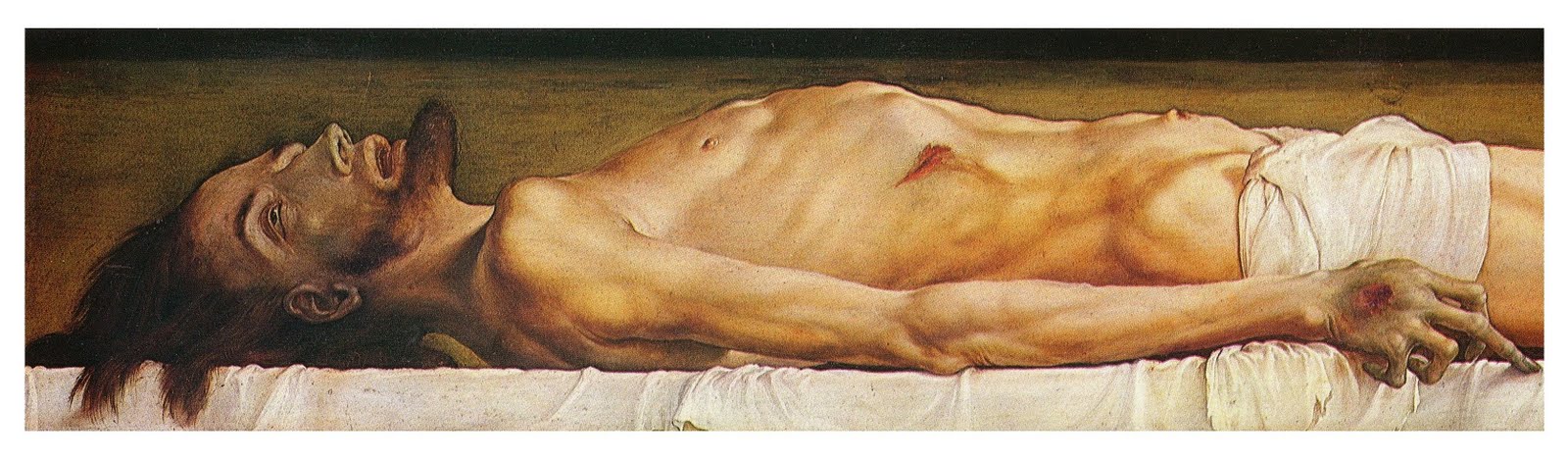


Thursday, April 5, 2012

Holy Saturday: A Reflection on the Chasm Between the Now and the Not-Yet

Holy Saturday is the time that the “Western Church,” Protestants included (well some), contemplate the moment between the death and resurrection of Jesus. It is the contemplation of the burial in 1 Corinthians 15:3, 4:

For what I received I passed on to you as of first importance: that Christ died for our sins according to the Scriptures, 4. that he was buried, that he was raised on the third day according to the Scriptures, . . .

What a time to contemplate the time between the now and the not yet. This time between Christ’s cross and humiliation of unspeakable depths, and the glories’ of His coming resurrection and ascension; analogically represent the time we inhabit now. We currently wait to fully realize the glory that Jesus has shared with the Father before the world began. And like the Apostles, Disciples, and hopefuls who followed Jesus to the cross, during this time of Jesus’ silence we can despair, be full of fear, angst, anxiousness, etc. We often wonder is this it? We face circumstances that seem overwhelming, that seem to eclipse and overcome the life of Christ . . . that make it seem as if Christ stayed in the grave. As Christians in this big world, some-times like the disciples of Christ (during this time in history), we can cower behind locked doors, scratch our heads, and wonder, “what now?”

If only the disciples would have remembered, and put 2 + 2 together, what Jesus had said to them in the past (easy for me to say):

As they were coming down the mountain, Jesus instructed them, ‘Don’t tell anyone what you have seen, until the Son of Man has been raised from the dead.’ ~ Matthew 17:9

Maybe their despair, their bewilderment, would be turned to joy. Maybe their burden would have been light. Maybe they would have been grieving as ones with real hope. But they forgot, at that moment of time they became so gripped with fear they could not really function (at least some of them, His closest). Even though we know the story, because we can read about it at one sitting, don’t we live like Jesus’ end was the grave? We fall into caverns of unbelief that seem to eclipse and overshadow what we know to be true . . . if only we would remember the hope, the hope that Jesus spoke of in Matthew 17, and the hope that was realized in Matthew 28:1-10.

As we look forward to Sunday, lets not grow weary by the unanswered questions and grief of Saturday. Instead of forgetting what Jesus has said about the resurrection (i.e. His second advent), lets glory in advance, in anticipation of the glory that will be revealed in us, as we are hidden in Christ. While we live in Saturday, in anticipation, lets rest with Jesus, lets, with Jesus say: ” . . . Father, into your hands I commit my spirit (Lk 23:46).” 

I think the best thing about this analogy, of “Holy Saturday,” is that it breaks down at a point. We don’t despair as if there is no resurrection, in fact as Christians we have been brought into the heavenly places with Christ (cf. Eph. 1), now; we have intimate union with Him now (cf. I Cor. 6:17); we have been given the Holy Spirit now (cf. Jn 14–16); and a whole array of distinguishing factors from those disciples of the first century. So take heart, don’t forget, this Holy Saturday, Jesus’ words of glory in humility:

. . . I have told you these things, so that in me you may have peace. In this world you will have trouble. But take heart! I have overcome the world. ~ John 16:33

Saturday, March 31, 2012

The Historicity of the Resurrection with Licona, and a Theological Correction from Torrance

The following are three videos done by Dr. Michael Licona, and sponsored by Michael Patton's Credo House. Licona is an expert (wrote his PhD dissertation) on the historicity of the resurrection. Even though I am more Torrancean in orientation, I still find the kind of work that Licona, Wright, Bauckham (to name a few) are doing in this area of Christian origins is still a viable and necessary piece of historical work (V. a Christian Dogmatic one). In light of the season we are in I am at least going to feature the first three of the ten videos that Licona has done thus far on the historicity of the resurrection. Here they are:

Myth #1: Contradictions in the Gospels from Credo House on Vimeo.
Myth #2: Pagan Parallels in the Mystery Religions from Credo House on Vimeo.

Myth #3: The Fraud Theory from Credo House on Vimeo.


Here is Thomas Torrance providing a more balanced way to understand the relation between the historical and the revelatory from within a Christ-conditioned mode of conception. I think Licona's & companies' work in their areas fits into the 'historical' side of the work that is indeed important to the Christian faith. But left to itself, using a Christological index, we end up with an Adoptionistic approach to Christ; wherein the humanity of Christ is merely a historical appendage adopted by the Divine Logos in his incarnation instead of given direct shape by his person in the womb of Mary (an/enhypostasis).

The mystery of Christ is presented to us within history — that historical involvement is not an accidental characteristic of the mystery but essential to it. That is the problem.

Let us first put it this way, recalling the bi-polarity of our theological knowledge. If God has become man in the historical Jesus, that is an historical event that comes under our historical examination so far as the humanity of Jesus is concerned, but the fact that God became man is an event that cannot be appreciated by ordinary historical science, for here we are concerned with more than simply an historical event, namely, with the act of the eternal God. So far as this event is a fact of nature it can be observed, and so far as it is historical in the sense that other natural events are historical, it can be appreciated as such; but the essential becoming behind it cannot be directly perceived except by an act of perception appropriate to the eternal event. That act of perception appropriate to an eternal act, or divine act, would surely be the pure vision of God, which we do not have in history. Here on earth and in time we do not see directly, face to face, but see only in part, as through a glass enigmatically, in a mystery. We see the eternal or divine act within history, within our fallen world where historical observation is essential. Faith would be better described then as the kind of perception appropriate to perceiving a divine act in history, an eternal act in time. So that faith is appropriate both to the true perception of historical facts, and also to the true perception of God’s action in history. Nor is it the way we are given within history to perceive God’s acts in history, and that means that faith is the obedience of our minds to the mystery of Christ, who is God and man in the historical Jesus. What is clearly of paramount importance here is the holding together of the historical and the theological in our relation to Christ.

If the two are not held together, we have broken up the given unity in Christ into the historical on the one hand, and the theological on the other, refracting it into elements which we can no longer put together again. We then find that we cannot start from the historical and move to the theological, or from the theological and move to the historical without distortion, and nor can we rediscover the original unity. We can only start from the given, where the historical and the theological are in indissoluble union in Christ. [Thomas F. Torrance, Incarnation, 6-7] 

I hope, with Torrance's caveat in mind, that you can appreciate something like what Licona is attempting; while at the same time understanding that Licona & company probably could use the theological corrective that Torrance has to offer!

Tuesday, March 27, 2012

Resurrection of Jesus: Apologetics or Dogmatics?

In keeping with the resurrection season we are in; here is Douglas Farrow on Thomas
Torrance and the Resurrection, as it relates to time and eternity:

[...] Torrance's important work, Space, Time, and Resurrection, was informed by his labours in ecclesiology and eschatology and at the interface between theology and the philosophy of science. 'The resurrection of Jesus is an event that happens in history in continuity with the living event of the whole historical existence of Jesus, yet as an event of fulfilled redemption the resurrection issues in a new creation beyond the corruptible processes of this world, on the other side of decay and death, and on the other side of judgement, in the fullness of a new world and of a new order of things' (Torrance 1967:86). In his attempt to answer the question as to how these things can be thought together, Torrance appealed to the concept of recapitulation and, like Irenaeus, tried to work out a view of creaturely reality capable of accommodating it. If this made the whole historical life of Jesus 'resurrection from beginning to end' (Torrance 1976:94), it did not obliterate the distinction between pre- and post-Easter forms of existence. Following Calvin and William Milligan, Torrance was careful to distinguish the doctrines of resurrection and ascension and to develop both. His focus on Christ's heavenly priesthood helped to counteract the tendency in Barth, as in some patristic thought, to emphasize the revelation of Christ's divinity at the expense of his reconstituted humanity (cf. Gunton 2003: 67-91; Burgess 2004; Dawson 2004) and drew attention to the problem of the presence and the absence, that is, to the eschatological tension generated by the departure of Jesus (cf. Seitz 2001: 133-48; Marion 2002: 124-52). It also left more room, at least in principle, for coordination of the messianic and the pneumatological dimensions of resurrection theology. [Douglas Farrow, Chapter 12 Resurrection and Immortality, 227 in The Oxford Handbook of Systematic Theology, edited by Webster, Tanner, and I. Torrance]

For Torrance, the facticity of the resurrection does not take on Apologetic value, primarily; instead, resurrection is seen as the center-piece of history that ties the beginning (protology) and the end (eschatology) together in Christ. As Christians, we already believe in the resurrection; so our procedure and approach to the resurrection will be much richer and deeper than merely trying to PROVE Christianity; the resurrection represents the recreation and opening up of all creation (cf. Rom. 8:18ff) into its original purpose. That is, to find its reality in the point and preeminent over all of creation, Christ.

So when you turn on the History Channel this week (or the Discovery Channel); don't let your first instinct be to react to their doubts and cynicism and antagonism towards the veracity of the resurrection.  Instead, understand that those very doubts have been defeated by the very thing these are doubting; the death, burial and resurrection of Jesus Christ.

Monday, March 26, 2012

The Death of Death

**This week I am going to hit the motif of death, burial, and resurrection for my posts leading up to Resurrection Sunday. Here is a post I just wrote recently that I thought I would post again because I think it fits in well with the timing of our Christian calendars.

I don't know about you, but I grow weary of sin; I (we) face an ongoing battle every breath that we take. Whether it be perverse thoughts, dark deep secrets that plague the conscience, actions that result in destruction for you and all those related to you, systemic evil that permeates the very fabric of society (this is probably most insidious since we are conditioned by it in ways that give it a normalcy and thus societal and then personal acceptance); the Apostle can relate,

23But I see another law in my members, warring against the law of my mind, and bringing me into captivity to the law of sin which is in my members. 24O wretched man that I am! who shall deliver me from the body of this death? Romans 7:23, 24
We battle on. But how do we know what we battle; how do we gauge the target, how do we even know that there is a target to hit? How do we realize that evil isn't some just mysterious lurking principle 'out there' that ultimately is outside of me, and not something that actually implicates my very being to its deepest depths---even when I engage in the evil 'out there' occasionally or situationally? How do I know, even if I can index concrete and ongoing instantiations of evil 'out there, that the evil is indeed me? And that this all encompassing wickedness and deprivation consumes my inner self, which organically shapes my outer self---since really ourselves (body/soul) are integrated wholes. In other words, I am sin to the depths, and the reason there is sin, evil, wickedness 'out there'; it is mostly because it has a context 'in here', in me. But how can I say such things, how can I ground such assertions beyond some sort of psychological intuition? We know that we are blind when the impression of light intensifies our darkness; when Jesus acts the way he does, and did, we know we are indeed blind. We come to the realization that for all our good, for all our posturing toward ourselves; that the next to the last word is that we live in a state of No, or blindness to the fact that what we see the Apostle Paul giving voice to can only come when faced with the depth of our problem as we participate in the life of Christ. The One who took our No, our blindness, and indeed our sin unto himself 'by becoming sin for us that we might become the righteousness of God in him' (II Cor. 5:21). As Calvin so perceptively knew, we only truly have knowledge of ourselves (and our abysmal state), when we first have knowledge of God through Christ, God the Redeemer.

It is this that John Webster masterfully elucidates as he engages Karl Barth's vision of a christologically conditioned knowledge of sin in its most depth dimension. Let me quote Webster, who is commenting on Barth's Church Dogmatics & Ethics, and the moral anthropology embedded therein:

[B]arth's Christological determination of sin is not so much an attempt to dislocate 'theological' from 'empirical' reality, as an argument born of a sense that human persons are characteristically self-deceived. Human life is a sphere in which fantasy operates, in which human persons are not able to see themselves as they truly are. The 'man of sin'

thinks he sits on a high throne, but in reality he sits only on a child's stool, cracking his little whip, pointing with frightful seriousness his little finger, while all the time nothing happens that really matters. He can only play the judge. He is only a dilettante, a blunderer, in his attempt to distinguish between good and evil, right and wrong, acting as though he really had the capacity to do it. He can only pretend to himself and others that he has the capacity and that there is any real significance in his judging. (CD IV/1, p. 446.)

This theme of concealment surfaces frequently in paragraph 60 (and elsewhere). Believing ourselves to see clearly, even allowing ourselves to suppose our sight to be sharper than that of our fellows, we are blind to the reality of our own selves. Barth acutely perceives that moral earnestness frequently rests upon clouded vision and lack of self-awareness and self-distrust. And so, once again, we return to the Christological basis for the treatment of human sin: 'Compared with Him we stand there in all our corruption ... The untruth in which we are men is disclosed ... We are forced to see and know ourselves in the loathsomeness in which we find ourselves exposed and known.'

Human sinfulness, then, entails an ability to disentangle ourselves from our acts in such a way that they are no longer really ours. As Barth puts it in a passage in Church Dogmatics IV/2, we allow ourselves to believe that:

The sinful act is regrettable but external, incidental and isolated failure and defect; a misfortune, comparable to one of the passing sicknesses in which a healthy organism remains healthy and to which it shows itself to be more than equal. On this view, the individual --- I myself --- cannot really be affected by the evil action. I do not have any direct part in its loathsome and offensive character. In the last resort it has taken place in my absence. I myself am elsewhere and aloof from it. And from this neutral place which is my real home, I can survey and evaluate the evil that has happened to me in its involvement with other less evil and perhaps even good motives and elements; in its not absolutely harmful but to some extent positive effects; in its relationship to my other much less doubtful and perhaps even praiseworthy achievements; and especially in my relationship to what I see other men do or not do (a comparison in which I may not come out too badly); in short, in a relativity in which I am not really affected at bottom. I may acknowledge and regret that I have sinned, but I do not need to confess that I am a sinner. (CD IV/2, p. 394)

These clarifications of the forms of human self-deception (which are by no means intended to underrate the ambiguity of the moral situation) are an important background to Barth's treatment of original sin. His objection to some formulations of that doctrine is, at heart, that they are deficient in their account of positive evil. And his refusal of an independent locus peccati, his rejection of anything other than a Christologically determined account of sin, is directed by precisely the same concern. Far from averting attention from evil as fact, Christology is intended to furnish a means of clarifying our vision and dissolving our illusions about our own moral integrity. [John Webster, Barth's Moral Theology: Human Action in Barth's Thought, 69-70.]

The Apostle Paul concurs with this kind of assessment about the deleterious effects of sin upon a life that knows that it only knows its true state of affairs because of the One who finally has given the last word to our No-being by his Yes to the Father for us---viz. a Yes that is given concrete form through his death, burial, and most importantly resurrection-ascension. The Apostle Paul, with his eyes wide open, as we noted earlier, gives a final sigh of relief when he writes:

25I thank God through Jesus Christ our Lord. So then with the mind I myself serve the law of God; but with the flesh the law of sin. Romans 7:25

The Apostle knew, that he knew sin, not ultimately because of the Law; but ultimately, because of Christ who penetrated deeper than the Law could on its own---viz. into the cavernous depths of the human soul which left to itself continues to look at evil and wickedness as if its 'out there', while all along failing to realize that they've never even seen sin and evil and wickedness in its most grotesque form; that's because they've never presumed that maybe, just maybe the most insidious form of evil, in the end, dwells where they can't peer, where they dare not, in themselves.