Showing posts with label Thomas F. Torrance. Show all posts

Thursday, July 12, 2012

You Can't Have Jesus Without Faith

You can't simply do historical analysis of the New Testament and expect to come to right conclusions about Jesus. And yet this is where so much of 'Evangelical' scholarship (and Christian scholarship in general) resides. You can't use analogies that start with yourself and work your way to Jesus from there, and expect to find the genuine Jesus; you'll just end up finding the Jesus who looks oh so much like yourself--the Jesus molded in your own image. So the irony of what I just asserted is that I am saying that you can't 'solely' rely on historical Jesus studies and expect to find the true Jesus, and at the same time I am asserting that we must avoid somehow importing our own historical culturally situadedness back onto the face of Jesus. So what's the answer to this dilemma? What get's us beyond this impasse of dualism between studying Jesus through historical empericism and isolated subjectivism? I mean isn't Christianity a religion based in history? Yes. But history by itself does not have the proper traction or orientation to provide humanity--embedded within history--with the proper epistemological antennae needed to penetrate the depths which gives history its right relation to the one who gave us history to begin with. Am I speaking too cryptically for you yet?

Here Thomas Torrance speaks somewhat less cryptically about how we ought to dogmatically consider the relation between history and revelation through the optic of Faith:

All this means that any christological approach that starts from the man Jesus, from the historical Jesus, and tries to pass over to God, and so to link human nature to God, is utterly impossible. In fact it is essentially a wrong act: for it runs directly counter to God's act of grace which has joined God to humanity in Christ. All Attempts to understand Jesus Christ by starting off with the historical Jesus utterly fail; they are unable to pass over from man to God and moreover to pass man to God in such a way as not to leave man behind all together, and in so doing they deny the humanity of Jesus. Thus though Ebionite christologies all seek to go from the historical Jesus to God, they can make that movement only by denying the humanity of Jesus, that is by cutting off their starting point, and so they reveal themselves as illusion, and the possibility of going from man to God is revealed as likewise illusory.

No, it is quite clear that unless we are to falsify the facts from the very start, we must face with utter and candid honesty the New Testament presentation of Christ to us, not as a purely historical figure, nor as a purely transcendental theophany, but as God and man. Only if we start from that duality in which God himself has already joined God and man, can we think God and humanity together, can we pass from man to God and from God to man, and all the time be strictly scientific in allowing ourselves to be determined by the nature of the object. [Thomas F. Torrance, Incarnation, edited by Robert Walker, 10]

So Torrance's premise is that what has happened in the incarnation is totally unique, and has only been made accessible through the purview of faith. Not blind faith, but faith that takes it shape as it is given to us through the revelation of God himself in and through the vicarious humanity of Christ for us; the humanity that grounds all of humanity as the image of God (Colossians 1:15)--so faith is the eyes to see and the ears to hear with that Jesus so often challenges his audiences to employ.

What does this tell us about historical Jesus studies that seek to tell us the truth about Jesus, but then fail to do so through the mode of faith? It tells me that these approaches are trying to find a public square, a common ground through which to substantiate and situate Jesus in such a way that he has respectability amongst the world. Once this respectability has been established, and Jesus rightly reconstructed, then we can attend to the issues of faith (so there is an implicit competition, then, in this scenario, between the Jesus of Faith and History). To be clear, none of this is to reject the usage of historical tools, but it is to call attention to the need that these tools have; the need is to provide for them a prior Christian dogmatic order that will allow those tools to not chisel a Jesus into something he is not (e.g. first a man, then God added on). He is God first, who becomes man; and this is such a unique event that it in itself can only be its own analogy.

There is more to say about the TF Torrance quote above; especially about the affirmation of creation and humanity that is provided for it through the incarnation of Christ. Maybe another time, or in the comments. 

Tuesday, July 10, 2012

The Jesus of History & Faith, Conjoined

I wanted to address something that dovetails with a recent mini-essay that Darren Sumner wrote on Karl Barth's understanding of history and revelation. What I want to do is provide a counter-part post that underscores and articulates Thomas F. Torrance's view on the same subject. If you read Darren's post alongside this post; what you'll notice is that both Torrance and Barth share a very similar understanding on the relationship between how revelation and history work together, and how the former ultimately must be said to condition the latter; and not vice versa. Here is TF Torrance, at length (I will highlight the significance of this relative to the normal ways that Evangelicals and some of the Reformed use history as the foundation for their view of revelation---which is really backwards from a genuinely Christian order of things):

The mystery of Christ is presented to us within history --- that historical involvement is not an accidental characteristic of the mystery but essential to it. That is the problem.
Let us first put it this way, recalling the bi-polarity of our theological knowledge. If God has become man in the historical Jesus, that is an historical event that comes under our historical examination so far as the humanity of Jesus is concerned, but the fact that God became man is an event that cannot be appreciated by ordinary historical science, for here we are concerned with more than simply an historical event, namely, with the act of the eternal God. So far as this event is a fact of nature it can be observed, and so far as it is historical in the sense that other natural events are historical, it can be appreciated as such; but the essential becoming behind it cannot be directly perceived except by an act of perception appropriate to the eternal event. That act of perception appropriate to an eternal act, or divine act, would surely be the pure vision of God, which we do not have in history. Here on earth and in time we do not see directly, face to face, but see only in part, as through a glass enigmatically, in a mystery. We see the eternal or divine act within history, within our fallen world where historical observation is essential. Faith would be better described then as the kind of perception appropriate to perceiving a divine act in history, an eternal act in time. So that faith is appropriate both to the true perception of historical facts, and also to the true perception of God's action in history. Nor is it the way we are given within history to perceive God's acts in history, and that means that faith is the obedience of our minds to the mystery of Christ, who is God and man in the historical Jesus. What is clearly of paramount importance here is the holding together of the historical and the theological in our relation to Christ.

If the two are not held together, we have broken up the given unity in Christ into the historical on the one hand, and the theological on the other, refracting it into elements which we can no longer put together again. We then find that we cannot start from the historical and move to the theological, or from the theological and move to the historical without distortion, and nor can we rediscover the original unity. We can only start from the given, where the historical and the theological are in indissoluble union in Christ. [Thomas F. Torrance, Incarnation, 6-7]

So there is no analogy for the incarnation. And for Torrance, the incarnation must be the definitive touchstone for how we start to conceive of a knowledge of God (the Old Testament then is seen as the pre-incarnation of God in Christ); and since there is not human analogy for this reality to be found in the history of history (i.e. God and humanity united in a single person), the only 'foundation' that can be used to justify our belief about God must be given its shape and reality through the given reality of the incarnate Christ---which means, faith.

This means that we cannot start with an abstracted history (like a naked evidentialism) and seek to attach this to the history of Jesus, but the history we have, in itself, of Christ's revelation is the given reality itself; there is nothing else that can be determinate of that, other than the truly and self-determinately free God himself.

*A repost for those who may have not read this, I once posted this not too long ago at my EC (Wordpress) blog.

Monday, July 9, 2012

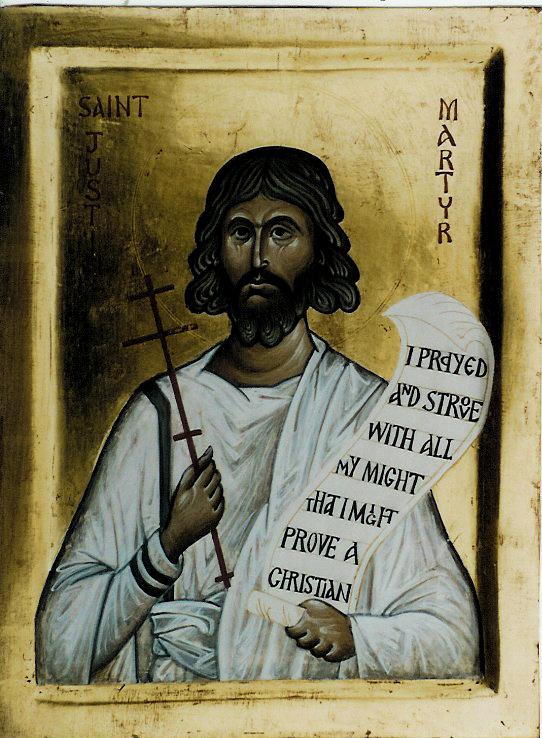
Thomas Torrance on Justin Martyr and "Proving Jesus" as Hermeneutic

Justin Martyr
Thomas Torrance, in his Theological Science (his theological method, and a title of one of his books), follows what he calls an epistemological inversion; in short, epistemological inversion is the approach that holds out that an object or subject (or both as in the case of Christian Theology) acts upon us (the knowers and inquirers), such that it itself opens up to us its own reality and structures of thought—this process remains an open structured event. It is from within this context that we can better understand Thomas Torrance’s appropriation of someone like Justin Martyr, and his defense of Christian reality and the Christic event itself (one and the same). Let’s follow along as Torrance engages Martyr, this quote will end with Torrance quoting Justin (which is the piece I really want to get to with this post—viz. Martyr’s “argument”):
The distinctive feature of this Word is its relation through the Spirit to historical facts and events. It is when we allow the Scriptures to direct us to these facts and events that our minds fall under the power of their truth and we are compelled to believe for they carry in themselves their own demonstration. This is not, of course, any kind of logical proof, but the kind of demonstration that arises immediately out of the facts and events themselves through their self-evidence. This is particularly well expressed in a fragment of a lost work on the resurrection that has survived through John of Damascus and attributed to Justin.
[T]he Word of truth is free, and carries its own authority, disdaining to fall under any skilful argument, or to endure the logical scrutiny for its hearers. But it would be believed of its own sake, and for the confidence due to him who sends it. Now the Word of truth is sent from God, wherefore the freedom claimed by the truth is not arrogant. For being sent with authority, it were not fit that it should be required to produce proof of what is said, since neither is there any proof beyond itself, which is God. For every proof is more powerful and trustworthy than that which it proves, since what is disbelieved, until proof is produced, gets credit when such proof is produced, and is recognised as being what it was stated to be. But nothing is more powerful or more trustworthy than the truth; so that he who requires proof of this, is like one who wishes it demonstrated why the things that appear to the senses do appear. For the test of those things which are received through the reason, is sense; but of sense itself there is not test beyond itself. As then we bring those things which reason hunts after, to sense, and by it judge what kind of things they are, whether the things spoken be true or false, and then sit in judgment no longer, giving full credit to its decision; so also we refer all that is said regarding men and the world to the truth, and by it judge whether it be worthless or no. But the utterances of truth we judge by no separate test, giving full credit to itself. And God, the Father of the universe, who is the perfect intelligence, is the Truth. And the Word, being his Son, came to us, having put on flesh revealing  both himself and the Father, giving to us in himself resurrection from the dead and eternal life afterwards. And this is Jesus Christ our Saviour and Lord. He, therefore, is himself both the faith and the proof of himself and of all things. [Thomas F. Torrance, Divine Meaning, 95-6; the quote from Justin, De resurrectione, 1.1f, from the Sacra Parallela of John of Damascus. E.T. from Ante Nicene Christian Library, vol. 2, pp. 341ff. This is not generally accepted as Justin's
own work, but like the Cohortatio ad Graecos was at least written under his influence.]

For all those weary souls who have labored under the Evangelical mantle of ‘Fighting Fundamentalism’ and the Apologetic Faith (as Warfield called it); won’t you join me in commending yourself to a more Christian Way? A ‘Way’ that does not entangle itself in the realm of rationalist-historicism, that seeks to ‘prove’ Jesus to themselves and the world. I am sure that it is the other way around … we are in need of ‘proving’. And I think the “Martyr” quote helps us to think in this order, and not the order of the “world.”

Sunday, July 8, 2012

Too Much Jesus in the Bible?

I would like to expose you all to Thomas Torrance's take on Irenaeus' understanding on what could be called a Christocentric Hermeneutic. As you read Torrance's account of Irenaeus, understand that you are reading Torrance too. Here is Torrance on Irenaeus:

It is, then, to the Incarnation that Irenaeus turns for the clue to the interpretation of the history of creation and redemption and therefore for the clue to the interpretation of the Scriptures. The essential order and connection of things is embodied in Jesus Christ and it is by reference to him that the economic ministrations of God in humanity and the historical covenants are to be understood aright, and therefore the interconnection between the scriptures of the prophets and the scriptures of the Apostles, 'the Gospel and the Apostles. Even the Scriptures of the old covenant have to be read in the light of Christ's advent in the flesh, for his coming connected the end with the beginning and made the beginning predictive of the end, thus showing that the faith of the patriarchs and prophets and ours is one and the same. They sowed the seed, the word about Christ (sermonem de Christo), but it is in us that the fruit is reaped and received, and only in the Church is the truth of the things prefigured realised. 'Certain facts had to be announced beforehand by the fathers in a paternal manner, (paternaliter), and others prefigured by the prophets in a legal manner (legaliter), but others delineated according to the pattern of Christ (deformari secundum formationem Christi) by those who perceived the adoption, for in one God are all things shown forth.' [Thomas F. Torrance, Divine Meaning, 122-23]

How does this strike you? Do you think this is too intense for a hermeneutic or mode for interpreting Scripture? Is your method of biblical interpretation this intensively Christ focused? I am really curious how you all think of this; I obviously highly appreciate this kind of 'Patristic' method of interpreting and reinterpreting (the OT) Scripture in light of  its fulfillment in Christ. This rubs against the method of interpretation I learned (by and large) in Bible College and Seminary; which is the Literal Grammatical Historical method (the kind that leads to and from Dispensationalism).

Saturday, July 7, 2012

Knowledge of God for Thomas Torrance

Here is a video I did about 2 years ago (forgive my haircut, this is actually just after I finished my chemo treatments, so my hair is growing back :-). Anyway, I am interacting with Paul Molnar's book Thomas F. Torrance: The Trinitarian Theologian. I think the material covered in this video is apropos towards providing more insight into some of the issues that seem to be arising for Roger Olson as he interacts with our book. Furthermore, the material covered in this video is what I develop further in my personal chapter in our book.


So knowledge of God can only come through knowledge of God as it is Self-revealed and determined to be in Jesus Christ (cf. Jn. 1:18). Knowledge of God can only be regulated by his own Self-revelation, and thus other modes for providing grammar and content for knowledge of God cannot be entertained (such as using philosophical categories like appealing to Aristotle etc. appeal to).

Friday, July 6, 2012

Classical Determinism

Over at Roger Olson's blog, and in his most recent post where he is interacting with our recently released book, one of the issues that has come up or that is not being appreciated 'yet' is the Evangelical Calvinist eschewing of logical-causal-deductive determinism. This is somewhat of a fundamental key toward appreciating the distinct offering that we are, under the 'Evangelical Calvinist' nomenclature. True, not all, even of the authors in our book, would necessarily go this far in offering critique of classic determinism (or they might, but just might to it differently); but the following (which is a repost of mine), will illustrate how I, at least, want to proceed in relation to the usual epistemological methods employed by the 'classical' tradition. So the following is in response to what I am perceiving, thus far, as somewhat of a lacuna in the reading of Olson and those commenting vis-à-vis an Evangelical Calvinist approach.

Here T. F. explains and undoes the usual understanding of how events in history and causation relate one to the other. He defeats the idea of causation, appropriated by Classical Theists, in general; and Classical Calvinists & Arminians, in particular, that there is a necessary relation between the event that happened, and the events that led to the happening. He makes a disjunction between Factual event and Necessary event; the former being that which we understand as an actual happen-stance of the past, and the latter having to do with the idea that because that happen-stance happened, that the events that led to its happening also were necessarily organised in a certain way in order for the the conditions of that event to be so — as if we, as historians (or scientists, theologians, etc), can absolutize causes based upon an idea of uniformitarian conception of Event. Obviously this is a little complicated, and not for the faint of heart, but I think it important to be grasped in order to understand what Evangelical Calvinists mean when we say that we eschew the logico-causal-determinism of ‘classic’ thought.

 Here’s T. F. Torrance (this whole discussion takes place in the context of TFT talking about resurrection):

(a) Interpreting ordinary historical events
(i) Freedom and necessity in historical events
Let us try to understand this from a merely natural point of view. Think of a historical happening: in taking place it appears as a free happening. Once it takes place, it cannot be undone. Throw a stone through that window and you are engaging in a free act, but once it has taken place, the act cannot be recalled — we cannot turn it backwards as we can a film of the event. Thus once an event has taken place, it becomes ‘necessary’ — in the sense that it cannot now be other than it is. At this point, however, we are liable to suffer from an illusion, for we tend to think that because it is now necessary fact, it had to happen. This is the kind of optical illusion we suffer from on the golf course when our opponent putts a ball from the other end of the green and it goes right down into the hole — immediately that happens we somehow think it had to happen from the start, but what we have done in a flash is to read the final result back all along the line of the ball’s course into the free act behind it. It is through this kind of illusion or indeed delusion that some historians think that historical events are to be interpreted in the same way in which they interpret the events of natural processes as concatenated or linked together through causal necessity.

The distinction between causal necessity and factual necessity
But it is important to distinguish in historical happening between causal necessity and factual necessity, between causal determination of events and the fact that once they happen they cannot be otherwise. An historical event, once it has taken place, is factually necessary for it cannot now be other than it is, but an historical event comes into being through a free happening, by means of spontaneous human agencies. Certainly all historical events are interactions between human agents and nature, as well as interactions between agents and other agents — so that there are elements of causal determination in historical happening that we have to take into account, physical factors relating to the kind of patterns of space and time in which we live and work. But historical events are not by any means merely natural physical processes, for as happenings initiated and bound up with purposeful agents they embody intention which often conflicts with and triumphs over the course of events that nature would take on its own.

(ii) History is the interweaving of natural processes with human intention
It is this interweaving of natural processes and human agencies, of nature and rational intention, that gives history its complicated patterns. The course of events has often quite unforeseen results, for human acts may fail to achieve what would have been expected or may achieve far more than would or could have been anticipated. But in our interpretation of history we must never forget that in the heart of historical events there is free happening which bears the intention in which the true significance of history is to be discerned. Thus while we must appreciate fully the physical factors involved, we must penetrate into the movement of time in the actual happening in order to understand the event in the light of the intentionality and spontaneity embedded in it. The handling of temporal relation has proved very difficult and elusive in the history of thought, for it has so often been assimilated to logical relation and so transposed into something very different. The confusion of temporal with logical connection corresponds here to that between spontaneity and causal determinism in natural science. We can see this error recurring, for example, in notions of predestination where the free prius of the divine grace is converted by the scholastic mind into logico-causal relation, while the kind of time-relation with which we operate between natural events is imported into the movements of divine love and activity. It is a form of the same mistake that people make in regard to the resurrection, when they think of its happening only within the logico-causal nexus with which they operate in classical physics. (Thomas F. Torrance, Atonement: The Person and Work of Christ, edited by Robert T. Walker (Downers Grove, Illinois: IVP Academic, 2009, 249-50)

In keeping with Torrance’s usual mode of thinking from the Incarnation & Atonement (here the resurrection being the focus), he seeks to excoriate any ideas of logico-causal determinism as the lens through which profane historians would attempt to interpret the ‘historicity’ and ‘facticity’ of the resurrection itself — Torrance’s discussion here, is all taking shape within his line of thought associated with Kata Physin (or according to the nature of the thing, or his more popular method Theological Science). As he deconstructs the post hoc ways of what might be called ‘natural theology’ (meaning all modes of intellectual inquiry which make inferences from supposed stable events, works, physical nature, etc. to their “necessary causes”), by implication, he also gets at theological constructs (like classic Calvinism-Arminianism, Neo-Orthodoxy like Brunner’s) that operate with this same modus operandi.

The moral: There are unseen, unknown contingencies built into the nature of things themselves that make it impossible to accurately infer a stable causal chain of events from the event back to the cause itself. The answer to this, in relation to knowledge of God, is to see the event and cause conjoined together in the person-act of Jesus himself. It is from this vantage point that we then are set up to know God, in Christ, but no longer as some sort of deterministic causal agent; but instead, as personal, triune Divine agent who apocalyptically breaks into the contingencies of history re-creating them towards their telos or created purpose in Christ (cf. Col. 1:13ff) — the resurrection, then, being the instantiation of this within time-space history.


I doubt this has cleared much up, but if nothing else it helped me to write this out for my own process. I also would surmise that it is because of the nuance of this kind of thought, evinced by TFT, that Evangelical Calvinism will continue to have problems with making headway with the typical American Christian. It is easy to understand causal-determinism, because that’s what “we see” in “nature” all the time (there is an “apparent” coordination between how things appear to the naked mind’s eye, and how we then assume things in themselves “must” be — so it is natural to operate with a docetic understanding of things — but this is not Christian (and when I write 'Christian', I mean by way of what we perceive as 'principled' Trinitarian theological methodology — I am not even coming close to questioning anyone's 'salvation'), nor Evangelical Calvinism — it is the mode of Classical Calvinism & Arminianism [and I realize this is hard teaching, who can hear it?]).

Wednesday, July 4, 2012

Was Karl Barth a 'neo-Orthodox' Theologian? The Third Time ...

For anyone who was interested in that question of mine a few posts ago – e.g. whether or not Barth was actually neo-Orthodox – well, another Princeton guy I know (a bit ;-), David Congdon has offered the lineaments of a really helpful argument for why Barth was not neo-Orthodox [and he also comments on where he sees T.F. Torrance on (or not) spectrum as well]. It gives me hope, relative to my own thinking, that what David iterates jives with my earlier hunch (i.e. that natural theology is definitive for whether or not something can count as neo-Orthodox, or not). Below are the two links to the previous posts on this, and then David's clarifying comment.

1st post & 2nd post

Bobby,
I see you've posted Travis's comment. It's mostly right, but I would like to specify matters somewhat further. What neoorthodoxy did was to marshal certain ideas from Barth (mainly, divine transcendence, revelation as encounter), abstracted as static, stand-alone propositions, and use them to buttress the project of Christian orthodoxy within the modern era (hence the "new"). Neoorthodoxy is fundamentally ideological, in that it presupposes the validity of something like a Christian orthodox tradition. Having presupposed this tradition as something to be preserved and maintained, it then finds in Barth certain concepts that are useful toward that end. The reason neoorthodoxy is not dialectical theology is that the latter makes no such presupposition; it is in fact the total abolition of ecclesiastical presuppositions. Dialectical theology is a thoroughly destabilizing understanding of the gospel. Neoorthodoxy is basically a species of natural theology, in that it takes for granted something stable and given in the world -- in this case, the church. It is therefore no wonder that Barth and Brunner would fall out over that issue.

For these reasons, I demur from Travis on two points. First, existentialism as such is not a constitutive element of neoorthodoxy. It is only existentialism as it is welded to a certain kind of natural theology, as it was in Brunner's case, but emphatically not in the case of Bultmann. Second, I cannot help but see Torrance as operating within the ambit of neoorthodoxy. He did not engage in natural theology (I agree fully with Travis there), but it seems to me that he takes for granted a kind of ecclesiological givenness in the form of the orthodox tradition. That was precisely the underlying presupposition for his ecumenical work. And, conversely, it is why Barth cared so little about such ecumenical agreements: not because he did not believe in the unity of the church, but because such unity only exists in the person of Christ -- and the person of Christ is a reality that does not give itself to ecclesiastical and theological traditions. The saving event of Christ must always be an offense to those theologies that seek to sustain and prop up the tradition of the church. Orthodoxy, as Barth insisted, is only ever an eschatological reality. As such, there is no orthodox faith in history. And therefore there can be no neoorthodox theology. [David Congdon's comment, here]


To be as radical and 'critically-dialectically-realistic' as Barth, the theologian must endeavor to rub out any inkling of human mastery when it comes to knowledge of God in Christ. This is why Barth is known as a post-metaphysical theologian who works from his actualistic mode of theological endeavor.


Thanks, David.

Sunday, June 10, 2012

What is the 'Analogy of Faith'? And Why classic Calvinism and Evangelical Calvinism ARE distinct

My personal chapter for our soon to be released book (this month, I venture to say) is entitled: "Analogia Fidei or Analogia Entis: Either Through Christ or Through Nature." In it, I basically provide a comparative sketch between the broader contours that inhere between two disparate methods of engaging in systematic-dogmatic theology. The form of the so called analogia fidei that I describe is of course from the mind of Thomas Torrance; I compare his 'analogy of faith' with Thomas Aquinas' and classical theism's notion of the 'analogy of being' (analogia entis) approach which is embedded within what is often called 'natural theology'. After I briefly describe the two approaches, I then creatively seek to illustrate these methods by doing a comparison of some Reformed Confessions and a Reformed Catechism (e.g. Scot's Confession, 1560 & Heidelberg Catechism V. Westminster Confession of Faith & Belgic Confession---the former two I situate within a more 'analogy of faith' mode, and the latter two in the 'analogy of being' mode ... so a rather suggestive way to re-read these confessions, and an example of how Evangelical Calvinism seeks to carve out Confessional space within the Reformed tradition). That understood, I want to provide some further thought on where someone like Torrance's 'analogy of faith' received its origin. As many of you know, it is from Torrance's teacher, Karl Barth. In light of that, let me quote Bruce McCormack (one of Barth's foremost interpreters today) on what Barth's 'analogy of faith' entailed:


The 'analogy of faith' refers most fundamentally to a relation of correspondence between an act of God and an act of a human subject; the act of divine Self-revelation and the human act of faith in which that revelation is acknowledged. More specifically, the analogy which is established in a revelation event is an analogy between God's knowledge of Himself and human knowledge of Him in and through human concepts and words. There are three aspects of this analogy which need to be highlighted. First, the analogy in question is not posited with creation. It is not an analogy between the being of the Creator and the being of the creature---which Barth refers to as an analogia entis in contrast to an analogia fidei. The focus here is not being but rather a highly concrete event: the event of revelation. Second, there is nothing in the being or knowing of the human subject which helps to bring this event about---no capacity or pre-understanding which might be seen as a necessary precondition to its occurrence. The only capacity needed for the analogy is one which God Himself graciously provides in the event itself as a gift, namely faith. In the event of revelation, human knowledge is made by grace to conform to its divine object. Thus (the reader will forgive an overused metaphor, but it is good Barthian language), the direction in which the analogy works is always 'above to below'. That is to say, God's Self-knowledge does not become analogically related to prior human knowledge of Him in revelation; rather, human knowledge is conformed to His. God's act is the analogue, ours is the analogate; His the archetype, ours the ectype. Third, the 'analogy of faith' is to be understood 'actualistically', that is, strictly as an event. The relation of correspondence which is established in the revelation-event does not become a predicate of the human subject. To put it another way, the "being" of the human subject is not altered through the experience of faith's knowledge of revelation. The analogy endures only so long as the revelation-event endures. Thus, the 'analogy of faith', once realized, does not pass over into human control. It must continue to be effected moment by moment by the sovereign action of the divine freedom if it is to be effected at all. [Bruce L. McCormack, Karl Barth's Critically Realistic Dialectical Theology: Its Genesis and Development 1909~1936, (Barnes & Noble, Nook edition), 32]


I won't try to do an itemized reflection on all that McCormack develops for us, but let me notice something. A very important consequent of Barth's 'analogy of faith' is that God's Self-freedom remains just that. Creation (humanity) in its pursuit to know God is not allowed to construct a prior methodological apparatus that supposes a notion of God (simpliciter) prior to meeting God in Jesus Christ, at least not in Barth's accounting. Instead, the 'analogy of faith' requires that God both confronts and contradicts any conceptions of Godself that humanity has tried to construct on their own as a prius (no, not the Toyota ... silly ;)---this would be idolatry, and the kind of theology that springs from the so called 'analogy of being' (which McCormack touches upon in his development)---the kind of theology that has its high places, like what we see constantly in Israel's history (the syncretization of worshipping God through mixture and integration with human conceptions, using creation with our own hands to ultimately gain mastery and control over the god we [or they, Israel in the OT] worship). 


So this is where Torrance appropriates his own special way of articulating the 'analogy of faith'; from his teacher, Karl Barth. It is one, obviously, that I advocate, and think that it is one that all genuinely Christian Dogmatic & Theological efforts should likewise adopt as their method for 'doing' theology, ethics, and life. 


An aside: I am often accused of, apparently, pitting classic Calvinism against Evangelical Calvinism; as if I am artificially flavoring the waters to the point of making theological kool-aid out of this continuum (of Calvinism). So people often think that I am just naïvely creating a chasm between the two instantiations of Calvinism, either because I must be naïve or just plain antagonistic (both of which may be true, but NOT in this instance!). This issue right here (the topic of this post) is where the definitive distinction and wedge come between the two approaches. When I write classic Calvinism, I am not primarily using this designation to assert that this is the historic version of Calvinism V. Evangelical Calvinism, or something. Instead I am tying this version of Calvinism ('classic') into the system of theology given its first real legs by Thomas Aquinas' synthesis of Christian theology with Aristotelian categories; his integration has become known as classical theism, which spawned the so called analogia entis or analogy of being approach to doing theology. When I use Evangelical in front of Calvinism, I also do this intentionally; and it is derivative of what I consider to be its 'Good News' message, i.e. that God is love and triune, and that he is Sovereign and Free and comes to us in Christ and we have the capacity, through Christ, to participate in his life and answer for life in the life of the eternal Word---this is the kind of positing that supplies us with the 'analogy of faith' approach.

So if you are going to presume that I am naïvely, or unfoundedly pitting classic Calvinism against Evangelical Calvinism; think again. By the way, I realize it's not en vogue for theological types like myself to be so real and impassioned about something; but I actually believe what I am writing, if I didn't, I'd quit writing! Does this kind of topic need more development? Probably, but McCormack has already gone along ways (not to mention Torrance and Barth) in providing a substantial situation from which to draw lines; and so I stand on their shoulders (with a post like this), and refer you to them if you desire a fuller accounting of everything---beyond what my meager out-letting at the blog allows for.

Sunday, June 3, 2012

The Centrality of The Vicarious Humanity of Christ for EC

Here is a repost that some of you may have not ever read, so thus the repost. It touches upon the centrality that the vicarious humanity of Christ has within the theology offered from the mood of Evangelical Calvinism. You will notice a polemical bite towards the end of the post, as I contrast EC with what I usually call classic Calvinism (I do this intentionally as a riff on this version of Calvinism's dependence upon 'classical theism' in general). Don't stumble unnecessarily over the polemical bite; the bite simply is taking notice of the fact that there truly is a real and material difference between EC and classic Calvinism. And the vicarious humanity of Christ is a pivotal point of departure between the two, and its implications for soteriology as it is framed from a christologically conditioned notion of our triune God. Here is the post.

Here is a great summary of how Thomas Torrance understood the biblical realities of:justification, reconciliation, and redemption. This summary is provided by Robert Walker, TFT's nephew and editor of Torrance's book Atonement. Of note is thevicarious nature of all three concepts, all grounded in Jesus Christ as our priest and mediator:
(ii) Justification, reconciliation and redemption are the act of God and man in Christ
Again throughout his theology, Torrance emphasises that in Jesus Christ we have the act of God and of man, of God as man in his one person. Justification, reconciliation and redemption therefore must be thought of not simply as the act of God for our salvation, but also as the real act of man, of God as man for us. the importance of this for Torrance's theology and for understanding it cannot be overstated. Justification is not simply the act of God judging sin, atoning for it himself and declaring us righteous in his beloved Son, it is man saying amen to the righteous judgement of God and at the same time fulfilling all righteousness in his own perfect life and humanity. Reconciliation is thus not simply God reconciling the world to himself in Christ, but reconciliation worked out, achieved and realised by Christ as man within his own person, in his own mind, life, heart and soul. Redemption is the mighty act of God in which mankind is liberated from bondage and decay into the new creation through the resurrection of the man Jesus Christ from the dead in the fullness of physical existence. [T. F. Torrance, ed. Robert T. Walker, "Atonement," xlv]
This is the stuff (the guts) of Evangelical Calvinist thought on salvation. If you fail to grasp this, then you will fail to see how EC is indeed distinguishable from Classic Calvinism, in general; and most Christian soteriological understandings, in particular. Furthermore, if you fail to engage the material here, then at the same time, you'll also fail to realize 'how' Calvinist this actually is.

First, there is a grounding of all salvation in God's life alone, in Christ; thus the reason EC stresses the vicarious humanity of Christ for us. We press this, because if we don't, we leave open the possibility for man to have some objective part in salvation (i.e. cooperate with God kind of soteriology). If Christ truly assumed humanity --- and He did --- and if He truly is our priest and mediator --- and He is --- then He, as the firstfruits from the dead, accomplished every aspect of salvation (in Himself). He trusted the Father for us, He first loved the Father, that we might love Him; He repented in our stead, He resurrected that we might resurrect, etc. etc. How this is appropriated is through the Holy Spirit's creativity and otherness (who brings us into communion with the Father and the Son, just as sure as He is the bond of communion and union between the Son's divine and human natures) --- Myk Habets alerts us to the language of theosis and theopoieses in the theology of Torrance [fodder for another post] --- the Spirit provides the space (as He did in the Son) for humanity to 'respond' out of Christ's faith on our behalf.

Second, I say you'll realize how Calvinist this is because it places a genuine primacy on Christ's life. It places a supremacy on God's life as salvation and grace, as the origination of all that is. That without God's unilateral activity in salvation, there, indeed, is no salvation; after all, God's life is salvation. I say these markers are benchmarks of Calvinism because of Calvinism's goal, historically, to speak of salvation in terms that magnify Jesus alone. Now, just because all Calvinists would say these are the touchstones, does not mean all versions or instantiations of Calvinism reach these marks. My contention is that Federal/Classic Calvinism does not; and it is simply because Classic Calvinism has a flawed doctrine of God that does not allow fluid discussion about salvation, because it will not allow for a dynamic understanding of God's trinitarian and relational life.

Thursday, May 31, 2012

Thomas Torrance's Objection to Federal Theology

**Here is a rerepost. My next post will give a fuller description of 'Federal Theology' for those not in the know.


Here Paul Molnar gives a good summary overview of some of the reasons that T.F. Torrance objected to ‘Federal’ or ‘Westminster’ Calvinism:

Torrance’s objections to aspects of the “Westminster theology” should be seen together with his objection to “Federal Theology”. His main objection to Federal theology is to the ideas that Christ died only for the elect and not for the whole human race and that salvation is conditional on our observance of the law. The ultimate difficulty here that one could “trace the ultimate ground of belief back to eternal divine decrees behind the back of the Incarnation of God’s beloved Son, as in a federal concept of pre-destination, [and this] tended to foster a hidden Nestorian dualism between the divine and human natures in the on Person of Jesus Christ, and thus even to provide ground for a dangerous form of Arian and Socinian heresy in which the atoning work of Christ regarded as an organ of God’s activity was separated from the intrinsic nature and character of God as Love” (Scottish Theology, p. 133). This then allowed people to read back into “God’s saving purpose” the idea that “in the end some people will not actually be saved”, thus limiting the scope of God’s grace (p. 134). And Torrance believed they reached their conclusions precisely because they allowed the law rather than the Gospel to shape their thinking about our covenant relations with God fulfilled in Christ’s atonement. Torrance noted that the framework of Westminster theology “derived from seventeenth-century federal theology formulated in sharp contrast to the highly rationalised conception of a sacramental universe of Roman theology, but combined with a similar way of thinking in terms of primary and secondary causes (reached through various stages of grace leading to union with Christ), which reversed the teaching of Calvin that it is through union with Christ first that we participate in all his benefits” (Scottish Theology, p. 128). This gave the Westminster Confession and Catechisms “a very legalistic and constitutional character in which theological statements were formalised at times with ‘almost frigidly logical definiton’” (pp. 128-9). Torrance’s main objection to the federal view of the covenant was that it allowed its theology to be dictated on grounds other than the grace of God attested in Scripture and was then allowed to dictate in a legalistic way God’s actions in his Word and Spirit, thus undermining ultimately the freedom of grace and the assurance of salvation that could only be had by seeing that our regenerated lives were hidden with Christ in God. Torrance thought of the Federal theologians as embracing a kind of “biblical nominalism” because “biblical sentences tend to be adduced out of their context and to be interpreted arbitrarily and singly in detachment from the spiritual ground and theological intention and content” (p. 129). Most importantly, they tended to give biblical statements, understood in this way, priority over “fundamental doctrines of the Gospel” with the result that “Westminster theology treats biblical statements as definitive propositions from which deductions are to be made, so that in their expression doctrines thus logically derived are given a categorical or canonical character” (p. 129). For Torrance, these statements should have been treated, as in the Scots Confession, in an “open-structured” way, “pointing away from themselves to divine truth which by its nature cannot be contained in finite forms of speech and thought, although it may be mediated through them” (pp. 129-30). Among other things, Torrance believed that the Westminster approach led them to weaken the importance of the Doctrine of the Trinity because their concept of God fored without reference to who God is in revelation led them ultimately to a different God than the God of classical Nicene theology (p. 131). For Barth’s assessment of Federal theology, which is quite similar to Torrance’s in a number of ways, see CD IV/1, pp. 54-66. (Paul D. Molnar, “Thomas F. Torrance: Theologian of the Trinity,” 181-2 [fn. 165])

Thursday, May 24, 2012

A Christ-Conditioned Interpretation of Scripture, As Literature

Of course in light of my last post; scripture is literature, and so I should be clear that I am not in anyway suggesting a rejection of that more than obvious reality. Instead, that there is an ontology of Scripture that flows from within a properly construed concept of God's triune life and Self-revelation of himself in Jesus Christ. It is this framework that ought to tense the way we approach scripture as the literature that it is, and appreciate that the singular meaning of scripture is centered in Jesus Christ and the God revealed in and through Jesus Christ (Triune). As Thomas Torrance has said, this is scriptures 'depth dimension', and one that framing and understanding scripture in the way that Ernst Käsemann cannot appreciate. Scripture is about Jesus, and I think it is about Jesus in an intensively, principial way; meaning that Jesus and God's Triune life is what holds all of scripture together. If this is the case, and I think it is, then this ought to impinge on the way we interpret scripture (as it did for Karl Barth for example in his Commentary on Romans). Here is how David Gibson describes Barth's approach to biblical interpretation, and in particular, his interpretation of Romans 9--11 as a case study:

Karl Barth
 A good example can be found in the way Barth approaches Romans 9–11. When his thesis of biblical text as witness to revelation is read in conjunction with his understanding of Jesus Christ as the object of that witness, and with his understanding of Jesus Christ as therefore the electing God and the elected man, then a particular set of theological lenses for reading Romans 9–11 come into view. Barth’s approach is well stated by Douglas Sharp:
[Barth's] exegesis [of Rom. 9--11] presupposes the identity of revelation/incarnation and election, and can be seen to consist in the interpretation of an objective reality (Israel and the Church) which he finds imaged in the text. The truly significant element of the exegesis is the fact that it is not so much the intepretation of biblical revelation as it is an interpretation of a medium which is itself an interpretation of revelation. This is to say that the exegesis of Romans 9–11 is an interpretation of an interpretation. Jesus Christ is the revelation, and Barth views the existence of the community as an interpretation of that revelation. Thus Barth interprets the community in its two forms in terms of the primary reality of Jesus Christ’s election.
This argument corresponds with what we discovered in reading Barth’s exegesis of Romans 9–11. The two forms of the community, Israel and the church, were read by Barth as witnesses to the two-fold determination of Jesus Christ for both judgment and mercy; here Christology intensively occupies the horizon of interpretation. We may recall how different this is to Calvin’s approach. Calvin’s covenant hermeneutic for Romans 9–11 (arguably the most salient feature of his exegesis) is influenced by Christology. But his hermeneutic is not christologically intensive, because he does not see Christology as the meaning of certain verses where Christ himself is not mentioned or as providing the typological structures for Israel and the church within the details of the text.

It is now clear that Barth’s reading of the Bible displays a heremeneutical paradigm that is created not just by Barth’s doctrine of election as it has emerged out of his reading of the Johannine Prologue, but just as closely by a tightly related set of well developed and consistently applied hermeneutical convictions that have operated at least as far back as CD I/2. As Barth comes to provide extended exegesis of biblical texts as part of his doctrine of election, his understanding of interpretive freedom and responsibility ensures that his exegesis of election will be carried out in a manner that may be described as intensively christocentric. This is because his account of the required subordination of the biblical interpreter to the witness of revelation is itself intensively christocentric. [David Gibson, Reading The Decree: Exegesis, Election, and Christology in Calvin and Barth, (London: T&T Clark, A Continuum imprint, 2009), 190-91]

I am actually not totally sure I am altogether comfortable with interpreting scripture the way Barth does, in toto, but I am quite close. I see all of the OT, for example, prefiguring the preincarnate Christ; and then the OT given it's proper orientation in its fulfillment in and through Jesus Christ's actual incarnation (and all the attendant realities associated with that). Nevertheless, in gist, I am heading more in the direction of Barth, than what Gibson describe's of Calvin's approach as soteriological-extensive (which we can get more into later); if possible, I might be somewhere in between Barth and Calvin. Which really, that's right about where T.F. Torrance was at.

PS. Just so you all know, if not apparent, I often work through my thinking right here at the blog, in the open. So, a post like this represents that mode of my blogging existence; I'm in process here.


Wednesday, May 23, 2012

Knowledge of God From John Knox through Thomas Torrance

I am on a bit of a posting blitz, but here is a post I wrote quite some time ago that I really like; enjoy:

In commenting on Evangelical Calvinist, John Knox’s understanding of God; Thomas Torrance offers a profound statement of what all of this entails:


Young, Thomas Torrance
[K]nowledge of the one and only God, as far as it is true knowledge, enshrines the mystery of God, and so is confessed and acknowledged as God eternal, infinite, immeasurable, incomprehensible, omniscient, invisible. This God whom we know cannot be fitted into our knowledge. God cannot be commanded by our reasons — cannot be comprehended by our minds. It is certainly to our minds that God reveals himself but only in such a way that he remains eternal, infinite, incomprehensible, etc. Knowledge of God cannot be put into precise words. God’s majesty defies definition or description — all theological language is apocalyptic in so far as it is genuine. That is true above all of the Trinity — knowledge of this God is infinitely open. Thus in faith the human reason is opened wide to the infinite and incomprehensible being and majesty of God as the Father, the Son and the Holy Spirit. [Thomas F. Torrance, Scottish Theology: From John Knox to John McLeod Campbell, (T&T Clark: Edinburgh, 1996), 6 -- A review copy provided graciously by T&T Clark]

You will quickly notice which direction Torrance believes knowledge of God comes from; not from our epistemological schemas, but from God to us through Christ and into the Triune life of God himself. This approach to knowing God runs against the construing God from thinking of him through his works in creation or something. Or trying to find analogies in creation, or in humanity that in latent ways allow us to think and speak about God. No! Knowledge of God for Torrance, and as he would contend, John Knox, is a gift from God in Christ for us through the Spirit. There is never one-to-one correspondence between our theological language and God’s being. Instead, theological language is something that is constantly given to us anew as God continues to break in on our world, on our conceptions; and re-orders and re-orientates our grammar in a way that puts to death anything we had conceived of prior to this encounter in Christ. He provides a ground for knowing him that is completely out of this world (but decidedly and concretely in this world); the God-Man. He presents us with concepts that breaks up and re-orders our imaginations in ways that place us upon the precipice of heaven’s throne; Ezekiel knows what I’m talking about.
Just a little reflection . . .

Evangelical Calvinism is much better situated to be 'Incarnational-Missional' than is classic Calvinism

Being an 'incarnational-missional' or Evangelistically oriented Christian fits much better with Evangelical Calvinism than it does with classical Calvinism. [Todd Billings in is book Union With Christ provides a great critique of the usual usage of the language 'incarnational-missional', I am using this terminology with that critique in mind, and thus more in a denotative way---I think, later today, I will quote Billings and get further into what it means to actually live incarnational-missional over at my other blog 'Blogic Of Grace' (I already have a post up over there on this)]. Here is what I mean about 'Evangelical Calvinism' being better equipped to be 'Evangelistic' than its cousin 'classic Calvinism' is.

Evangelical Calvinists start with God as Self-revealed in Jesus Christ, and thus we have an orientation that grounds itself in Christ as the Son of the Father with the Holy Spirit as Triune; and thus our understanding of God is personalist and relational (other-centered from within the orbit of God's life as other centered or as 'subject-in-being' through mutual indwellment one in the other). Classical Calvinists start with a philosophical conception of God that appeals to Aristotle's notion of an unmoved mover, actual infinite, monad, or substance; once this conception of godness has been developed (apart from the Self-revelation in Jesus Christ), the classic Calvinist then applies this to the God of the Bible revealed in Jesus Christ. This initial and methodological move, relative to the disparate doctrines of God; leads Evangelical Calvinists and classic Calvinists to different paths in regards to their orthopraxis (or what each would consider right practice in the Christian life).

For the Evangelical Calvinist, she believes that God came down, immediately and personally, to humanity because of who he is in himself (antecedently); that is, that God is love (I Jn. 4:8 etc.). The Evangelical Calvinist thinks (at least this one does) that this 'coming down' means that Jesus truly became a human, entered into humanities' sinful state, and began redeeming us (from the inside out) from Christmas time, through his Baptism, into 'Good Friday', climaxing at Easter and Ascension, leading into Pentecost, and finally consummating and being fully realized at his second Advent. This all presupposes that all of sinful humanity was taken care of through the mediatorial and priestly work of Jesus Christ; emphasis is on ALL! In contrast, the classical Calvinist believes that God relates to humanity through abstract, deterministic, impersonal, philosophical decrees. Within the Covenantal/Federal system of Calvinism, this kind of Calvinist believes that God originally related to Adam and Eve through a situation of 'Law-keeping' (Covenant of Works); once Adam and Eve broke God's Law, then the Son and the Father agreed on a contract ('Pactum Salutis' or Covenant of Redemption), which resulted in the Covenant of Grace. This involved the Son coming, meeting the conditions of the Law (that Adam and Eve failed at), paying the legal penalty of death that accrued from original Law Breaking; and in so doing, literally purchasing an elect parcel of humanity for whom the Father and Son had already bartered over in the past (e.g. Unconditional Election). Once Christ fulfills and meets the conditions of the Law (forensically construed), and he purchases this elect group of humanity; then God is able to love this set of humanity.

It should be clear, at this point, why Evangelical Calvinists have a capacity to be incarnational-missional; wherein, the classical Calvinist does not. Since Evangelical Calvinists believe that God 'is' love; then this is what motivates his creating, incarnating, redeeming, and coming for all of humanity. Since classic Calvinists believe that God's primary mode of relation 'is' law; then this results in a theology and practice that sees God only being able to meet the needs of a few elect folk, and not deal with all of humanities' sin problem. Given this scenario, between these two disparate approaches; it should be obvious, by now, that the Evangelical Calvinist can genuinely preach salvation to ALL of creation (Romans 8), instead of just part of it. Myk Habets turned me onto this quote from TF Torrance, years ago now; this quote captures exactly what I have been getting at, in regard to the capacity for the Evangelical Calvinist to be incarnational-missional and evangelistic in a way that is motivated by love for all:

"God loves you so utterly and completely that he has given himself for you in Jesus Christ his beloved Son, and has thereby pledged his very being as God for your salvation. In Jesus Christ God has actualised his unconditional love for you in your human nature in such a once for all way, that he cannot go back upon it without undoing the Incarnation and the Cross and thereby denying himself. Jesus Christ died for you precisely because you are sinful and utterly unworthy of him, and has thereby already made you his own before and apart from your ever believing in him. He has bound you to himself by his love in a way that he will never let you go, for even if you refuse him and damn yourself in hell his love will never cease. Therefore, repent and believe in Jesus Christ as your Lord and Saviour." ~T. F. Torrance, "The Mediation of Christ", 94.
PS. Truth be told, I've never liked the language of 'incarnational-missional', because I've always understood the formation and impetus to this kind of language to flow from a theologically Pelagian perspective wherein the emphasis is upon what "I" can perform or do for Christ by way of mimicking my perception of the incarnation. This rubs against a truly Christ-conditioned understanding of Christian practice wherein we live lives that participate in Christ's life for us and others. So just understand that I am not endorsing the usual mode of what it means to be 'incarnational-missional'; which is why I opened up with that word about Billings critique of this movement.

Thursday, May 17, 2012

You Don't Need To Be an 'Egg-head' to be a Theological Thinker

Don't be an 'Egghead', you might break!
Trained theologians clearly have their place for the church of Jesus Christ (cf. Eph. 4:11ff), but, of course, not all Christian folk are going to be 'trained theologians'. This is a constant tension for me though; my desire is for all Christians to learn to think deeply and theologically about all of life. To inhabit the life of Christ by the Spirit so much, that we cannot but help to interpret all of life's circumstances through the lens of Christ's life. And yet, I so often don't see people moving in this direction; it isn't that everyone needs to be up on all of the cutting edge theological discussions, but it is that all Christians are commanded and exhorted to quit thinking like babies, and in fact grow in the grace and knowledge of Jesus Christ. So I have this tension; I want all people to be theologians, but I have to balance this out with the realization that not all Christians are called to be professional (so called) theologians. Thomas Torrance provides some good balancing words on this kind of tension:

[I] have been wonderfully blessed with a mother and a wife who have a profoundly Christian, and indeed a remarkably theological, instinct. My mother had little academic training in theology, but her life and her understanding were so tuned in to the mind of Christ that she knew at once where the truth lay and was quick to discern any deviation from it. This is also very true of my dear wife, who is imbued with an unerring theological instinct, evident again and again in her reaction to ideas put forward by preachers or teachers. At the end of the day that was the test I put to my students, as I read their essays and examinations or listened to them in the chapel. 'Has this person a genuinely theological instinct or not? Is his or her thinking spontaneously and naturally governed by the mind of Christ?' That is much more important than being theologically learned, much more important than being able to offer a formal academic account of some doctrine or historic debate in the church. What really counts in the end is whether a person's mind is radically transformed by Christ and so spiritually attuned to the mind of Christ, that he or she thinks instinctively from the depths of their mental being in a way worthy of God. [Thomas F. Torrance, Atonement, 445]

I similarly, like Thomas, am blessed with a dear wife who has these theological instincts. It is this kind of 'tacit knowledge' (another theme, or the same theme that TFT is appealing to here with his 'instinct knowledge') that we come to as we are in a submitted, even repentant posture towards our God through Christ, because we indeed love him (because he first love us in Christ I Jn. 4.19). Torrance's perspective is one that I must always keep before me; the goal, for the edification of the saints, is to equip them in ways that help to cultivate a life of instinctual, Holy Spirit given, Christ conditioned 'lights' that are constantly being switched on throughout our daily lives.

Not everyone is called to be a professional theologian, but everyone is called to love God in Christ. And cultivation of this call will result in this kind of instinctual discernment that lays everything at the feet of Jesus before proceeding (whatever it is). It will be a life characterized by utter dependance upon the One who raises the dead, such that life will only make any sense (in every waking and sleeping moment) as it is lived from the vicarious humanity of Jesus Christ. The ground of this instinctual knowledge of God is found nowhere else but in the gracious and loving demonstration and reality of that in the mediatatorial humanity of Jesus Christ 'for us'.

Do you have this kind of theological instinct? If not, why not? It is time to get moving, the days are short, and the coming of Jesus is at hand (cf. Heb. 5--6 & Heb. 10:24ff).

Tuesday, May 15, 2012

Trinity: Tom McCall Critiques Zizoulas as Tom Torrance Critiques the Cappadocians

In Tom McCall's critique of Eastern Orthodox and Trinitarian theologian, John Zizoulas; McCall offers a proposal that is highly similar (if not self-same) with that of Thomas F. Torrance's. McCall is appreciative of Zizoulas' emphasis on Being-As-Communion as definitive for how we should conceive of the divine Monarchia or God-head, but like Torrance, contra the Cappadocians; McCall finds concern with Zizoulas' retrieval, as it were of the Cappadocian grounding of the God-head in the Person's, or Person (the Father), instead of the Being of God (ousia) which is given shape by the mutual in-dwelling, subject-in-being kind of onto-relating (as Torrance calls it) that as Torrance has highlighted someone like Epiphanius or Athanasius has offered in the Patristic Tradition. McCall sketches, and develops what is called the Sovereign Aseity Conviction, which is the belief that God alone gives himself his own being. McCall is worried that when this reality is correlated with Zizoulas' belief that 'Being-As-Communion' is understood as definitive for God, and further, when the conception of Sovereign Aseity is grounded in the Person of the Father, rather than an actual Being that is indeed in communion; that we end up with a non sequitur (and I share his worry). For if the definition of God-ness is indeed given primary shape by BAC, then to posit (as Zizoulas does) that there is principle of God-ness, such as Father, prior to the possibility for genuine communion to inhere; then we end up with a non-starting conception of God-ness if this conception is going to be defined by being-in-communion. [There is further discussion needed to parse this out further, and McCall provides it; discussion on person-hood in the Monarchia etc. But I am not going to provide that here, at the moment---maybe in the comments if someone wants. I am highlighting McCall's critique of Zizoulas here because it sounds very very similar to Thomas Torrance's critique of the Cappadocians in his book Trinitarian Faith]. Here is McCall on Zizoulas, and McCall's counter-proposal to Zizoulas:

[T]he first adjustment [to Zizoulas' view] is this: the SAC [Sovereign Aseity Conviction] must be seen as a property of the triune God rather than as a property of the Father alone. As we have seen, to predicate the SAC of the Father alone is to raise several concerns, not least of which is whether this means that the Father is of a different essence than is the Son or Spirit. To assert that the Father alone is unthrown and a se is to say that the Father has different essential properties than does the Son or Spirit --- properties that are not either accidental properties (after all, this seems to be what it means to be the Father) or "onto-relational" properties. But to predicate the SAC of the Trinity alleviates this problem; it makes the SAC an essential property of divinity, one that is had by each and all of the divine persons. Furthermore, the ascription of the SAC to God is the way the biblical writers think of it (e.g., Exod. 3:14). [Thomas H. McCall, Which Trinity? Whose Monotheism?, 207]

I agree with McCall's call for an adjustment relative to Zizoulas' conceiving of things; just as I agree with Thomas Torrance's call for a dependence on Athanasius, Epiphanius, Didymus the Blind, et alia in contrast to the Cappadocians. A contrast that sees the importance of grounding God's being-in-communion in the Sovereign-Aseity of all the Persons mutual-indwellment of the other; instead of annexing this to the person of the Father alone (which would be contradictory because of prior conflict given the defined premises).

Anyway, besides the important theology being noted here; it makes me wonder how much McCall has depended on Thomas Torrance's proposal, contra the Cappadocians, for his (McCall's) own proposal contra Zizoulas? Let me close with a quote from Torrance, quoting Epiphanius, in Torrance's 'Trinitarian Faith':

[G]od is one, the Father in the Son, the Son in the Father with the Holy Spirit . . . true enhypostatic Father, and true enhypostatic Son, and true enhypostatic Holy Spirit, three Persons, one Godhead, one being, one glory, one God. In thinking of God you conceive of the Trinity, but without confusing in your mind the Father, the Son and the Holy Spirit. The Father is the Father, the Son is the Son, the Holy Spirit is the Holy Spirit, but there is no deviation in the Trinity from oneness and identity. (Epiphanius, “Anc., 10,” cited by T. F. Torrance, “The Trinitarian Faith,” 234-35)

Sunday, April 29, 2012

Wimpy Christianity: "We Have Christian Individuals, But Do We Have a Christian Church?"

Thomas Torrance asks very perceptively (as usual) whether or not we actually have a Christian church? He makes the point that we indeed have Christian individuals, but what does this mean when we inhabit an un-Christian church culture? The following Torrance quote comes from his lectureship at the University of Edinburgh, New College in Scotland where he lectured for many years. Understand that as he gave his lectures this takes us back some 40 to 50 years; but his concern then is of course, and more so, just as much of a concern today---especially in the American Evangelical church of which I am a part. Here is what Torrance asked his students:

[W]hat does this have to say to us today about what we call 'evangelical Christianity'? We have been concerned with evangelising men, women, and children as individual human beings, calling for repentance and personal decision for Christ as Lord and saviour, and rightly so. But have we been concerned with the evangelising of the mind of the society in which these people live? If not, how can a Christian church put down roots in an unevangelical society and remain genuinely Christian? I believe this is where evangelical Christianity today has failed terribly. By and large, as far as I can see, even the mind of the church, let alone the mind of society, is still secular in that it shares the mind of the secular society within which it exists. We have Christian people, but do we really have a Christian church? We have people who profess to believe in Christ as Lord and saviour, but do we have a church that is so imbued with the mind of Christ that its members individually and as a community think instinctively in a Christian way? Thomas F. Torrance, "Atonement," 444-45.

Torrance's concern is something that I have been burdened with for quite awhile now. I think the mission field (as one of my other teachers, Ron Frost has said) has actually come to us right in the church. There is such a dearth of sound Christian teaching with an emphasis on lively doctrine (which should produce worship) that I think it can truly be said that the American (Western) Evangelical church, by and large, is lost. That seems to be a hard teaching and critical diagnosis, but if we don't make prescient diagnoses then we are bound to live in the captivity of our society and cultures and not bound by captivity to Christ!

So the goal for pastors and Christian teachers is to teach and model Christ crucified in a way that produces a tsunami and sea change such that there is a communitarian repentance of thought. We not only need to be evangelists to the individual, but we need to evangelize thought patterns and the systemic structures of our society through prophetic and witness oriented evangelism that penetrates down into the depths. Here is something Torrance said to his students in this regard:

[T]here often came a point in my classes when I felt that the students wanted to throw the books at me, as the inner struggle between the gospel and the frame of mind they brought to it became intense. Let us make no mistake about it: divine revelation conflicts sharply with the structure of natural reason, with the secular patterns of thought  that have already become established in our minds through the twist of our ingrained mental alienation from God. We cannot become true theologians without the agonising experience of profound change in the mental structure of our innermost being. Thomas F. Torrance, "Atonement," 443.

The way forward requires courage, and a resolve to disentangle oneself from secular thinking; this resolve must be present first and foremost in the leadership and teaching office of the church. This is a painful process that requires sacrifice, work, and time; or as Jesus said, it requires 'that we take up our crosses daily and follow him'. This isn't an option, by the way, it is a mandate from the one we call Lord! It's time to step up to the mic for a sound check; are you present and accounted for, or are you just going to be another wimpy who continues to feast at the secular table of "having it your way?"

Sunday, April 15, 2012

Evangelical Calvinist Christ Conditioned Supralapsarian Election

Here is Thomas F. Torrance critiquing George Hill’s understanding of limited atonement (you can find a fuller explication of this in TFT’s “The Mediation of Christ [must read]):

Hill seemed to have no idea of the biblical teaching about the election of one for the many found both in the Old Testament and in the New Testament, and of the idea that the redemptive purpose of God for all nations of the earth was narrowed down to Israel, to a remnant, and then in the most intensive way to Jesus in the midst of Israel, and was fulfilled in and through him in a universal way for all mankind. Thus in respect of the people of Israel the universalising purpose of God will lead to the point when ‘all Israel shall be saved’. Instead, Hill limited the universal sufficiency and extent of Christ’s atoning redemption by a notion of specific ‘destination’, governed by God’s eternal degree, of only certain individuals for ultimate salvation. Regarded from the end result, therefore, the penal satisfaction offered by Christ in his sacrificial death was held to be actually and finally effectual only for particular people. Thus even for George Hill, this evangelical moderate who sought to restore, in some measure at least, the place of the love and mercy of God to its primary place in redemption, the atonement was essentially and rigidly limited in its nature and extent. The question had to asked, therefore, as indeed it was by Thomas Chalmers, what kind of God does this imply? That was the great question with which the General Assembly was faced in 1830, with McLeod Campbell’s revolt against the idea of God that lay behind the doctrine of predestination and limited atonement in what George Hill regularly referred to as ‘the Calvinistic System’ that prevailed in the Kirk.

– Thomas F. Torrance, “Scottish Theology,” 262-63

The one for the many is a key biblical motif, and it first finds its ‘rootage’ in the antecedent life of God. In other words, who we see mediated through the national life of Israel, and then fully enfleshed in the tabernacling of Jesus (Jn 1:14); is what has always already been a reality in God’s life for us in the Son for all eternity (or ‘supra-time’). This is the some of the stuff that goes into an Evangelical Calvinist understanding of a Christ conditioned election or Christic Supralapsarianism. Salvation is grounded in God’s life, and so who we see revealed in Jesus of Nazareth is who has always been in the ontological coinhering relations of the Father, Son, and Holy Spirit.

All of this dovetails nicely with Scott’s recent post on election.

*PS. This is a repost from way back in October 2009. This kind of 'Christ-conditioned' supralapsarianism is given masterful explication in Myk Habets' chapter on the same topic in our forthcoming book (due out, Lord willing, this May).

Sunday, April 8, 2012

Χριστος ανεστη! Resurrection and Ascension, Where Would We Be Without Him?

We just finished watching The Passion of the Christ, a very hard movie to watch! But, tonight it was fitting to watch a movie that sketched the last hours and Passion of our Lord and Savior Jesus Christ! Praise the LORD he did not stay dead, but He is Risen, Χριστος ανεστη! The reality of this is overwhelming, and in light of the continued plight of human suffering and angst in the world it is the only news that makes sense of any and all of this. Thomas Torrance has written this as he comments on Scottish Theologian John Knox's understanding of the Resurrection, and then Justification:

[J]ustification is regarded as importing new humanity. The resurrection means that our redemption, our salvation by the death of Christ, is carried through death and hell into the new realm, into the Kingdom where there is no possibility of defeat, decay or destruction. As believers in the death of Christ we believe that we are forgiven, while we remain in the world of sin and decay. But the Resurrection of Christ assures us that the death of Jesus, that the atonement, is not involved in any passing world of decay. Our atonement is Christ and he has by his resurrection passed beyond the read of any defeat – hence the complete finality of atonement and salvation. This resurrection imports more than the victory over death and damnation, for it establishes the fact that just as in his Incarnation the Son of God was really made man as one of us, so we are united with him in his risen humanity and may therefore ever live before God as those whose humanity has been recreated and renewed. We died when Christ died, but we rose again when he rose again.... [Thomas F. Torrance, Scottish Theology: From John Knox to John McLeod Campbell, 20-1]
This truly is worth getting up to hear; isn't it? Jesus went through tormentuous depths to bring us, his beloved into his throne room, with the Father and by the communion of the Holy Spirit. He is seated there now, for real; it all to often seems like, at least to me, that when we talk about 'Theology' and things like this that we end up thinking about all of this in abstractions, even mythically; but NO! He is risen in concrete particular historical physical bodily reality; and in this resurrected glorified body he sits always living to make intercession for us. I know that today we remember his resurrection, but this would remain incomplete without his intercession; wherein his Priestly mode of mediation ensues for us at the right hand of the Father (cf. Heb. 7:25). Torrance writes this as he reflects on hyper significance of the ascension (his points are answering the question "What did the ascension do?"):

(1) It was the completion of the Incarnation event. He who descended also ascended. The very same body which had been born of the Virgin Mary, was crucified, and died was buried, ascended into heaven, for the accomplishment of all things. Thus the saving work of Christ reaches up into eternity, into the ultimate mystery of God.

(2) The union of God and man in Christ was assumed into the immediate presence of God the Father on his throne – there Christ wears our human life, and it is in our name that he is there at the right hand of God the Father Almighty, standing in for us.

(3) In our name and for our comfort he ascended to take possession of his Kingdom, to inaugurate it and enlarge it. There he is given and receives all power in heaven and on earth – there the crucified Christ sits at the right hand of power and glory.

(4) The Heavenly Session of Christ speaks of the fact that he ever lives to make intercession for us as our Advocate and High Priest and only Mediator, and prays and intercedes for us. This is the teaching of the Epistle to the Hebrews, and plays a central role in Knox's doctrine of the Lord's Supper.

(5) In his ascension Christ opened the heavens into which we may appear in him before the throne of the Father's mercy. Christ's ascension is the ground of our comfort and assurance. It is the ascended Christ who sends us his Spirit, the Comforter. Thus the full meaning of the ascension is to be discerned in relation to the outpouring of the Holy Spirit upon the Church. It is in this light that the Church of Christ is to be understood, as 'the blessed society which we the members have with our Head and only Mediator Christ Jesus, whom we confess and avow to be the Messiah promised, the only Head of his Kirk, our just Lawgiver, our only High Priest, Advocate and Mediator. [Torrance, Scottish Theology, 21-2]

A lot to be thankful for this resurrection morning and day and life! Not only could death not hold Jesus down, but the heavens could not but receive him into the presence of the Father for us. This is our great hope, and joy and source of deep comfort; Jesus is in the heavenlies, having ripped them open through the veil of his flesh, his broken but now glorified body. We are not orphans, and this all because He is Risen, Χριστος ανεστη!