Showing posts with label Dispensationalism. Show all posts

Saturday, July 14, 2012

Wright on Dispensationalism and the Nation of Israel in the Theology of the Apostle Paul

Jerusalem besieged, 70 A. D.
I thought this was an interesting point made by N. T. Wright in his book Paul: Fresh Perspectives, he is discussing the nation of Israel and how Israel functions in the theology of the Apostle Paul. The point I am lifting from Wright here is a point that illustrates his dismay over North American Dispensational readings of Paul's theology, in particular his conception of the second coming of Christ. Here is what Wright writes:

[...] For some, alas, the very phrase 'second coming', and even perhaps the word 'eschatology' itself, conjures up visions of the 'rapture' as understood within some branches of (mostly North American) fundamentalist or evangelical Christianity, and as set out, at a popular level, in the 'Left Behind' series of novels by Tim F. Lahaye and Jerry B. Jenkins, and the theology, if you can call it that, which those books embody. That scheme of thought, ironically considering its fanatical though bizarre support for the present state of Israel, is actually deeply un-Jewish, collapsing into a dualism in which the present wicked world is left to stew in its own juice while the saints are snatched up to heaven to watch Armageddon from a ringside seat. (p. 145, Nook edition)

And then he goes on in the next paragraph to develop the Apostle Paul's actual thinking, in contrast to dispensationalism, on such things; he continues to write:

This is massively different from anything we find in Paul [referring to the dispensationalist reading he just mentioned], for all that the central text for the 'rapture' theology is of course I Thessalonians 4.16-17. What we find in Paul at this point is four things, in each of which we see the still-future Jewish eschatology redrawn around the Messiah.... (p. 145, Nook edition)

He goes on to develop his 'four things', which I don't want to get into at this point. Instead, I simply want to draw attention to the way that N. T. Wright (unsurprisingly) thinks of dispensational theology. I have come to agree with Wright about my former dispensationalism (I am an American Evangelical after all). But what does Wright mean when he writes 'That scheme of thought, ironically considering its fanatical though bizarre support for the present state of Israel, is actually deeply un-Jewish, collapsing into a dualism in which the present wicked world is left to stew in its own juice while the saints are snatched up to heaven to watch Armageddon from a ringside seat'? It is something that I have harped on for quite some time, whenever I write about dispensationalism; that is, this neo-Platonic, hard and fast distinction between Israel and the Church (the Church=for Wright 'the saints snatched up'). It is this distinction that ironically, but not, makes the Church God's saints, and the nation of Israel his Covenant People; such that the latter are judged (even though Jesus already was ... he was the Jew, wasn't he) by God in the 'Great Tribulation' (Daniel's so called 70th Week, or Jacob's Trouble, cf. Jer. 30:7), and the former are the beneficiaries of Christ's death for them on the cross. So we end up with this strange dualism between God's "two people," with the result that one still has to go through a blood letting of unimaginable depth, and the other has been released from such blood letting (the Church) through their Savior, Jesus Christ. My depiction might seem crude, but this is the inevitable conclusion to consistent and honest classical dispensational theology.

Wright, in the end, is right that dispensational theology offers a bizarre picture of what it means to 'support' the nation of Israel. Their theological framework has abstracted the nation of Israel out from Christ (in this dispensation, anyway ... i.e. the so called "Church Age"), and essentially placed them into a situation that has them facing something akin to a medieval Roman Catholic conception of purgatory; but instead dispensationalists have named it, 'The Great Tribulation', riffing on Jesus' words in the Olivet Discourse.

What say you Dispensationalist?

PS. In the end, though, I think Wright unhelpfully ends up offering an ecclesiocentric view of God's people, instead of grounding God's people (the Pauline 'One New Man' cf. Eph. 2.11ff) in God's life in Christ as his new creation in his covenant life of grace. So I think Wright is still in need of some dogmatic reflection, and I am happy to see that he seems to be open to some correction by some of his more recent interaction with Kevin Vanhoozer (esp. in areas having to do with union with Christ theology).

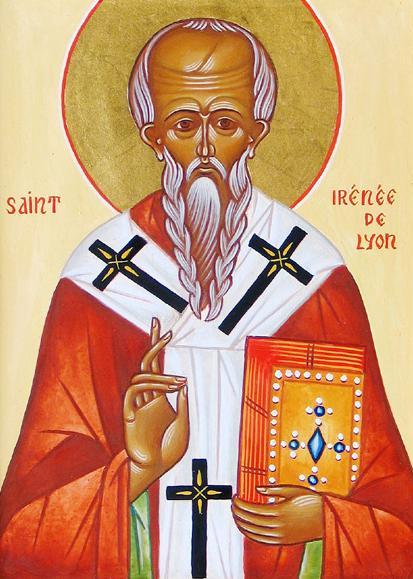
Sunday, July 8, 2012

Too Much Jesus in the Bible?

I would like to expose you all to Thomas Torrance's take on Irenaeus' understanding on what could be called a Christocentric Hermeneutic. As you read Torrance's account of Irenaeus, understand that you are reading Torrance too. Here is Torrance on Irenaeus:

It is, then, to the Incarnation that Irenaeus turns for the clue to the interpretation of the history of creation and redemption and therefore for the clue to the interpretation of the Scriptures. The essential order and connection of things is embodied in Jesus Christ and it is by reference to him that the economic ministrations of God in humanity and the historical covenants are to be understood aright, and therefore the interconnection between the scriptures of the prophets and the scriptures of the Apostles, 'the Gospel and the Apostles. Even the Scriptures of the old covenant have to be read in the light of Christ's advent in the flesh, for his coming connected the end with the beginning and made the beginning predictive of the end, thus showing that the faith of the patriarchs and prophets and ours is one and the same. They sowed the seed, the word about Christ (sermonem de Christo), but it is in us that the fruit is reaped and received, and only in the Church is the truth of the things prefigured realised. 'Certain facts had to be announced beforehand by the fathers in a paternal manner, (paternaliter), and others prefigured by the prophets in a legal manner (legaliter), but others delineated according to the pattern of Christ (deformari secundum formationem Christi) by those who perceived the adoption, for in one God are all things shown forth.' [Thomas F. Torrance, Divine Meaning, 122-23]

How does this strike you? Do you think this is too intense for a hermeneutic or mode for interpreting Scripture? Is your method of biblical interpretation this intensively Christ focused? I am really curious how you all think of this; I obviously highly appreciate this kind of 'Patristic' method of interpreting and reinterpreting (the OT) Scripture in light of  its fulfillment in Christ. This rubs against the method of interpretation I learned (by and large) in Bible College and Seminary; which is the Literal Grammatical Historical method (the kind that leads to and from Dispensationalism).

Tuesday, July 3, 2012

Dispensationalists should "Re-interpret"

Addendum: See this dovetailing post I just read by Matthew Malcolm: Fundamentalist Hermeneutics Serves a Secularistic, Atheistic Agenda . Matthew's title is quite provocative, especially if you're still working from a dispensational hermeneutic; how would you counter Matthew's (and my) claim contra dispensational hermeneutics in particular? Matthew doesn't use the language of dispensational, but this is what he's referring to in the post (and then he broadens this out, as I have, to the issue that this revolves around; hermeneutical structure).

Rubin, Jerusalem circa. 1926
Must I? I guess I must. I must inform any of my newer readers that I grew up classic dispensational, moved to progressive dispensationalism (about 14 years ago), and finally (after much angst and study and deliberation ... seriously!) have arrived at all truth; viz. I am amillennial (so called). This is my little caveat prior to getting into the rest of this post. With that ground cleared before us, I simply wanted to highlight something that kept hitting me in the face as I was reading through Deuteronomy tonight. That is, that my dispensational brethren severely misread scripture (this is a strong statement ... who can hear it?) when they supposedly follow their literalist hermeneutic of interpretation instead of re-interpreting Scripture (like the New Testament authors did, as well as the early Church) in light of the Old Testament fulfillment, in Christ. Jesus was under no delusion that, indeed, Scripture was all about him; notice what he said to the religious leadership of his day (I think he would reiterate the same thing to Dispensationalists today):

39 You study the Scriptures diligently because you think that in them you have eternal life. These are the very Scriptures that testify about me, ... John 5:39

Jesus understood the Old Testament Scriptures, and the promises therein, as finding their reality and fulfillment and purpose in him. He believed that the Scriptures, and the Old Testament promises to his covenant people were all about him; and that they were personally fulfilled in him. For example, as I was reading through Deuteronomy this evening, the concept of "land" and blessing and "Yahweh's people" kept popping up. Like the Jewish zealots of Jesus' day, dispensationalists collapse this promise of blessing in the land for Yahweh's people into a geo-political and "literal" promise that is yet (and is currently) to be fulfilled by the Jewish people in present day Israel (a sign of this fulfillment, for dispensationalists, is the re-establishment of the nation of Israel in 1948). But if we re-interpret these promises as if their fulfillment has come to reality in Jesus Christ, then the promise of blessing in the land for Yahweh's covenant people will be understood to have fulfillment in and through the obedient humanity of Christ as the new man; the new and obedient Israel (Eph. 2:11ff); and in the New Heavens and New Earth, the Heavenly Jerusalem, as described in Revelation 21--22. So there is a literal fulfillment after all, but it has already been fulfilled (the now and not yet aspect of the kingdom ... or the in-between time we inhabit currently) penultimately in Christ's first advent, and yet ultimately in Christ's second advent and the consummation of all things.

One of the problems for dispensationalists is that they understand "literal" through a neo-Platonic lens; so that there is a hard distinction between the spiritual heavenly realm and the physical earthly realm. What the dispensationalist fails to appreciate, properly, is that if we interpret all of reality and the purpose of creation through the analogy of the incarnation and the hypostatic union between the divine and human; that the hard distinction between heaven and earth is not a viable option. If you will, the dividing wall has been broken, and all things have become One in Christ. Thanks for letting me get this off my chest ...

*Repost

Tuesday, June 19, 2012

Why such the emphasis on Israel ...? Dispensationalism Revisted

I am continuing to respond to a good brother from our church congregation; I am responding to his queries about Dispensationalism, and eventually attempting to engage some of the broader contours related to this whole topic of discussion (e.g. eschatological and hermeneutical frameworks, and their relationship---which will ultimately lead us back to a doctrine of God, but that will be later ... this post is more specific to a certain set of questions). My brother from church asked me the following (on Facebook):

Reading your post over again, I am really curious about the two views on the nation of Israel and its position in God's plan for salvation (i.e. as the subject of the sentence or as one with Gentiles in Christ Jesus).

Perhaps both views hold to this idea or neither do, but I have always been under the understanding that God chose Israel, set them apart, and gave them the Law to be a light to the world in order draw the world to Himself. Obviously because of their disobedience this did not work as it should have so Christ came into to history to redeem humanity (something I assume He would have had to do anyway since even if we attempt to fully obey the Law, we will always be sinful in our current state and animal blood only points to Christ not actually covering our sins... right?). Wouldn't this mean that while God's promises for Israel will still be upheld, that salvation was always for all humanity (Jew and Gentile) and not just focused on Israel (which is what CD sounds like to me)? Why such the emphasis on Israel?

My response:

Orthodox Jews
The two views my friend is referencing (for those who are late to following this discussion) are the variances between a so called classic Dispensationalist view of Israel and the Church; and a so called Amillennial view of Israel and the Church (by the way, Postmillennialists, Historic Premillennialists, and Progressive Dispensationalists would all affirm the Amillennialist's view of Israel and the Church, in general ... of course where they go from there, at least the Progressive Dispensationalists, will vary from the Postmil, Historic Premil, and Amil understanding). And so to answering this question, we turn---I will be simply focusing on the classic Dispensational understanding in this post, since this is mostly what my friend's question is after (thus far).

Why is there such a focus on the Nation of Israel in Dispensational thought? The answer is really quite straightforward, it comes down to their asserted method of biblical interpretation; that is, they follow what they call a Literal method of interpretation. Here is how one of the most famed Dispensationalists, Charles Ryrie, states the classic and/or revised Dispensational approach to biblical interpretation:

Literal Hermeneutics. Dispensationalists claim that their principle of hermeneutics is that of literal interpretation. This means interpretation gives to every word the same meaning it would have in normal usage, whether employed in writing, speaking, or thinking. It is sometimes called the principle of grammatical-historical interpretation since the meaning of each word is determined by grammatical and historical considerations. The principle might also be called normal interpretation since the literal meaning of words is the normal approach to their understanding in all languages. It might also be designated plain interpretation so that no one receives the mistaken notion that the literal principle rules out figures of speech. Symbols, figures of speech, and types are all interpreted plainly in this method, and they are in no way contrary to literal interpretation. After all, the very existence of any meaning for a figure of speech depends on the reality of the literal meaning of the terms involved. Figures often make the meaning plainer, but it is the literal, normal, or plain meaning that they convey to the reader. [Charles C. Ryrie, Dispensationalism, Revised and Expanded, (Chicago: Moody Press, 1995), 80-1]

So when confronted with a passage of Scripture like this:

12 The Lord had said to Abram, “Go from your country, your people and your father’s household to the land I will show you.
“I will make you into a great nation,
    and I will bless you;
I will make your name great,
    and you will be a blessing.
I will bless those who bless you,
    and whoever curses you I will curse;
and all peoples on earth
    will be blessed through you. ” ~Genesis 12:1-3 [The 'Abrahamic Covenant']
Or,

37 The hand of the Lord was on me, and he brought me out by the Spirit of the Lord and set me in the middle of a valley; it was full of bones. He led me back and forth among them, and I saw a great many bones on the floor of the valley, bones that were very dry. He asked me, “Son of man, can these bones live?”I said, “Sovereign Lord, you alone know. ”Then he said to me, “Prophesy to these bones and say to them, ‘Dry bones, hear the word of the Lord! This is what the Sovereign Lord says to these bones: I will make breath enter you, and you will come to life. I will attach tendons to you and make flesh come upon you and cover you with skin; I will put breath in you, and you will come to life. Then you will know that I am the Lord. ’” ~Ezekiel 37:1-6 [The Dry Bones (or 'Nation' of Israel) Vision]
Or especially a passage like this:

 35 This is what the Lord says,
he who appoints the sun
    to shine by day,
who decrees the moon and stars
    to shine by night,
who stirs up the sea
    so that its waves roar —
    the Lord Almighty is his name:
36 “Only if these decrees vanish from my sight,”
    declares the Lord,
“will Israel ever cease
    being a nation before me.”
37 This is what the Lord says:
“Only if the heavens above can be measured
    and the foundations of the earth below be searched out
will I reject all the descendants of Israel
    because of all they have done,”
declares the Lord. ~Jeremiah 31:35-37 [This is right after the famous New Covenant passage, which Dispensationalists believe is only properly understood as applicable to the nation of Israel.]
 If we are employing a literal method interpretation, as Ryrie describes it; then how else can (must) we take passages like these from the Old Testament? It must be understood as referencing the Nation of Israel as God's prescribed plan for human history; that is, it must be that God has an all encompassing plan for human history that is solely oriented around the Nation of Israel. When you couple this kind of literalist method of interpretation with a Progressive Revelation reading of Scripture (meaning that we start in the Old Testament, and read that into the New Testament); then the natural outcome will be to see the Nation of Israel at the center of prophetic and biblical history. 

What is lost in this approach, is an emphasis on Jesus as the the point of Israel's vocation; they were to mediate Yahweh's salvation to the Nations, and it was always understood that the 'Seed' that they carried would be the One to accomplish that purpose for all of humanity (including the Nation of Israel). At least that is what the Apostle Paul thought when he was writing Galatians 3. And yet, I jump ahead of myself; I will touch upon the contrary approach to the Dispensational approach later (and soon).


If I was committed to the philosophy of history, the philosophical assumptions (Scottish Sense Realism), that governs the Dispensational mode of life; then it does make internal sense (relative to their system of interpretation, etc.) that they end up where they do. So the question isn't if Dispensational hermeneutical theory (what informs the way they conceive of doing biblical interpretation) is coherent and self-referentially consistent (within their system); the question is whether or not their system actually best proximates the actual intention of Scripture's message, and salvation history's purpose? I will seek to answer these questions some time soon. 

So, do the promises made to the Nation of Israel still stand? I would say yes (again I am jumping ahead of myself, but only to gesture towards answering your questions to me, I will develop my views more later). But qualified in a way that sees Jesus as the ground and fulfillment of what it means to be Israel. The Nation of Israel has the same purpose, in Christ (cf. Eph. 2:11ff) as every other nation. The promises made to Israel are indeed irrevocable (cf. Rom. 11:29), but Israel was always intended to be understood through her ground and purpose and fulfillment, 'in Christ'. This is the key, that is, Christ is the key to sourcing an understanding of a properly constructed 'literal' method of biblical interpretation. The New Testament authors thought so, and thus; so should we. I have left us with quite a few assertions, but this is where I will finally get to as we continue to work through Dispensationalism V. a 'Christ-Conditioned' hermeneutic; for this is where this whole debate really dwells. That is, how it is that we conceive of our philosophies of biblical interpretation? Until next time, brother ...


Tuesday, June 12, 2012

A Primer and Comparison on Classic Dispenationalism and Amillennialism

This post is my inaugural one that will be dealing with a comparison between Dispensational Premillennialism and Amillennialism. This post represents one of many posts that I will be doing in a loose-leaf series kind of way (in another words, sporadic) on a concern that largely is an un-concern for many of the types of folk I generally engage with in Christian academia. In other words, this issue has really become more of an idiosyncratic one that a certain subset of American Evangelicals (usually) emphasize in their biblical interpretive strategies. So consider me an idiosyncratic American Evangelical when it comes to this, especially when I do posts on the finer nuances of the respective systems of interpretation (for that is what these are). My hope though, in the process of doing posts on this topic, is that I can somewhat de-idiosyncratize this issue by framing it in such a way that my personal and rather amorphous 'Christ-conditioned' biblical hermeneutic will bubble over; such that what is at the heart of this 'idiosyncratic issue' (e.g. biblical interpretation/hermeneutics) will become significant relative to framing the finer points of discerning a difference between the philosophy of interpretation that either leads to adopting a system that is Dispensational, or not.

A Classic Dispensational Chart (click on for larger view)
With that ground cleared lets get into it. As a caveat, I have been in some recent correspondence with a brother from my church; and he is interested (and curious) about the differences between classic Dispensationalism (which is what our church denomination teaches from, in general, i.e. Calvary Chapels) and Amillennialism---and then of course the finer nuances that characterize such systems of interpretation, such as: views on the so called 'Tribulation' period (for Dispensational Premillennialists those range from Pre-Tribulational, Mid, and Post and then there is Pre-Wrath for good measure); concerns about the Kingdom 'Now & Not-Yet'; etc. So understand that as I write posts (this one included), I will have my friend in mind (who hasn't had really any exposure to any of these, except for the subconscious teaching that he has received on it, which is informed by a Dispensational lens). And I am sure that as I have him in mind, that his questions and curiosities are representative of a whole host of you readers 'out there'.

Now let's get into it. For this first post, let me just highlight (off the top) some general differences between Premil classic Dispensationalism (CD), and Amillennialism (A):

  • CD "supposedly" follows a literal method of biblical interpretation. Meaning that they take the plain sense meaning of words in their 'plain sense' until taking them in their plain sense becomes non-sensical. 
  1. A is usually purported to follow a allegorical or symbolic ('type/anti-type') method of biblical interpretation. Which for some of its history is true, but not all of its history. I will argue (suggestively on the blog) that A actually is follows a more consistently literal method of biblical interpretation than does CD.
  • CD believes, in general, that there is a hard distinction between Israel and the Church (in fact this is probably the sine qua non of what identifies someone as Dispensational, even Progressive Dispensationalists); such that ethnic Israel are God's so called 'earthly people' to whom all the promises were made (like the 'Land Covenant' etc.), and that prophetic history is oriented and directly and solely about the Nation of Israel. And CD sees the Church as God's Heavenly People who are only being included in his salvation as a parenthesis in his 'real' prophetic plan of salvation which is for the Nation of Israel (e.g. so if you were to think of God's plan for prophetic and salvation history in terms of a 'sentence', the Nation of Israel is the subject of the whole sentence, but because of their rejection of their Messiah [initially at his first coming], God interrupts his plan, his sentence, and inserts a parenthesis into his sentence (an after-thought, to be crude)---that parenthesis is the so called 'Church Age' and Dispensation of Grace. Once the full number of Gentiles (and some Jews) come into the fold, during this season, they will be snatched (raptured) out of the world, and God can return his focus back on his primary plan of salvation which only for the Nation of Israel). 
  1. A holds that the two peoples, Jew and Gentile, have been made one new man in Christ (Ephesians 2:11ff); and thus God does not have two peoples, but one, and that those peoples find their ground for their humanity in the vicarious humanity of Christ (note, my redressing of Amillennialism will be nuanced by my own appropriation of it---in general, by way of framework, I am consistently thinking from within the Amillennial purview, I will just shape and nuance things per my own theological thinking (Evangelical Calvinism). So prophetic and salvation history, for the A, is actually totally and completely about Jesus Christ. The implication of this being that prophetic and salvation history is all about ALL of Humanity, since Jesus is God for us!
  • CD believes that we God relates to humanity through 7 Dispensations (or economies). And that these relationships are cyclical, such that once a particular group finally biffs an economy up so bad (the arrangement God had set up with them, to relate to them---which is preceded by his judgment); then this screw up initiates another cycle. So, for example, we went from a time of Law to a time of Grace (between part of the OT and NT); since Israel messed it up so bad, this in turn initiated God's next Dispensation of Grace, wherein God now relates to humanity in the Church. But once the time of 'Apostasy' comes to fruition (referenced in the Epistles to Timothy), then this will initiate the turn to the Dispensation, again, preceded by judgment which is what the 'Great Tribulation' represents.
  1. A believes that God relates to humanity by overarching Covenants. This is a point where I will distinguish myself from the regular Amillennial approach, which is usually framed through Federal or Covenant Theology; the former being a special kind of Covenant theology. Classic Covenant Theology sees God relating to humanity through a Covenant of Works (which he initiated with Adam and Eve in the Garden), and Covenant of Grace. The former is one that is conditional and based upon obedience to God's Law; since Adam and Eve failed, this plunged humanity into an irreparable situation and a penalty was now required to be paid for the 'Law-breaking'. This is remedied by the Covenant of Grace, wherein Jesus comes for an elect group of people (that God arbitrarily had already elected in eternity past) for whom he pays their penalty (death---passively), and fulfills the conditions of the Law for them (actively). This is usually the hermeneutical schema used for framing A through (in the classic way). But for reasons that go beyond this post (and which I have already elaborated upon, substantially), I will not get further into critiquing this position. In Contrast:   I follow a Covenantal scheme as well. Yet, my scheme only has the Covenant of Grace, which its inner reality is God's life (its outer is exemplified in creation); such that God's life and choice for humanity (including the initial act of creation) is all based in his life of other-centeredness, which is definitive of his inner Trinitarian life of love (which I have already discussed at length at the blog here as well). This is the 'Covenantal' scheme that I think from, just to be clear. And this whole point to highlight, that A, in general, is much different in orientation to biblical interpretation than is CD. The primary thing of note here is that, I will argue, that CD's biblical interpretation is given shape by a Nation (Israel); while A is, in general, given biblical interpretive shape by a Person (Jesus Christ). I will get more into this later, as I relate this to my so called 'Christ-conditioned' hermeneutic, which I have posted a bit on already here at the blog. 
  • CD believes that the promised Davidic Kingdom (cf. II Sam. 7) will only 'LITERALLY' be fulfilled in the future earthly 1000 year reign of Christ. Which is one of the reasons CD must have a yet future fulfillment of the Davidic Kingdom; because they believe it is only applicable for the the Nation of Israel. So this also will tie into their need for a Pre-Tribulational view of the Tribulation options. Further, CD interprets Revelation 20 and the thousand years there as a literal-sequential time frame.
  1. A holds that the Davidic Kingdom has been inaugurated at the first coming of Jesus; through the shedding of his blood and the establishment of the New Covenant. They interpret the thousand years of Revelation 20 through an apocalyptic genre lens leading to the conclusion (given the numerous usages of the multiple of 10 in Revelation and gematria as a 1st century interpretive method) that this should be understood symbolically or  figuratively of the current period we inhabit between the first and second comings of Jesus. So A believes that there is a two-age model of the Kingdom, i.e. the "Now/Not-Yet" aspects. 
  • CD holds to a Pretribulational theory of the rapture. Meaning that they believe prior to the the last week of Daniel's so called '70 Weeks'---which is the 7 year period often referenced when thinking about the future tribulation period---the Church will be snatched out or raptured out of this world, this ending the Church Age, and initiating the time of "Jacob's Trouble" (Jer. 3), and/or "The Great Tribulation". CD needs this mechanism (Pre-Trib) in order to remove the Heavenly People from the earth, so that God can get back to dealing with his Earthly People, ethnic Israel. The Tribulation period, is primarily God's judgment on the Nation of Israel for their initial rejection of the Messiah; and yet, it will have universal ramifications causing God to judge the world, since they will rise up to try and destroy Israel and ultimately God (or "Armageddon"). They also argue that Christians are not appointed to God's wrath (cf. I Thess. 5:9), and since the Tribulation is representative of the "Lord's Day" and God's wrath, there is no reason for us (the Church) to be here. I will get into more of this later.
  1. A, in general, holds that 'The Great Tribulation' was historically in reference to the destruction of Jerusalem in 70AD by Titus Vespasian of Rome. Yet, some also believe, that this is typological of an intensification of Tribulation that will encompass the whole globe up until the 'end'. This is how some As interpret the book of Revelation, through a progressive parallelism, such that each of the groupings of judgments (seals, trumpets etc.) are referencing the same thing; but at the same time they also represent an intensification of God's judgment and a Great Tribulation just prior to his coming. So, in general, As believe that we have been in Tribulation and will be, in intensifying ways, right up until the end (or beginning). I will be talking more about an interpretation of the book of Revelation, through Richard Bauckham later, which nuances this in a way that I really appreciate.
I think, as an opener, this will have to suffice. You can check out a comparison chart between Dispensationalism and Amillennialism (that I stole from Google images) below. I am not sure how 'ordered' my following posts on this will be---I might jump around on things---but I will be doing future posting on all of this. Primarily because I am buffeted with this stuff quite frequently in the circles which I inhabit, and so it prompts responses in me that I need to give voice somewhere. And since I don't have anywhere to teach real life people, I end up voicing my thoughts here ;-).

Comparsion Between Premil and Amil

Sunday, June 10, 2012

An Up-Tick Discussing Dispensationalism and my Amillennialism

I am planning on writing a bit more on amillennialism V. dispensationalism, stay tuned. For those who don't know, I was a dispensationalist (classic and progressive) for many years; I have been an out of the closet amillennialist (fully persuaded), now, for probably close to a year now. It has taken me years of study to come to this conclusion, and I only came to this conclusion somewhat tentatively. But once I came to this conclusion, I now wonder how I ever held to the Dispensational hermeneutical framework.

Anyway, I look forward to writing some on this; I have a lot to say about it, as I have probably spent more time reading and studying this issue as much as anything else I have spent studying (including Trinitarian theology, and all of the historical systematic and biblical theology that I have studied). I will still be, of course, posting on other things; but I just wanted you all to know that you should expect an up-tick in this area of my posting---I see a bunch of confusion on this stuff out there, especially in the American Evangelical realm which I inhabit.

PS. Hermeneutical theory will definitely a major part of my discussions on this. I will be getting into Torrance's 'Depth Dimension' hermeneutic, and a 'Christ-conditioned' approach to biblical interpretation. A lot of my discussions, I imagine, on this will once again be instances of me simply thinking out loud---which is how I have used my blogging (at points) over the years, i.e. as a notepad where I do my theological brainstorming, and creative writing.

Wednesday, May 23, 2012

The Guts of Classic Dispensationalism

If you are unaware of what classic Dispensationalism is shaped by, then I offer you this post. I will never fully escape Dispensationalism; I am an American Evangelical after all, and it has held more of my life than not (now I am amil), thus far. So I will continue to write on this system of interpretation, as I have a chance; and I will do so in constructive ways ;-).

According to Charles Ryrie here are the 3 most basic ingredients that must be present in order for someone to pop out as an Dispensationalist:

[T]he essence of dispensationalism is (1) the recognition of a consistent distinction between Israel and the Church, (2) a consistent and regular use of a literal principle of interpretation, and (3) a basic and primary conception of the purpose of God as His own glory rather than the salvation of mankind. (Charles Ryrie, “Dispensationalism,” 45)

Jerusalem, 70 A.D.
This provides the rubric from which dispensationalism flows (esp. in its Classic and Revised forms). Each of these points require further explanation, and development; but for now I will just state them up front like this, just in case you are unaware of some of these basic points upon which dispensational theology pivots. In the same flow, let me also list the 7 dispensations usually articulated by both Classic/Revised dispensationalists; again, we will hear from Ryrie:

1.) Name: INNOCENCY –> Scripture: Genesis 1:3–3:6 –> Responsibilities: Keep Garden, Do not eat one fruit, Fill subdue earth, Fellowship with God. –> Judgment(s): Curses, and physical and spiritual death.
2.) Name: CONSCIENCE –> Scripture: Genesis 3:7–8:14 –> Responsibilities: Do good –> Judgment(s): Flood.
3). Name: CIVIL GOVERNMENT –> Scripture: Genesis 8:15–11:9 –> Responsibilities: Fill earth, Capital Punishment –> Judgment(s): Forced scattering by confusion of languages.
4.) Name: PATRIARCHAL RULE –> Scripture: Genesis 11:10–Exodus 18:27 –> Responsibilities: Stay in Promised Land, Believe and obey God –> Judgment(s): Egyptian bondage and wilderness wanderings.
5.) Name: MOSAIC LAW –> Scripture: Exodus 19:1–John 14:30 –> Responsibilites: Keep the law, Walk with God –> Judgment(s): Captivities.
6.) Name: GRACE –> Scripture: Acts 2:1–Revelation 19:21 –> Responsibilities: Believe on Christ, Walk with Christ –> Judgment(s): Death, Loss of rewards.
7.) Name: MILLENNIUM –> Scripture: Revelation 20:1-15 –> Responsibilities: Believe and obey Christ and His government –> Judgment(s): Death, Great White Throne Judgment.
– Charles C. Ryrie, Dispensationalism, 54

Do these sound familiar? Maybe not all of these, but I would imagine the last 3 that many of you are quite familiar with; at least if you are an American Evangelical. You can see how the cycles of “stewardship” work between each new dispensation. There are certain responsibilities given to humanity in each dispensation; when this group of people fail, they experience God’s judgment, which then also becomes the trigger for the next dispensation to start. Interestingly, the end of the 6th dispensation would come about by unbelief in Christ (by much of the Church); which for the Apostle Paul (like in his epistles to Timothy) coincides with the “Great Apostasy” that will typify the end of days (which many believe we are experiencing right now).

Let me know what you think . . .

PS. Addendum: You know how I just recently said I was going to be writing at my other blog 'Blogic Of Grace', well I lied ;-). I am just going to post here, it gets too confusing sometimes for folk to follow me at two venues. The reason I was going to blog elsewhere is becomes sometimes being known as 'The Evangelical Calvinist' in the blogosphere carries with it unwanted connotations amongst various Christians, and I get tired (some times) of having to explain how EC is different than what people usually think of as Calvinist; and usually what happens is that people presumptuously pigeon hole me, and don't even give me a chance to explain what Evangelical Calvinism entails. Anyway, forget that, I am 'The Evangelical Calvinist' in the blogosphere for better or worse ... ultimately I think, for the better :-)!

Monday, May 14, 2012

Classic Dispensationalism's Faulty Understanding of 'Seed' in Galatians

Let me continue on with my thinking relative to Dispensationalism. And to clarify, for those unaware, I grew up as the son of a Conservative Baptist Dispensational Premillennial Pre-Tribulational pastor; I inherited and owned this view as my own, especially as I entered into Bible College and even Seminary; and then became a vociferous advocate for this framework of interpretation with whoever would listen, and especially here on the internet (in my earlier years of blogging, starting about 7 years ago now). After moving from classic Dispensationalism, I moved into what is called Progressive Dispensationalism (I will have to sketch the differences at a later time). Since, then, I have had a radical shift, moving into Historic Premillennialism; and finally after much ado landing where I am now as an Amillennialist. With that ground cleared, let me get us into what I want to look at in this post.

Classic Dispensationalists [CD from here on out] (Progressives are different at this point) see a hard distinction between the nation of Israel, and the Church. They see the former as God's chosen people, and as those for whom prophetic and salvation history has always been intended; they see the nation of Israel as God's "earthly people." CD see the Church as God's "heavenly people;" as an interruption or parenthesis in God's real plan for his earthly people the Jews. So you see right away that CDs operate with the belief that God has two distinct peoples, and it is this distinction that becomes one of the sine qua nons of Classic Dispensationalism (and all Dispensationalisms). In this context, I want to offer a quote from a stalwart of Classic Dispensational thought from just recent yesteryear, J. Dwight Pentecost; in fact the quote I am providing for our consideration is actually Pentecost quoting another Classic Dispensational stalwart John Walvoord (his colleague for many years at the hub of this teaching, Dallas Theological Seminary). The quote is Walvoord's sketching of how Classic Dispensationalists make a distinction between the 'kinds of seeds mentioned in Scripture'. Walvoord is contrasting the CD approach with his understanding of the amillennial interpretation. After I provide this quote I will offer a critique of Walvoord's presentation, and also offer a short critique of the typical amillennial approach here as well; I actually think the classic amillennial is a bit off as well when it identifies the 'seed'. Without further ado here is that quote:

[T]here are, then, three different senses in which one can be a child of Abraham. First, there is the natural lineage, or natural seed. This is limited largely to the descendants of Jacob in the twelve tribes. To them God promises to be their God. To them was given the law. To them was given the land of Israel in the Old Testament. With them God dealt in a special way. Second, there is the spiritual lineage within the natural. These are the Israelites who believed in God, who kept the law, and who met the conditions for present enjoyment of the blessings of the covenant. Those who ultimately possess the land in the future millennium will also be of spiritual Israel. Third, there is the spiritual seed of Abraham who are not natural Israelites. Here is where the promises to "all the families of the earth" comes in. This is the express application of this phrase in Galatians 3:6-9. . . . in other words, the children of Abraham (spiritually) who come from the heathen or Gentiles fulfill that aspect of the Abrahamic Covenant which dealt with Gentiles in the first place, not the promises pertaining to Israel. The only sense in which Gentiles can be Abraham's seed in the Galatians context is to be "in Christ Jesus" (Gal. 3:28). It follows: "And if ye be Christ's, then are ye Abraham's seed, and heirs according to the promise" (Gal. 3:29). They are Abraham's seed in the spiritual sense only and heirs of the promise given "to all the families of the earth."

While premillennarians can agree with amillennarians concerning the fact of a spiritual seed for Abraham which includes Gentiles, they deny that this fulfills the promises given to the natural seed or that the promises to the "seed of Abraham" are fulfilled by Gentile believers. To make the blessings promised all the nations the same as the blessings promised the seed of Abraham is an unwarranted conclusion. [John Walvoord cited by J. Dwight Pentecost in, Things To Come, 87-8]
And here is the text from Galatians that is under discussion:

O foolish Galatians! Who has bewitched you that you should not obey the truth,[a] before whose eyes Jesus Christ was clearly portrayed among you[b] as crucified? This only I want to learn from you: Did you receive the Spirit by the works of the law, or by the hearing of faith? Are you so foolish? Having begun in the Spirit, are you now being made perfect by the flesh? Have you suffered so many things in vain—if indeed it was in vain?Therefore He who supplies the Spirit to you and works miracles among you, does He do it by the works of the law, or by the hearing of faith?— just as Abraham “believed God, and it was accounted to him for righteousness.”[c] Therefore know that only those who are of faith are sons of Abraham. And the Scripture, foreseeing that God would justify the Gentiles by faith, preached the gospel to Abraham beforehand, saying, “In you all the nations shall be blessed.”[d] So then those who are of faith are blessed with believing Abraham.10 For as many as are of the works of the law are under the curse; for it is written, “Cursed is everyone who does not continue in all things which are written in the book of the law, to do them.”[e] 11 But that no one is justified by the law in the sight of God is evident, for “the just shall live by faith.”[f] 12 Yet the law is not of faith, but “the man who does them shall live by them.”[g]13 Christ has redeemed us from the curse of the law, having become a curse for us (for it is written, “Cursed is everyone who hangs on a tree”[h]), 14 that the blessing of Abraham might come upon the Gentiles in Christ Jesus, that we might receive the promise of the Spirit through faith. 15 Brethren, I speak in the manner of men: Though it is only a man’s covenant, yet if it is confirmed, no one annuls or adds to it. 16 Now to Abraham and his Seed were the promises made. He does not say, “And to seeds,” as of many, but as of one, “And to your Seed,”[i] who is Christ. 17 And this I say, that the law, which was four hundred and thirty years later, cannot annul the covenant that was confirmed before by God in Christ,[j] that it should make the promise of no effect. 18 For if the inheritance is of the law, it is no longer of promise; but God gave it to Abraham by promise. 19 What purpose then does the law serve? It was added because of transgressions, till the Seed should come to whom the promise was made; and it was appointed through angels by the hand of a mediator. 20 Now a mediator does not mediate for one only, but God is one. ~Galatians 3:1-20
Stupid blogger just ate most of my comments following the quote here. Let me just briefly state that Classic Dispensationalism and Classic Amillennialism understand lineage to Abraham wrongly since they apply the Seed argument of Paul to the 'many' instead of to the One, Jesus Christ. Paul is very explicit about the Seed being singular; Jesus is the new Israel, he fulfills both Walvoord's physical and spiritual aspects in himself (it is this kind of distinction---e.g. physical V. spiritual---wherein Classic Dispensationalism falters most ... this kind of thinking is not biblical or christocentric, it is neo-Platonic and dualistic ... something which Scripture and God's Self-revelation in Christ know nothing of). The Church is not the new Israel (contra classic Amillennialism), unless you want a Roman Catholic ecclesiology; and the nation of Israel is not an end in itself as the new Israel. Only Jesus, according to Paul's singular Seed argument, can and has fulfilled this role. QED

Sunday, May 13, 2012

Rebutting Dispensationalism

Let me take a quick run at Dispensationalism; the system of hermeneutics and history that I grew up in, and by and large was trained in for many years. I usually don't like it when a former adherent to a belief system, or interpretive framework returns to their former 'system' only to bash it over the head---as if to bolster their new found, and maybe even novel (to them) way of thinking. And yet, I have avoided head on critique of dispensationalism for quite some time now; to satisfy my own self imposed moorings in line with what I just described. No more. I have been listening to some classic dispensational teachers lately, and they only have made it that much more clear why I have repudiated my once held classic and progressive dispensational beliefs.

For those who don't know; classic Dispensationalism holds that there is a hard or even soft (depending on what version) distinction between ethnic Israel and the Church. Such that the former are God's special covenant people whom all of history and creation is oriented around and toward, and the latter are God's mystery people whom he briefly interrupted his plans for Israel with; in order to let some of the Gentiles into the heavenlies. Clearly this is bolderdash! And yet the teachers I have been listening to lately believe just the opposite; they believe that anyone, like me, who thinks that Jesus is the point and purpose of Israel, and Creation, no less are most likely close to not being Christian. And/or, they believe folk like me are severely confused, and need to be corrected. But wait a minute, who needs to be corrected? Doesn't the Apostle Paul say that there has been one new man created in Jesus Christ? That the dividing wall between Jew and Gentile has been broken down in Christ? Doesn't the Apostle say that Jesus is the point of creation, being the firstborn from the dead? Doesn't the Apostle Paul argue that the point of the Abrahamic Covenant was not for seeds (like the nation of Israel), but for the Seed, singular, who is Jesus Christ? And if this is so, doesn't it make more sense to conclude that the point and vocation of the nation of Israel was to serve as the mediator of the Mediator to the nations; and that in their mediation, their election is made sure through the fulfillment of Jesus Christ's life for them and all humanity? Jesus is Israel (not even the church); Jesus is the point and fulfillment of the Abrahamic Covenant; Jesus is the point of prophetic history; Jesus is the point of salvation history; Jesus is the point of creation through recreation in him. Dispensationalism, in any of its forms, has just been defeated at this point; it can go no further. It can't cope with the straightforward teaching of the Apostle Paul.

So it isn't someone like me, who affirms an amillennial understanding of salvation history, that needs to be corrected on the point and purpose of salvation history and creation; it is the dispensationalist who denies the clear teaching of Scripture on this issue. Salvation history has never primarily been about the nation of Israel, it has always been about the one whom Israel was elected to mediate to the nations in fulfillment of the Abrahamic Covenant; Jesus Christ. If your interpretive schema, dispensationalist, ends with a nation instead of a person; then you are wrong, and you ought to reconsider your interpretive paradigm.

This was somewhat of a rant; in the near future I plan on offering some more substantial/supported points in this regard. I grow weary of hearing dispensationalists assert the things they do without understanding.